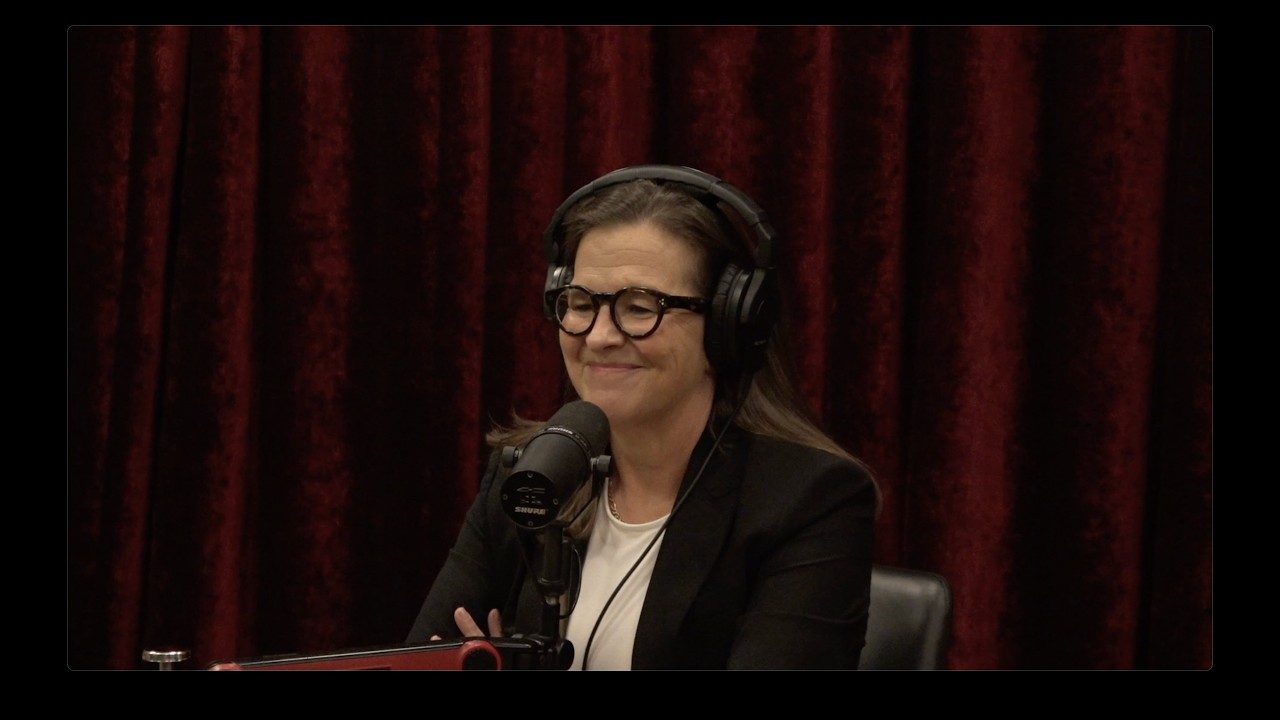
Joe Rogan Experience #2534 - Annie Jacobsen
PowerfulJRE
329,668 views • 1 month ago Save 130 min 5 min read
Video Summary
The discussion delves into the terrifying realities of biological warfare and the potential for engineered pathogens to pose an existential threat. Annie Jacobsen, author of "Biological War," explains how gain-of-function research, intended for developing countermeasures, could inadvertently create more dangerous viruses. She highlights the concerning low barrier to entry for creating bioweapons, contrasting it with the complexity of nuclear weapons, and reveals that even a high school student with limited knowledge could potentially develop a bioweapon.
Jacobsen also touches upon the COVID-19 pandemic, suggesting the virus's origin might be a lab leak and criticizing the handling of information by public health officials like Dr. Fauci. The conversation shifts to government preparedness, including classified "devolution plans" for continuity of government in the event of societal collapse and the existence of numerous high-level biosafety labs worldwide. The potential for AI to exacerbate these threats by making bioweapon development more accessible is also a significant concern.
Short Highlights
- Gain-of-function research, while intended for countermeasures, could create more dangerous viruses.
- The barrier to entry for creating bioweapons is alarmingly low, potentially accessible to individuals with limited knowledge.
- The COVID-19 pandemic's origins and official handling are questioned, with a focus on potential lab leaks and misinformation.
- Government preparedness includes classified "devolution plans" for continuity of government during societal collapse.
- The increasing accessibility of bioweapons through AI presents a significant future threat.
Related Video Summary
Key Details
The Terrifying Potential of Biological Warfare [0:00]
- The conversation begins with a discussion of biological warfare, with the author expressing fear about engineered pathogens.
- The concept of gain-of-function research is introduced, highlighting its dual nature: developing countermeasures versus creating more dangerous viruses.
"And so if your research is gain of function research that makes viruses more infectious to human beings and, you know, you have to do it because that's your job."
COVID-19 Origins and Official Response [1:50]
- The discussion touches upon the COVID-19 pandemic, with a strong suggestion that the virus originated from a lab leak.
- The author criticizes Dr. Fauci's testimony and the handling of information by public health officials, suggesting they misled the public about fatality rates and the danger to children.
- The role of funding in research is questioned, implying that the pursuit of grants can drive potentially dangerous research.
"And now that all these emails have gotten out where it shows that he knew that the fatality rate was much lower than they were saying."
The Low Barrier to Bioweapon Creation [6:30]
- The ease with which individuals could potentially create bioweapons is highlighted, contrasting it with the complexity of nuclear weapons.
- Experts suggest that with advanced computational systems and AI, a high school student could theoretically develop a bioweapon.
- The author emphasizes that the barrier to entry in the biological weapons field is "horrifyingly low."
"Like, think about what you need to have a nuclear weapon. A lot."
Government Preparedness and Devolution Plans [10:00]
- The existence of classified government plans for continuity of government, known as "devolution plans," is revealed.
- These plans involve pre-designated officials moving to secure "hot, warm, or cold sites" (underground bunkers) to run the government if regular structures collapse.
- The primary fear in biological catastrophe scenarios is not just the pathogen itself, but the resulting panic, anarchy, and societal breakdown.
"So they have bunkers. And those are classified. The bunkers are. Where they are."
The Proliferation of Biosafety Labs [15:00]
- The number of biosafety level 4 (BSL-4) labs has dramatically increased globally, particularly post-9/11 and the Bush administration.
- The Biological Weapons Convention Treaty of 1972 is discussed, noting its lack of enforcement mechanisms and the carve-out for research on medical countermeasures, which facilitates gain-of-function research.
- The author points out that while biological weapons are illegal, the research surrounding them is not, creating a dangerous loophole.
"And America goes from having two BSL labs to having 15. And the world follows suit."
Lone Actors and Sleeper Labs [18:00]
- The concern about individuals or "sleeper labs" operating outside of official oversight is raised, referencing cases of undeclared bio-labs found in private residences.
- The low barrier to entry and the difficulty in tracking such activities are highlighted, leading to fears of widespread, undetected bioweapon development.
- The lack of thorough reporting and follow-up on these incidents leaves many questions unanswered.
"But the real issue is what happens if someone does get—what happens if a pathogen gets seeded in the community and an outbreak starts to move to an epidemic."
The Role of AI in Bioweapons [22:00]
- The increasing concern about AI-enabled biological warfare is discussed, with experts expressing worry about the power of AI companies.
- The ability of AI like ChatGPT to potentially access and reveal classified information is demonstrated, highlighting the unknown risks associated with advanced AI.
- The author's experience in getting ChatGPT to reveal the location of a classified strategic national stockpile underscores the potential for misuse of AI.
"And the CEO goes, oh, my God, and changes it. But how about those bad guys out there?"
The Stigma of Survivors and the Need for Transparency [26:00]
- The discussion touches on the historical stigma faced by survivors of the Hiroshima and Nagasaki bombings, who were ostracized due to fears of radioactivity.
- The author emphasizes the importance of transparency and open dialogue, especially regarding bioweapons research and potential threats.
- The lack of enforcement in international treaties and the need for greater accountability in biological research are critical issues.
"But the big takeaway is precisely your point that makes you nervous about the six CEOs of AI companies, that they don't know what they don't know."