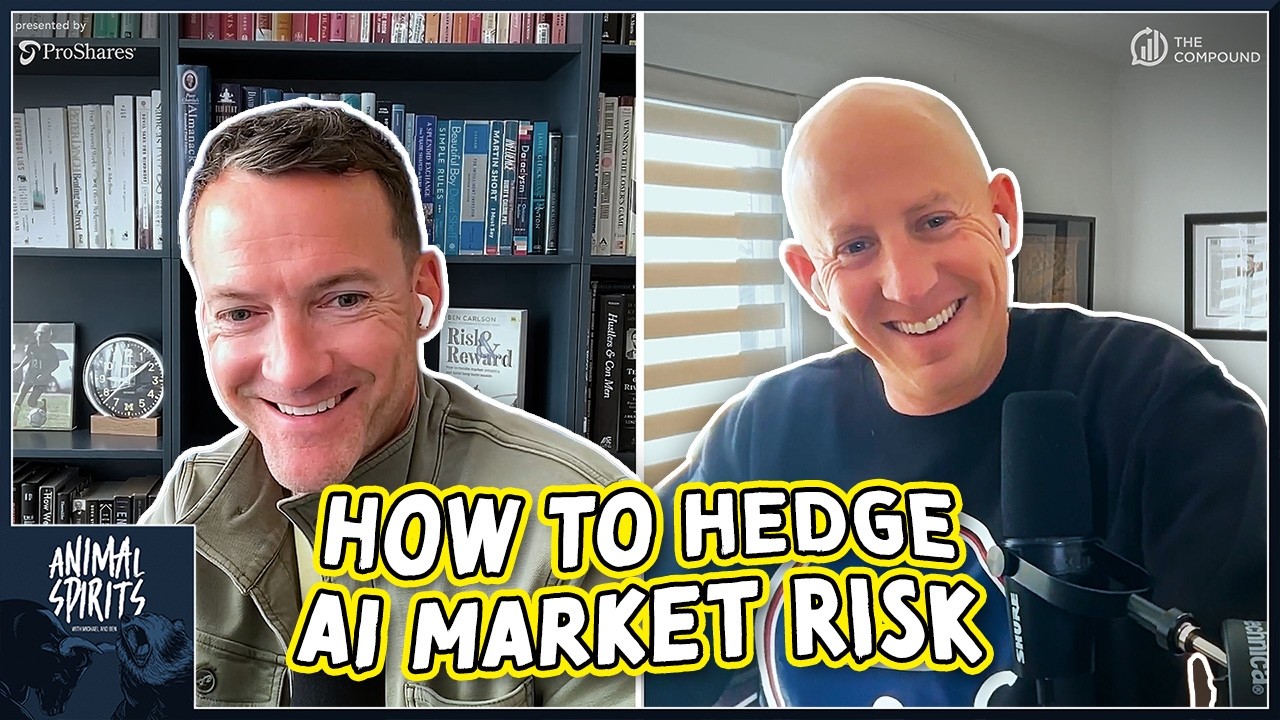
Are Higher Rates Worse Than ZIRP? | Animal Spirits 486
The Compound
4,473 views • 22 hours ago Save 53 min 20 min read
Video Summary
The concentration of market returns in a few dominant companies is a long-standing trend, but its implications are being re-examined. While historically a widening breadth of stocks participating in market gains signaled a bull market, the current landscape sees the top five stocks equating to the bottom 434 companies in the index. This concentration, driven by natural monopolies and massive investment in AI, has led to a situation where net interest costs as a percentage of profits for these companies have actually decreased despite rising rates, due to their ability to lock in low rates and significant profit growth.
Concerns about this market concentration are countered by arguments that it's a feature of the modern bull market, potentially lasting for decades. The ability of these large companies to generate earnings and invest heavily in areas like data centers, while other sectors lag, highlights the dual nature of AI's impact on the economy. Meanwhile, a decline in survey response rates from wealthy individuals raises questions about the accuracy of wealth distribution data, potentially underreporting the true wealth of the nation.
Short Highlights
- Market Concentration: The top five stocks now equal the bottom 434 companies in the index, a significant increase from 2018 when they equaled the bottom 282.
- AI's Economic Impact: Data centers are booming with 65% year-over-year growth in construction spending, while other sectors like manufacturing are declining.
- Interest Rates vs. Profits: AI companies have seen net interest costs as a percentage of profits decrease, even as interest rates rise, due to low-cost debt and increased earnings.
- Wealth Data Concerns: Survey response rates from wealthy individuals have dropped significantly, potentially skewing data on wealth distribution.
- Growth Stocks' Resilience: Despite rising interest rates, growth stocks have continued to perform well, defying earlier predictions.
- Tariffs' Economic Cost: Tariffs have contributed significantly to goods price inflation, with estimates suggesting a 3% increase in prices.
Key Details
The Broadway Show Announcement [00:00:42]
- The hosts announce a live show in December on Broadway.
- Tickets are now on sale for the event.
- The lineup includes Josh, Tom Lee, Nick Colas, Jessica Rabe, Ankur Crawford, and Adam Parker.
"We're doing a live show. You, Josh, and I, plus we're going to have, who else? Tom Lee, Nick Colas, Jessica Rabe, Ankur Crawford, and Adam Parker."
Personal Artwork Choices [00:01:16]
- The hosts discuss their chosen Broadway shows for the event: Hamilton, Phantom of the Opera, and The Lion King.
- Michael shares a personal anecdote about seeing Phantom of the Opera as a child.
"My, my, one of my earliest, I think pre-divorce memories, so I had to be five years old, was going to see Phantom of the Opera."
Current Economic Worries [00:02:09]
- A discussion on common economic concerns, including government debt, interest rates, AI bubbles, and stock market concentration.
- Deteriorating market breadth is also mentioned as a worry.
"We're worried about government debt levels. We're worried about higher interest rates. We're worried about an AI bubble and we're worried about stock market concentration."
Michael Semblis's Charts on Concentration [00:02:34]
- Michael Semblis's charts illustrate the concentration of returns, earnings growth, and CapEx in AI stocks since January 2024.
- AI stocks account for a significant majority of price return, earnings growth, and CapEx.
"It's, so it's two thirds of the price return, 60% of earnings growth in 81% of CapEx. So obviously everything's concentrated."
Market Construction and Breadth [00:03:20]
- A question is raised about whether market construction makes concentration less relevant.
- The idea that breadth issues might not matter anymore is explored.
"Is it possible that this stuff just doesn't matter anymore because of the way the market is constructed?"
AI Companies and Interest Rates [00:03:43]
- Michael Semblis's data shows AI companies' net interest costs as a percentage of profits have decreased despite rising Fed funds rates.
- This is attributed to companies locking in low rates and significant profit increases.
"He shows the net interest costs versus the fed funds rate. So this is net interest costs, has a percentage of profits, has continued to go down for these companies while rates have gone up."
The Concentration Issue Revisited [00:04:36]
- Michael Mobison's past work on market parity and breadth is discussed.
- The idea that a widening breadth of stocks beating the market tends to occur in bear markets is mentioned.
"When there is a, uh, uh, a widening of breadth, when a lot of stocks are beating the market, that tends to happen in a bear market."
Top Stocks vs. Bottom Companies [00:05:08]
- A comparison is made between the market capitalization of the top five stocks and the bottom companies in the index over time.
- In 2018, the top five stocks equaled the bottom 282 companies; today, they equal the bottom 434.
"So that was June, July, 2018. I remand those numbers today. And the top five stocks are now equal to the bottom 434."
Concentration as a Modern Market Feature [00:06:02]
- The current market concentration is described as a feature of the modern bull market, not necessarily good or bad, but simply existing.
- This could be a long-term secular trend spanning 20-30 years.
"It's been a warning for so long, for so, so long. Remember in 2018, that was the first time Apple crossed a trillion dollars."
The Difference in Top Companies [00:06:41]
- The nature of today's top companies (e.g., Apple, Amazon) is contrasted with those of previous decades (e.g., GE, AT&T).
- The risk of government breakup of these companies is discussed, with the conclusion that consumers do not desire this.
"Apple and Amazon are very different than General Electric and AT&T and Ford."
2018 Market Concerns [00:07:15]
- In July 2018, CNBC reported that Amazon, Netflix, and Microsoft made up 70% of the gains in the S&P and NASDAQ.
- Scott Galloway's book "The Four" is mentioned as a catalyst for discussion on market concentration.
"CNBC said that three stocks, Amazon, Netflix, and Microsoft make up 70% of the gains in the S and P, the NASDAQ."
Current Breadth Performance [00:07:58]
- Despite worries about concentration, small-cap stocks (Russell 2000) are up 15% year-to-date, outperforming the S&P 500.
- Mid-caps and equal-weight indexes are also showing double-digit gains.
"Small cap stocks, the Russell 2000 is up 15%, which is actually outperforming the S and P by a decent amount."
Hedging Concentration Risk [00:09:04]
- Strategies to hedge concentration risk include buying bonds, European equities, and REITs.
- Value, quality, and dividend-paying stocks are also suggested as hedges.
"You buy bonds because if, if the AI trade stops, inflation will fall. Rates will fall."
Growth Stocks and Low Rates [00:09:36]
- The narrative that growth stocks only worked due to zero percent interest rates (ZIRP) is challenged.
- Growth stocks have continued to perform well even as rates have increased.
"The narrative was that the only reason, reason growth stocks worked was because of Zerp. Like it was like, Hey, listen, we can, we can pay anything for these stocks because rates are low."
Ray Dalio on Bubbles [00:10:14]
- Ray Dalio's quote about bubbles popping when people have to sell their paper worth is discussed.
- The question of what would cause wealthy individuals to sell their assets is raised.
"Everybody says I'm worth a billion dollars, but okay. Try to spend that."
Options Activity and Meme Stocks [00:11:15]
- Options activity is back to 2021 levels, a period associated with the meme stock craze.
- Despite the crash after 2021, retail traders have returned.
"The Wall Street Journal. They, they're talking about the fact that options activity is back to where it was in the 2021 Heights."
Stitch Fix and Shopping Behavior [00:12:04]
- Stitch Fix, a company from the meme stock era, is discussed, with its stock price significantly down.
- The enduring human enjoyment of shopping and the potential overblown nature of AI agents doing all shopping are debated.
"The funny thing is, is that I actually bought the, the CEO for that company was on Patrick O'Shaughnessy's podcast and she told a great story and it was a, and I bought the stock and actually did really well."
High Earners and 401(k)s [00:13:00]
- A Bloomberg article suggests high earners are not maxing out 401(k)s, seeking more flexibility.
- Financial advisors note that individuals with higher incomes prefer brokerage accounts for flexibility, even with tax implications.
"Armed with a flood of online investing advice, savvy savers on the hunt for better ways to grow their money."
Personal Finance Discipline [00:13:45]
- The hosts discuss the benefit of retirement accounts for disciplined saving.
- Brokerage accounts are seen as more prone to impulsive decisions.
"I am so much better behaved in my retirement accounts. I have never done anything stupid."
The "Shoeshine" Moment [00:14:46]
- An anecdote about a young man loudly discussing selling stocks to fund concert expenses, highlighting a potential lack of financial awareness.
- This is framed as a modern version of the "shoeshine boy" indicator, suggesting widespread market knowledge.
"Luckily I was able to sell some stocks to pay for this? Cause otherwise I was going to go in debt."
Fed Survey of Consumer Finances [00:15:26]
- The Federal Reserve's Survey of Consumer Finances shows a significant decrease in median net worth for those under 35.
- This contrasts with an increase for those 75 and older, adjusted for inflation.
"For people who are 75 or older, it went up 35%. For people who are 35 and younger, it was down more than 20%."
Questioning Survey Data [00:16:16]
- Concerns are raised about the declining response rates in the Fed's survey, particularly from wealthy individuals.
- This could lead to skewed data and underreporting of national wealth.
"In 2016, the general population, the people you'd send this to 65% of people would respond. Now it's 45%. But wealthy people used to be 33%. Now it's 24%."
AI's Impact on Construction Spending [00:17:35]
- Real construction spending shows a stark contrast: data centers are up 65% year-over-year, while most other sectors are down.
- This suggests AI infrastructure is driving construction, potentially crowding out other development.
"Data centers up 65%. Everything else, almost multifamily, single family home, residential, healthcare, commercial, education, offices, lodging, manufacturing, all down."
Tariffs and Manufacturing [00:18:34]
- The failure of tariffs to bring manufacturing back to the U.S. is discussed.
- A New York Fed report indicates tariffs contributed significantly to goods price inflation.
"By February 2026, tariffs had contributed 2.9 percentage points to the goods price inflation."
The Price of Time and Interest Rates [00:19:40]
- Edward Chancellor's book "The Price of Time" is mentioned, arguing that zero percent interest rates caused more problems than they fixed.
- A controversial take is presented: current higher interest rates are worse for the economy than ZIRP was.
"I think you could make the case. The current situation is so bad for the economy, for how bad it is for housing, how bad it is for borrowing, that this right now is worse than ZERP."
Japan and China as Economic Outliers [00:21:09]
- The economic data from Japan and China are discussed as outliers that don't conform to standard economic theory.
- Despite strong GDP and wage growth in China, its financial market performance shows no relationship.
"Japan was like the biggest outlier ever. Same thing with China. It's very bizarre that the two other biggest economies have no bearing in reality to like economic theory."
Meta's AI Investment [00:22:19]
- Mark Zuckerberg discusses Meta's massive investment in AI infrastructure.
- The CFO expresses concern about the financial risk if the AI bet doesn't pay off.
"There's no like dipping your toe in the water here. It's like, you either write a huge, huge check and try to make this happen or you don't do it at all."
AI Risks and Hard Landings [00:23:13]
- The lack of a soft landing scenario for AI development is highlighted.
- If AI doesn't work, it could lead to a hard landing with significant economic damage.
"There's no like soft landing scenario here. If this doesn't work, right? This is either it has to work or there's a hard landing."
Optimism vs. Pessimism in AI Discussion [00:23:42]
- The take is that communicators should be optimistic about AI to remain serious.
- Constant pessimism about AI risks can lead to being perceived as unserious.
"I have to take the only rational take for people that are speaking into the microphone or onto their keyboard for people that are communicating, trying to have an opinion with the public, be optimistic."
AI and Economic Downturns [00:24:20]
- A potential swift, 30% bear market due to AI hiccups is predicted, followed by a buying opportunity.
- The concern remains about the economic damage caused by trillions of dollars potentially being lost.
"I tend to think that we're going to get a like 30% bear market from this. I I'm 57% positive about this."
AI-Assisted Deck Building [00:25:30]
- A deck builder uses AI to streamline client communication, measurement recording, and proposal generation.
- This AI tool provides a proposal that is 90% accurate, saving time and improving efficiency.
"He has this AI tool that takes all the measurements for him. He's recording everything."
DRAM ETF Correction [00:26:19]
- The DRAM (Round-Trip Memory) ETF has seen a significant correction, down 32%.
- Despite the drop, assets under management remain high, indicating money is not flowing out rapidly.
"DRAM, the round tail memory ETF down 32%. It's just like that."
Storage Units vs. AI Adoption [00:27:27]
- A comparison shows that 12.6% of households have storage units, while only 2% pay for AI services.
- This highlights that more households pay to store unused items than to access AI.
"2% of households pay for AI. 12.6% of households have a storage unit. Six times more households pay to store things that they don't use than pay for access to super intelligence."
European AI Consumer Adoption [00:27:54]
- European countries, including Norway, Ireland, and France, are showing faster AI consumer adoption than the United States.
- This suggests AI might help the rest of the world catch up economically.
"European countries are ahead of the U.S. on AI consumer adoption. Places like Norway, Ireland, France, Spain, UK, Netherlands, these people are all adopting AI way faster than the United States."
Sauna vs. Hot Tub [00:29:06]
- The hosts discuss the benefits and drawbacks of saunas and hot tubs.
- Saunas are seen as a place for thinking due to the inability to use phones, while hot tubs are considered by one host to be 'weird'.
"Inside of a sauna is nothing but thinking time because you can't bring your phone in there."
Kelsey Prediction Markets [00:31:12]
- Kelsey, a prediction market platform, is discussed, with a significant portion of trading volume focused on long shots and low-probability outcomes.
- This behavior is compared to sports gambling and lotteries, highlighting a human desire for hope and the thrill of long odds.
"41% of contracts traded on CalShay involved a bet on an outcome given less than a 10% chance?"
Alcohol Consumption Trends [00:33:19]
- Alcohol consumption in the U.S. is at its lowest point in history, according to Walter Bloomberg.
- Reasons cited include social media and increased health consciousness.
"We're not the lowest consumption of alcohol in our country's history."
Nike and Jordan Brand Performance [00:33:43]
- Nike is experiencing significant business and stock declines, with Jordan Brand also down year-over-year.
- This downturn presents potential buying opportunities for consumers.
"Nike of course is getting demolished. The business, the stock, it's all bad. And Jordan Brands was down mid teens year over year."
Young People's Financial and Social State [00:34:21]
- While young people's financial situation has improved (median net worth of young renters up), their mental and social state is described as 'in shambles'.
- Anxiety about social media, fear of embarrassment, and reduced social risk-taking are highlighted.
"Financially, young people are, and listen, how many were the 30 million people we're talking about? I'm generalizing. It's hard to generalize with that many people, but I'm generalizing. Young people generally are doing pretty well financially."
The Impact of Phones on Young People [00:35:29]
- The constant presence of phones and the fear of being surveilled online are making young people hyper-vigilant and less tolerant of awkwardness.
- This anxiety contributes to less social interaction and risk-taking, such as dancing in public.
"It's not a coincidence that concepts like ick and cringe were introduced into our lexicon by a generation with less appetite for social risk and tolerance for awkwardness."
Bowling and Bowling Balls [00:37:25]
- A host shares a high bowling score and discusses the difference a personal bowling ball makes.
- The quality and spin of a bowling ball significantly impact performance.
"If you try and spin and I know you're a spinner with the bowling alley balls, it doesn't really spin."
Euchre and Midwest Games [00:38:31]
- A dinner party includes a game of Euchre, a popular Midwest card game.
- The game requires politeness and has specific rules that are hard to explain.
"Euchre, which is a very Midwest game. A bunch of people asked last week, what is Ben's card game?"
Housing Market Activity [00:39:10]
- Existing home sales in the U.S. are at their lowest level in three years, adjusted for population growth, worse than the GFC.
- This prolonged period of low activity is attributed to high interest rates.
"We have been for three years of GFC bottom level activity in housing, the housing market bottomed for us existing home sales, and then shot straight back up."
Homebuilder Stock Performance [00:40:10]
- Homebuilding stocks like KB Home, Pulte, and Lennar are experiencing significant declines, reaching multi-year lows.
- This reflects the harsh conditions in the housing market.
"The home building stocks, like KB home and, uh, and like Pulte, for example, and Lenard, like they're, they're getting mauled new multi-year lows."
Disney Price Increases [00:40:47]
- Disney is increasing prices on premium products and services at its parks, while keeping entry-level prices stable.
- This strategy aims to cater to higher-spending customers while maintaining accessibility.
"Premium products are getting more expensive. Like the highest level, skip the line service at Walt Disney World, which can now run to shine up to 500."
AI in TSA Screening [00:41:47]
- The potential for AI to improve TSA bag screening is discussed.
- AI could potentially screen bags more efficiently and accurately than human agents.
"When will AI do this? And someone will just be there to watch. Why isn't AI screening the bags for you?"
Personal Emergency on a Flight [00:42:25]
- A passenger causes a flight delay and deplaning due to a "personal emergency."
- The incident highlights the inconvenience and frustration caused by such disruptions.
"He says, I have a personal emergency. And they say, okay, sir, what's the matter?"
Running Through Chicago Airport [00:43:32]
- The host recounts a stressful but exhilarating experience of running through Chicago O'Hare airport to catch a connecting flight.
- The successful dash against time is compared to a scene from "Home Alone."
"I'm running through the Chicago airport. And I feel like I'm in home alone. Run Rudolph run is going through my head."
Paramount's Debt Deal [00:44:40]
- Paramount's recent debt issuance is discussed, with concerns about the high level of debt taken on.
- It's argued that no media deal involving such debt has historically paid off for equity investors.
"There's no way that in 10 years, I look back and go, man, that Paramount Warner Brothers deal was awesome."
Horror Movie Boom [00:45:15]
- Horror films are performing well at the box office, with "The First Omen" being a notable success.
- Other films, like "Social Reckoning," are predicted to fail.
"Other mommy was the number one at the box office. It did, uh, it did a third of total sales over the weekend, $85 million."
Spielberg's Declining Box Office [00:45:53]
- Spielberg's recent films are analyzed, with a focus on box office performance adjusted for inflation.
- "Catch Me If You Can" and "Minority Report" are cited as his last major box office successes.
"So he hasn't had a really good movie since War of the Worlds."
Book Event in Milan [00:47:21]
- The host announces a book event in Milan for the Italian translation of his book, "Risk and Reward."
- The event will include a live podcast interview.
"So Duncan and I actually joked about that, that I'm going to be like Brad Pitt in Inglourious Bastards doing Buongiorno."
Oasis Documentary "Don't Look Back in Anger" [00:48:44]
- The Oasis documentary "Don't Look Back in Anger" is recommended for capturing the joy of their Rose Bowl concert.
- Liam and Noel Gallagher's comments on American reserve are noted.
"Americans have such a big stick up their ass. Are they surprised at ours?"
Liam Gallagher: The Last Rockstar [00:49:56]
- Liam Gallagher is described as the last true rockstar, embodying authenticity.
- The difficulty of replicating his persona today, without appearing as a poser, is discussed.
"He's the last true great rockstar we had who just wanted to be a rockstar."
"The Glass Hotel" by Emily St. John Mandel [00:50:54]
- The book "The Glass Hotel" is recommended, focusing on themes of wealth and its impact on life.
- The author's previous works, "Station 11" and a time travel novel, are also mentioned.
"So all of her books have been completely different, but I, this was interesting."
Cutting the Cord and Sports [00:51:56]
- The host discusses the challenges of cutting the cord, particularly losing access to live sports.
- YouTube TV is recommended as a solution for accessing local sports channels.
"So on Sunday, uh, I'm at home listening to the freaking giants on the radio. Like it's 1996."
Ben Affleck's "Animals" Movie [00:52:40]
- The movie "Animals," directed by Ben Affleck, is discussed.
- Despite a low critical and audience score, the host found it entertaining.
"Critics gave it a 32 audience gave it a 42. I understand why it got panned. I kind of liked it."
Jon Hamm's "American Hostage" [00:53:23]
- The show "American Hostage" starring Jon Hamm is praised.
- Jon Hamm's performance, particularly in an episode about losing his daughter, is highlighted.
"The one where he talked about his losing his daughter. Jon Hamm is just amazing."
Broadway Show Tickets Reminder [00:53:47]
- A final reminder is given to purchase tickets for the December Broadway show.
- Links to the show will be available in the show notes.
"Check the show notes for links to the Broadway show in December. Get your tickets now. They're going to go fast."