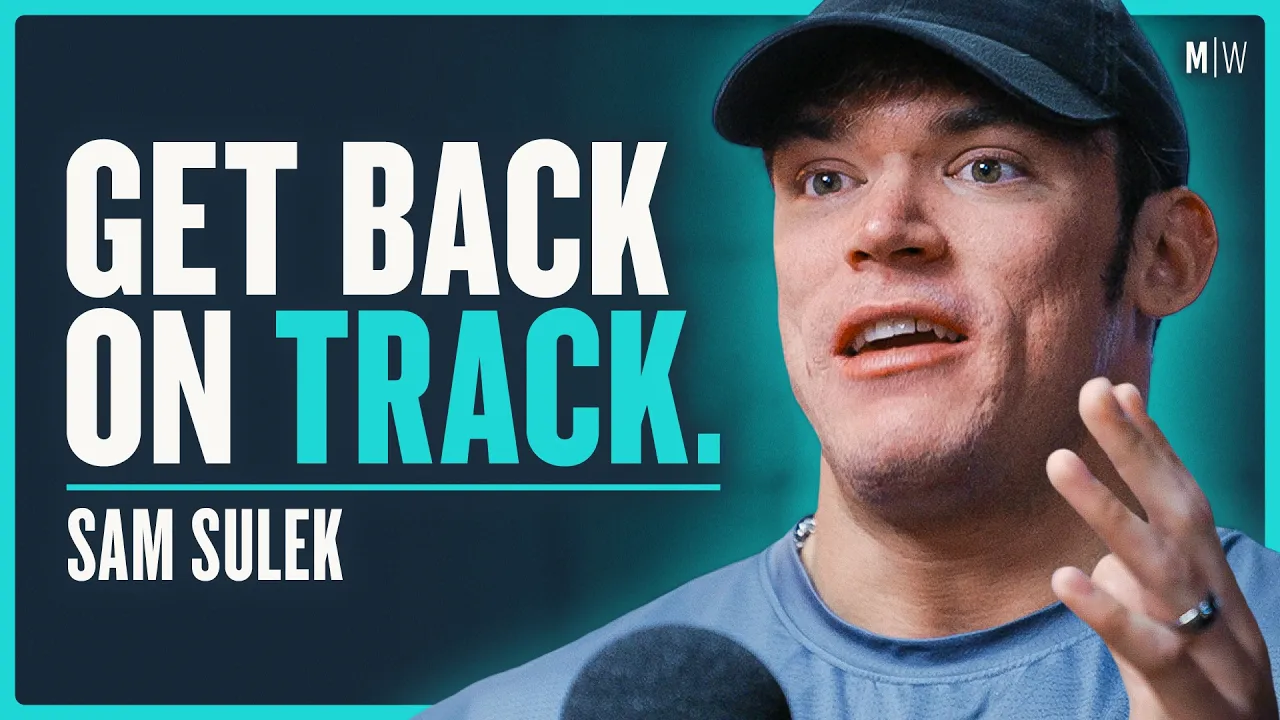
How To Go Hard, Even When You Don’t Want To - Sam Sulek
Chris Williamson
2 views • yesterday Save 94 min 7 min read
Video Summary
Bodybuilder Sam Sulik reveals that the secret to his massive physique isn't a complex, over-optimized science experiment, but a relentless commitment to "just going harder." By prioritizing consistent, high-intensity effort over the "tutorial-based mindset" that plagues modern fitness, Sulik argues that most people fail because they seek shortcuts or perfect conditions rather than building the mental toughness to push through their worst days.
Beyond the gym, Sulik discusses the "upward spiral" of habit formation, where training hard improves sleep, nutrition, and recovery, creating a self-reinforcing cycle of progress. He emphasizes that while tactics like specialized exercises or supplements have their place, they are secondary to the robust, fundamental principles of training and diet that remain effective regardless of one's environment or current motivation levels.
Short Highlights
- The primary driver of muscle growth is simply training harder, not finding the perfect, complex movement.
- Over-optimization creates fragility; robust principles like consistent training and diet are more reliable than rigid routines.
- Motivation is an unnecessary middle step; the most successful athletes train regardless of how they feel.
- The "upward spiral" effect: training hard improves sleep and appetite, which in turn fuels better performance in the next session.
- Avoid the "tutorial mindset" where you wait for the perfect steps; start with incremental changes from your current baseline.
- Personal disclosure in content creation is a double-edged sword; maintaining a "digital hijab" preserves personal sanity.
- Competitive advantage in life comes from having a partner who values who you are, not just what you achieve.
Related Video Summary
- Give Me 12 Minutes and I’ll Give You 30 Years of Productivity Advice
- How to Improve Motivation & Overcome Procrastination | Dr. Masud Husain
- Essentials: How to Assess & Improve All Aspects of Your Fitness | Dr. Andy Galpin
- The REAL Reason 91% of traders fail (It has nothing to do with their strategy)
Key Details
Raising the Bar [01:38]
- Sulik emphasizes the importance of gradually raising the bar for oneself rather than comparing progress to elite bodybuilders at the Olympia.
- He notes that the most jacked individuals at the gym have simply adapted to a high level of intensity, making it their new normal.
There's no end point where I'm like, okay, now I'm totally perfect. And I know everything. And like, everything I do is awesome. It's like, I'm always just trying to creep up.
Practice Without Striving [03:20]
- The concept of "practice without striving" involves going as hard as possible while making that effort feel seamless and natural.
- Sulik notes that many people only start seeing physical changes after years of consistent work.
You're going as hard as you can, but you want that going as hard as you can to just be seamless.
The Floyd Mayweather Principle [05:07]
- Sulik adopts the mindset that even on his worst day, he should be performing at a level that exceeds what is required to make progress.
- This is achieved by drilling the basics of muscle activation and diet until they are automatic.
I don't got to beat you with my A game. I could beat you with my C, D or E game.
The Tutorial-Based Mindset [06:05]
- He criticizes the current trend of obsessing over "funky" or overly specific gym movements that promise results without the requisite hard work.
- Simple, standard movements like dumbbell curls are far more effective than complex, self-assisted variations.
I think it's way more important to just, like, this is the most simple thing anybody could ever say, but just go harder.
Over-Optimization and Grind Slop [09:12]
- There is a growing trend of "grind slop" where people obsess over optimizing every minute of their day, creating fragile systems that break under pressure.
- Resilience and redundancy are more valuable than a rigid, perfect routine.
If you break it, then it no longer works.
The Power of the "Gym Bowl" [12:08]
- Sulik highlights the underrated value of having a high-quality, high-sided bowl for consistent, efficient meal consumption.
- He views these meals as both fuel for his goals and a source of enjoyment, rejecting the need for Instagram-worthy presentation.
Every man, every gym bro has a favorite bowl in the house.
The Cost of Public Disclosure [15:53]
- Reflecting on his marriage announcement, Sulik warns that once personal details are shared online, it is nearly impossible to close that door again.
- He maintains a distinction between his public persona and his private life.
When you open the door to that part of your life, it's very hard to close it.
Relationship as a Performance Enhancer [18:55]
- A stable, loving relationship acts as a "performance enhancer" by providing a foundation that makes external professional successes or failures less defining.
- He argues that delaying commitment for career goals is often an error in judgment.
A good career and an unhappy marriage will make you miserable, but a bad career and a happy marriage will mean that you probably don't give a fuck.
The Winter Arc [23:25]
- The "winter arc" is a powerful tool for locking in during dark, difficult periods to build momentum for the coming year.
- Sulik suggests asking oneself what a future version of oneself would want them to do today.
I'm always thinking, okay, what would me three months want me to do right now?
Motivation is Unnecessary [27:32]
- Motivation is often treated as a necessary precursor to action, but it is actually an unnecessary middle step.
- One can simply choose to perform the task regardless of current emotional state.
Feeling motivated is an unnecessary middle step between where you are and doing the thing.
The Upward Spiral of Habits [28:43]
- Good habits compound, creating an upward spiral where training hard leads to better sleep, nutrition, and hydration, which in turn fuels further training.
- Conversely, skipping sessions feeds a downward spiral of poor habits and metabolic decline.
Good habits compound, but so do bad habits.
Coaching Yourself [35:55]
- Sulik chose to coach himself for his bodybuilding preps to maintain autonomy and because he finds the process of designing his own "homework" more engaging.
- He accepts the consequences of his results, whether good or bad, as part of the personal challenge.
If I showed up and I look like total trash, I guess I'd have to just be like, all right, guys, I don't know what I'm doing.
The Reality of Peptides [41:17]
- Sulik views peptides as legitimate tools that have been overhyped and dramatized by social media trends.
- He notes that many people lack the foundational knowledge to use these tools safely and effectively.
It just gets overhyped, you know? Cause now, I mean, you get all the, all the TikTok kids and like, literally kids, these guys are like teenagers.
Principles vs. Tactics [47:35]
- Tactics are fragile, while principles are robust; understanding the underlying mechanics allows one to make adjustments when things go wrong.
- He emphasizes that simple principles like calories in/out and progressive overload constitute 90% of training success.
Principles are much more robust, which is why, because you did eight years or whatever, six years of training yourself before you then decide to try and compete.
The Evolution of Bodybuilding [38:13]
- He observes that bodybuilding has shifted from a character-driven, WWE-like spectacle to a more outcome-focused and performance-driven sport.
- The transparency of social media has paradoxically led to less relatability among the current generation of competitors.
The nineties, early two thousands, like it was, it was to the same prestige. It's like the WWE, like these guys were, they were characters.
Conclusion [50:11]
- Sulik reiterates that his success is largely due to the fact that he would be training regardless of his online following.
- He encourages others to stop "speed running authenticity" and simply focus on being themselves.
The guys who end up doing the best are the ones where what they're doing is just what they would be doing anyway.