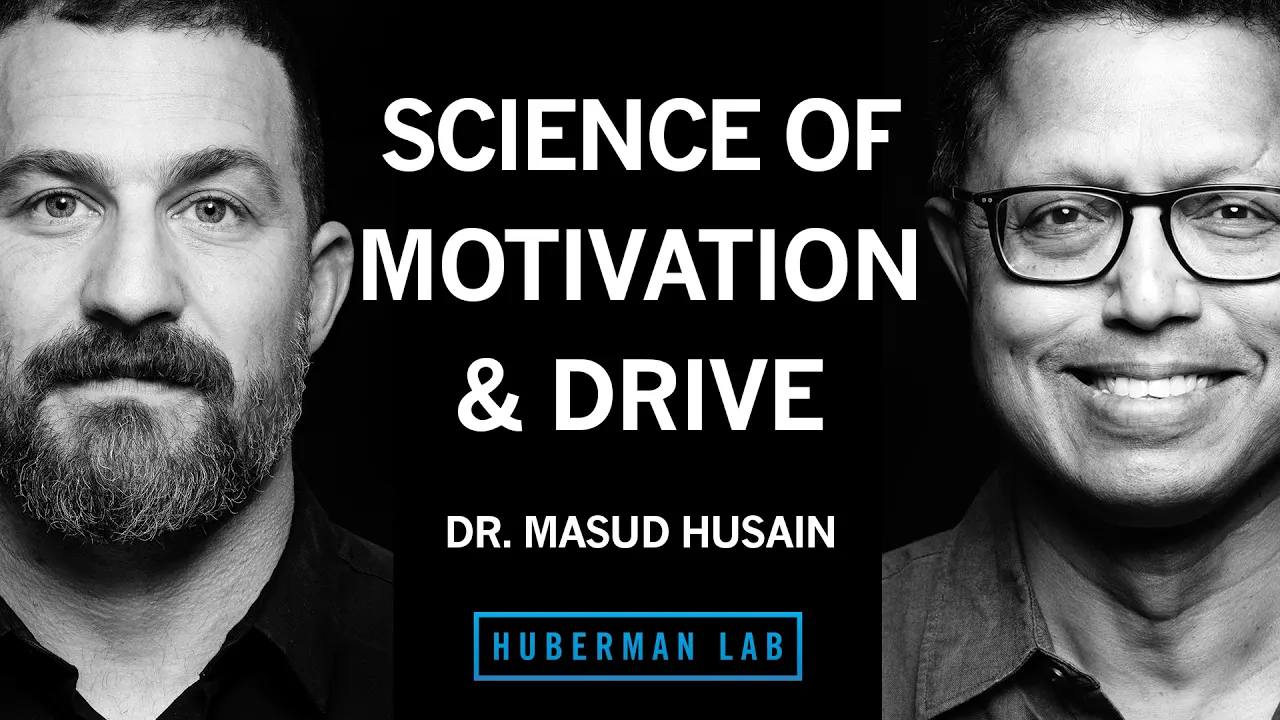
How to Improve Motivation & Overcome Procrastination | Dr. Masud Husain
Andrew Huberman
214,693 views • 1 month ago Save 131 min 9 min read
Video Summary
A rare neurological condition caused by two small strokes in the basal ganglia led to a man named David's profound apathy, extinguishing his motivation to act. Despite being happy, he couldn't be bothered to perform even simple tasks like setting up his music system, finding the effort too great for the reward.
Remarkably, this apathy was reversed with a dopamine receptor stimulant, restoring his motivation and transforming his life. This case highlights the critical role of dopamine circuitry in motivation and suggests that apathy, often seen in various neurological disorders, may stem from disruptions in this system. The research suggests that understanding the balance between perceived reward and effort is key to motivation, and interventions can target either by reducing effort or altering incentives.
Short Highlights
- Apathy can be caused by neurological damage, as seen in a patient who lost all motivation after two small strokes in the basal ganglia.
- Dopamine circuitry is crucial for linking motivation signals to action.
- Apathy is distinct from depression; apathetic individuals may be happy but lack the drive to act.
- The effort-reward calculation is central to motivation: apathetic individuals deem low-reward tasks not worth the effort.
- A dopamine receptor stimulant successfully reversed a patient's apathy, restoring motivation.
- Apathy is common in neurological disorders and can precede cognitive decline, as seen in Alzheimer's disease.
- Understanding and manipulating the reward-effort balance can help energize motivation.
Key Details
The Mystery of Apathy [00:02:05]
- A patient named David, once highly productive and social, became completely apathetic after experiencing unexplained changes.
- He lost his job due to lack of motivation and was so apathetic he couldn't even apply for social security benefits.
- Friends found him sitting in a chair all day, requiring prompting for basic hygiene.
"David did nothing. He just sat there in a chair all day long, waiting for his friends to come back, do the cooking, clean."
Effort vs. Reward [00:03:52]
- David's apathy was so profound that even a simple task like setting up his music system, which took five minutes, felt like too much effort for the reward of listening to music.
- This revealed a critical insight: the brain calculates whether a potential action is worth the effort in terms of the reward it will yield.
- Apathetic individuals are more likely to deem low-reward options not worth the effort.
Neurological Basis of Apathy [00:04:50]
- David's MRI scans revealed two small strokes in the basal ganglia, specifically the ventral striatum (nucleus accumbens).
- These strokes disrupted the link between motivation signals and action, leading to a complete loss of self-initiated motivation.
- He would still perform actions if prompted, but lacked the internal drive to initiate them.
"In David, these strokes in the ventral striatum, what's called the nucleus accumbens in animals, led to no motivation signals leading to action. Nothing happened."
The Dopamine Connection [00:07:10]
- Dopamine, a key neurotransmitter, plays a critical role in the neural circuitry of motivation.
- Initial attempts to treat David with levodopa, a dopamine precursor, were unsuccessful.
A Pharmaceutical Breakthrough [00:07:40]
- Treatment with a dopamine receptor stimulant (Rapinarol) dramatically reversed David's apathy.
- Within three months, he had a new job, a new girlfriend, and a restored sense of motivation.
- This demonstrated the potential to restore motivation by targeting dopamine circuitry.
"Three months after we started this medication, he came back, David came back to see us, and I did not recognize this guy in the waiting room."
Apathy Across Disorders [00:09:00]
- While David's case was rare, apathy is common across many neurological disorders, including Alzheimer's, Parkinson's, and multiple sclerosis.
- Pathological processes affecting motivation circuitry can lead to a loss of motivation.
Deconstructing Motivation [00:10:15]
- Motivation can be deconstructed into understanding the circuits involved and the signals they process.
- The mesolimbic circuitry, linking the basal ganglia to the frontal lobes, acts as a final common pathway for motivation signals to engage action systems.
Domains of Apathy [00:11:10]
- Apathy can manifest in different domains: behavioral, social, emotional, and cognitive.
- Individuals can be motivated in one domain (e.g., cognitive) but apathetic in another (e.g., social).
"So someone could be socially apathetic, but, you know, cognitively very highly motivated."
Neuroeconomic Decision-Making [00:12:40]
- Motivation involves a neuroeconomic calculation of reward versus effort.
- People prioritize actions based on their perceived reward and the effort required, whether physical, cognitive, social, or emotional.
Activation Energy [00:14:30]
- Each behavior has an "activation energy" barrier that must be crossed to initiate action.
- This barrier can be influenced by past experiences and biases.
- Low activation energy, as seen in highly motivated individuals, allows for more action and engagement with life.
Paradoxical Brain Activity in Apathy [00:17:00]
- Studies using fMRI on apathetic students showed greater activity in decision-making circuits compared to motivated students.
- This suggests apathetic individuals expend more brain energy to make decisions, indicating a higher activation energy barrier.
"The paradox here was that we found greater activity in those regions, in the students who were apathetic, compared to the students who are motivated."
Lowering the Activation Barrier [00:21:00]
- Motivation can be enhanced by either reducing the effort required (e.g., breaking down tasks) or changing/increasing the incentive.
- Initiating a task can itself be a significant motivational pull.
The Role of Self-Perception [00:25:00]
- Previous rewards or failures significantly impact future motivation and self-perception.
- The brain learns from outcomes, devaluing choices that led to negative experiences.
"Because if it turned out that I prioritized one, which turned out to be absolutely awful, next time it's coming up in my menu of things I could do, I am going to devalue that."
Perseverance and Completion [00:33:00]
- Initiating actions is only part of motivation; persevering to completion is equally important.
- Apathy can lead to a lack of completion, even if actions are initiated.
Apathy vs. Depression [00:35:00]
- Apathy and depression are distinct but can overlap.
- Pure apathy involves a loss of motivation without sadness, while pure depression involves sadness without necessarily losing motivation.
The Dopamine System and Addiction [00:43:00]
- Nearly every drug of addiction hijacks the dopamine system, leading to hypermotivation or addiction states.
- This contrasts with the hypoactive dopamine system seen in apathy.
"Almost every drug of addiction, whether we go from nicotine to alcohol to heroin to cocaine to amphetamine, almost every drug of addiction hijacks that dopamine system we were talking about."
Wanting vs. Liking [00:46:30]
- Dopamine is primarily associated with "wanting" (motivation and pursuit of a goal), while "liking" (hedonic pleasure) is linked to opioid neurotransmitters.
- This dissociation explains why individuals may seek a substance or behavior without necessarily enjoying it.
Dopamine's Role Beyond Motivation [00:51:00]
- Dopamine is also crucial for working memory, executive functions like planning, and inhibiting impulsive thoughts.
- Changes in dopamine systems can affect these cognitive functions, leading to disinhibition or impaired decision-making.
Parkinson's Disease and Motivation [00:53:00]
- Parkinson's disease, characterized by dopamine depletion, affects not only motor control but also the motivation to act.
- Patients may be able to act in high-stakes situations (e.g., escaping a burning house) due to a surge in motivation signals.
The Attention Economy [00:58:00]
- The brain has limited processing capacity, leading to competition for attention between internal thoughts and external stimuli.
- Distractions, like social media notifications, can degrade attention and make focusing on less engaging tasks difficult.
"So the first point is the brain has limited capacity. So some process has to be there to select the stuff that is important for you. And that process we call attention."
Alzheimer's Disease and Resilience [01:07:00]
- Alzheimer's pathology (plaques and tangles) can exist in the brain without causing dementia.
- Factors like social connection, curiosity, and a sense of purpose contribute to cognitive resilience against Alzheimer's pathology.
- Apathy can be an early indicator of Alzheimer's disease, preceding cognitive decline.
"And it turns out that perhaps 20 to 30% of these individuals who never had dementia have Alzheimer's pathology."
Changing the Self [01:15:00]
- The self is not immutable and can change due to factors like hormones, brain disorders, and life experiences.
- Taking on new roles and engaging in novel activities can alter one's sense of self.
The Value of Effort [01:23:00]
- Focusing on valuable activities, even if they involve effort, leads to a sense of pride and purpose.
- The "chop wood, carry water" principle highlights the satisfaction derived from completing necessary but perhaps unengaging tasks.
Spatial Neglect and Attention [01:30:00]
- Spatial neglect is a neurological condition where patients fail to attend to one side of space, often due to brain damage.
- This illustrates how attention can be profoundly affected, leading to a diminished perception of external reality.
Training Attention [01:35:00]
- While attention can be trained for specific tasks (e.g., video games), generalization to other activities is limited.
- Reducing environmental distractions and cultivating focus can improve attentional abilities.
"So I think although there might not be a great deal of evidence that you can intrinsically train your attention to better generally, what you could do is to cut out things that are distracting for you."
Time and Motivation [01:42:00]
- The basal ganglia's motivation circuitry is primarily designed for short-term goals.
- Long-term planning and perseverance likely involve higher-level cortical networks.
- Individual differences exist in temporal discounting, or how much people value immediate versus delayed rewards.
Memory and Alzheimer's [01:47:00]
- Alzheimer's disease pathology does not always lead to dementia; resilience factors play a significant role.
- Lifestyle choices and psychological factors like purpose and curiosity can buffer against cognitive decline.
The Future of Neurology [01:53:00]
- Advances in treatments for neurological disorders like multiple sclerosis and Parkinson's disease offer hope.
- Emerging therapies include deep brain stimulation, targeted drug delivery, and focused ultrasound.
"And for neurodegenerative diseases, it's a tough call as well. But so much has happened in a condition which was thought pretty untreatable 30 years ago, apart from giving steroids."