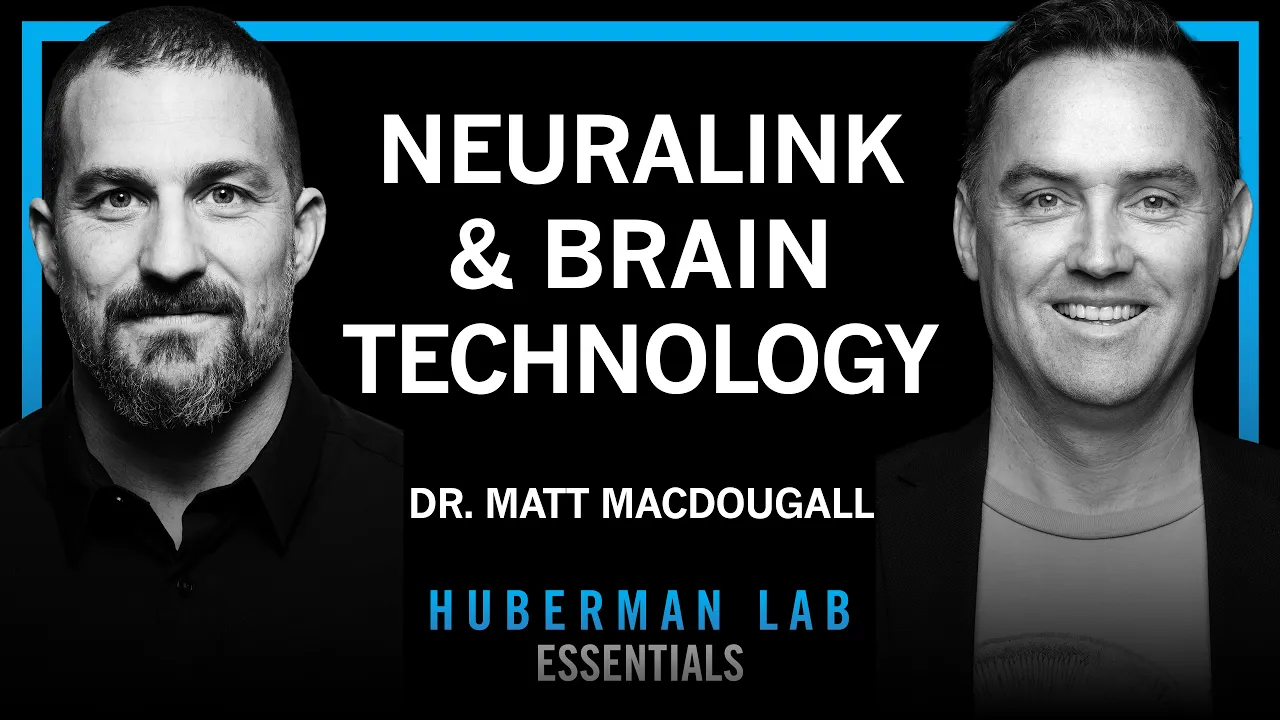
Essentials: Neuralink & Technologies to Enhance Human Brains | Dr. Matt MacDougall
Andrew Huberman
130,007 views • 12 days ago Save 23 min 7 min read
Video Summary
Neurosurgeon Dr. Matthew McDougall discusses the brain's intricate nature and the high-stakes field of neurosurgery, highlighting revolutionary laser ablation techniques for removing deep-seated tumors with minimal damage. He also details Neuralink's mission to alleviate human suffering through advanced neural implants, starting with restoring digital freedom for quadriplegics by enabling them to control computers with their thoughts.
McDougall shares his personal experience with an RFID chip implant, showcasing a tangible step towards human augmentation. He envisions a future where brain-machine interfaces could overcome communication barriers, enhance cognitive abilities by integrating with AI, and potentially even allow for the direct connection of minds, transforming human interaction and expanding cognitive potential beyond current limitations.
Short Highlights
- Revolutionary Brain Surgery: Modern techniques like laser ablation allow for precise tumor removal deep within the brain with minimal damage to surrounding tissue.
- Neuralink's Mission: The company aims to reduce human suffering by developing neural implants, initially to help individuals with spinal cord injuries regain control of digital devices.
- Restoring Digital Freedom: Neuralink's implants intend to translate motor intentions from the brain into commands for computers, enabling control of mice and keyboards for quadriplegic patients.
- Robotic Precision: Robotics are essential for implanting Neuralink's tiny electrodes due to the extreme precision required, surpassing human manual dexterity.
- Personal Augmentation: Dr. McDougall sports a subcutaneous RFID chip, demonstrating a personal commitment to and belief in implantable technology for everyday functions.
- Future of Communication: Brain-machine interfaces could enable direct thought-to-thought communication, transcending current limitations of verbal and textual interaction.
- Cognitive Expansion: Long-term goals include augmenting human cognition through AI integration and creating high-bandwidth interfaces for enhanced learning and communication.
Key Details
The Brain as a Functional Module [00:00:55]
- Neurosurgeons view the brain as a collection of functional modules, sometimes prone to "failure modes."
- A memorable case involved a patient with bilateral frontal lobe damage, resulting in a complete loss of impulse control.
-
"And so we were called back by his, you know, 80-year-old recovery room nurse saying, you've got to come see your patient right away. Something's wrong."
Neurosurgery's High Stakes and Rewards [00:02:39]
- All brain functions, from hormone control to motor movement, can malfunction.
- Neurosurgery carries high stakes but offers the profound satisfaction of fixing seemingly unfixable conditions.
-
"But once in a while, you get a chance to really help. You get a chance to fix something that seems unfixable."
Advanced Tumor Removal Techniques [00:03:12]
- Traditional tumor removal involved significant disruption of healthy brain tissue.
- Modern approaches use a small drill hole and a laser-guided cannula for precise, real-time tumor ablation under MRI visualization.
-
"So you're, this person is in the MRI scanner. You're taking pictures every second or so as the tumor heats up, you can monitor the temperature and get it exactly where you want it..."
Neuralink's Mission and Public Perception [00:05:32]
- Neuralink, like other ambitious ventures, attracts both extreme hopes and fears from the public.
- The company's core mission is to reduce human suffering, with a near-term focus on clinical applications.
-
"Neuralink and I think Tesla and SpaceX before it end up being these blank canvases that people project their hopes and fears onto."
Neural Implants for Spinal Cord Injuries [00:06:16]
- Neuralink's initial goal is to implant electrodes in the motor cortex of quadriplegic individuals.
- The aim is to allow patients to control computer cursors and keyboards using their motor intentions, bypassing the spinal cord injury.
-
"So our goal is to place this implant into a motor cortex and have that person be able to then control a computer."
The Necessity of Robotics in Implantation [00:07:30]
- Robotic insertion is crucial due to the minuscule size of electrodes and the dense network of blood vessels on the brain's surface.
- Human hands lack the necessary steadiness and precision for this delicate procedure.
-
"A human hand is not steady enough to grab this, you know, couple micron width loop at the end of our electrode thread and place it accurately, blindly..."
Near-Term Clinical Goals vs. Long-Term Augmentation [00:09:30]
- The immediate focus is on helping those with severe medical conditions who have no other options.
- Longer-term aspirations include using brain interfaces to augment human capabilities, potentially integrating with AI.
-
"In the near term, we really are focused on people with terrible medical problems that have no options right now."
Decoding Motor Intentions and Animal Models [00:11:45]
- Sophisticated algorithms decode motor intentions from brain signals, with successful trials in monkeys playing video games.
- The technology has achieved a world-record bit rate for information extraction from a monkey's brain to control a cursor.
-
"We have, you know, a small army of monkeys playing video games for, you know, smoothie rewards. And they do really well."
Personal RFID Implant as Proof of Concept [00:15:30]
- Dr. McDougall has a small, implantable RFID chip in his hand, used for accessing his home and workplace.
- These passive chips, coated in biocompatible glass and silicone, can last a lifetime.
-
"So it's just a very small implantable chip that wireless devices can temporarily power. If you approach an antenna, they can power and send a small amount of data back and forth."
Reconnecting the Brain to the Body [00:18:00]
- Future Neuralink efforts aim to stimulate the spinal cord to bypass injuries.
- By connecting brain implants to spinal cord implants, motor signals could be routed to intact wiring below the injury site.
-
"Well, if you can bypass the damaged area of the spinal cord and have an implant in the spinal cord itself connected to an implant in the brain and have them talking to each other..."
Direct Mind-to-Mind Communication Potential [00:19:45]
- The technology could enable direct communication of thoughts between individuals, similar to texting but more direct.
- This would require interfaces in verbally focused brain areas to translate thoughts into audible speech or other forms of communication.
-
"Shifting that function from a phone to an implanted device, it requires no magic advance, no leap forward. It's technology we already know how to do."
Adaptive Learning Between Human and Machine Intelligence [00:22:40]
- Brain-machine interfaces involve a co-learning process between crude software intelligence and human intelligence.
- Both the human user and the Neuralink software adapt and improve over time, correlating brain signals with intended actions.
-
"So undoubtedly the human that has a Neuralink device will get better at using it over time. Undoubtedly the software that the Neuralink engineers have written will adapt to the firing patterns..."
Rationale for Animal Research (Pigs and Monkeys) [00:25:30]
- Animal research is necessary for FDA approval and demonstrating device safety, as there's no current alternative.
- Pigs are used for skull size and shape validation, while monkeys are crucial for functional testing and signal extraction.
-
"The pigs are, we don't necessarily need them to be smart or task performers. Although occasionally we have, you know, trained them to walk on a treadmill..."
Future Vision: Cognitive Expansion and AI Integration [00:30:30]
- Long-term goals include overcoming brain malfunctions like addiction and depression.
- Expansion of human cognition into AI, full immersion in the internet, and unrestricted communication are envisioned.
-
"Having communication with anyone that you want to, unrestricted by this, you know, flapping air past meat on your face."