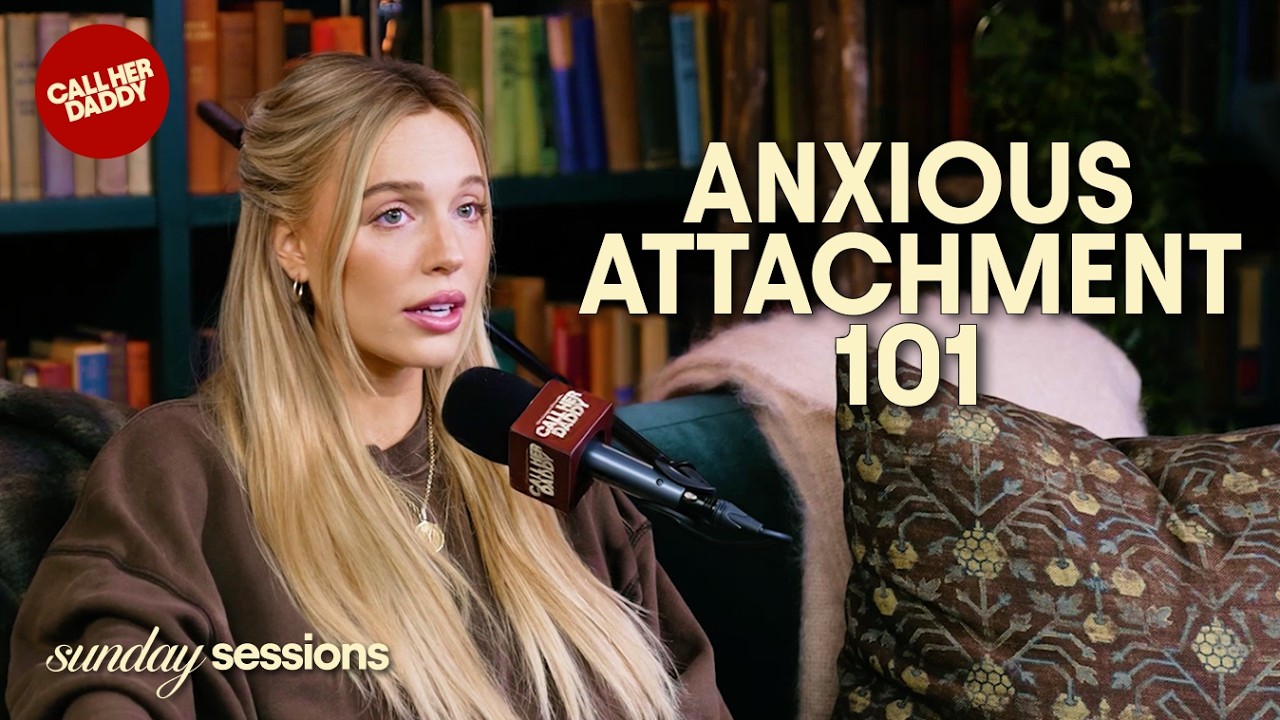
Anxious Attachment 101
Call Her Daddy
329,348 views • 1 month ago Save 40 min 8 min read
Video Summary
This episode of "Call Her Daddy" delves into the concept of attachment styles, explaining how early childhood experiences with caregivers shape adult relationship behaviors. The host highlights anxious attachment as a common pattern, where individuals may exhibit "protest behaviors" like silent treatment or threats to leave in response to perceived distance from a partner. These actions, stemming from a fear of abandonment rooted in inconsistent childhood care, often backfire, pushing partners away and perpetuating a cycle of anxiety and self-doubt.
The discussion emphasizes that this internal struggle involves a conflict between a person's logical brain and their survival instincts, leading to intense emotional and physical distress during triggers. The host offers practical advice for managing anxious attachment, including recognizing triggers, practicing self-soothing techniques, separating facts from anxious narratives, and communicating needs directly. Ultimately, the episode stresses that healing is possible through self-awareness, intentional effort, and sometimes, choosing a secure partner, while acknowledging the profound impact of attachment styles on relationships and self-esteem.
Short Highlights
- Attachment theory, originating from early caregiver interactions, acts as a blueprint for adult behavior in relationships.
- Anxious attachment is characterized by a fear of abandonment and a tendency to engage in "protest behaviors" when feeling distant from a partner.
- These protest behaviors, such as silent treatment or threats to leave, are often counterproductive and push partners away.
- The internal experience of anxious attachment involves a battle between logic and survival instincts, leading to significant emotional and physical distress.
- Managing anxious attachment requires recognizing triggers, practicing self-soothing, and differentiating between objective facts and anxious narratives.
- Direct and vulnerable communication of needs, using "I statements," is crucial for building secure relationships.
- Choosing a secure partner can significantly aid in healing and developing earned security, while the "anxious-avoidant trap" is particularly detrimental.
Related Video Summary
Key Details
Understanding Attachment Theory [00:00:00]
- Attachment theory is presented not as trendy lingo but as a fundamental blueprint for decision-making and behavior.
- It explains why individuals might be trapped in cycles of chaos or unrecognized patterns, often due to ingrained, innate wiring.
-
"It is the literal blueprint of your brain. It dictates essentially everything you do."
The Anxious-Obsessive Cycle [00:01:30]
- The episode poses questions to listeners about why healthy relationships feel boring while toxic interactions spark excitement.
- It addresses the intense anxiety and physical sickness experienced when a partner doesn't reply quickly, leading to self-convincing that they are hated.
-
"If you get physically sick to your stomach if someone doesn't reply to a meme you just sent within 45 minutes and then you immediately are convincing yourself, oh my God, they literally hate me."
Childhood Roots of Adult Behavior [00:02:45]
- The core idea is that how one attached to caregivers as a toddler directly influences adult life, affecting choices in partners, arguments, and trust.
- Understanding one's attachment style is likened to driving with eyes closed, leading to repeated mistakes.
-
"how you attached to your caregivers when you were a literal toddler, a baby, an infant, is currently running your adult life."
Attachment Styles Defined [00:05:15]
- Attachment style is defined as a subconscious blueprint for behavior, communication, and reactions in relationships, developed in infancy.
- It dictates how the brain responds to intimacy and threat and continues to impact individuals well into adulthood.
-
"At its core, an attachment style is your subconscious blueprint for how you behave, how you communicate, and how you react in close relationships."
The Four Attachment Categories [00:06:30]
- The four main attachment styles are identified: secure, anxious, avoidant, and fearful/disorganized.
- This episode focuses primarily on anxious attachment, with plans for future deep dives into the others.
-
"So we have secure attachment, we have anxious attachment, we have avoidant attachment, and then fearful slash disorganized attachment."
Identifying Anxious Attachment [00:07:30]
- Individuals with anxious attachment may have been called "crazy," "needy," or "too much" by partners who were unresponsive.
- The episode aims to explain the brain's response, the tendency to choose partners who create a sense of "starvation," and how to change this pattern.
-
"If you have ever been called crazy, needy, too much, or dramatic by someone who couldn't even manage to text you back, this episode is gonna hopefully be your holy grail."
The Anxious Spiral [00:08:45]
- A scenario is presented where a casual text goes unanswered for hours, triggering a "DEFCON 1 alert" in the anxious brain.
- This leads to obsessive checking of communication history, social media, and location, fueled by a fear of being seen as unlovable.
-
"But your brain, your brain goes into full-blown DEFCON 1 alert. You're like, okay, I gotta open the chat. I have to reread every single text we've ever exchanged."
Protest Behaviors Explained [00:13:00]
- "Protest behaviors" are actions taken to regain control when an anxious attachment is triggered, such as giving the cold shoulder or threatening to end the relationship.
- These actions, intended to elicit a response and reassurance, often backfire by appearing as mind games or drama.
-
"A good example would be when someone is triggering you and you're an anxious attachment, you give the cold shoulder. You ignore this person's text for four hours to punish them."
The Pain of Anxious Attachment [00:16:30]
- Living with anxious attachment is described as exhausting, lonely, and physically draining, akin to being on a constant emotional roller coaster.
- The internal reality is a painful struggle, often misunderstood by those without this attachment style.
-
"But the actual internal reality of living with anxious attachment is it's incredibly painful and it's lonely and it's physically exhausting."
The Anxious-Avoidant Trap [00:23:30]
- The combination of anxious and avoidant attachment styles is highlighted as a notoriously toxic and common pairing.
- Initially drawn to each other, these styles trigger each other's deepest wounds, creating a self-reinforcing, exhausting loop.
-
"the absolute worst, most emotionally exhausting pairing for an anxious attachment style is to be with someone who has an avoidant attachment style."
Healing Anxious Attachment [00:27:45]
- The first step to healing is recognizing the "anxious spark" and understanding that real love feels calm and safe, not chaotic.
- Tracking triggers, identifying physical sensations, and naming them helps to strip away their subconscious power.
-
"You can heal this. You can. You do not have to live your life like this forever."
Self-Soothing and Cognitive Reframing [00:30:00]
- When a trigger occurs, the advice is to self-soothe physically (e.g., exercise, shower) before reacting, proving to the nervous system that one is safe.
- This is followed by separating facts from the anxious narrative by writing down objective realities and alternative, realistic explanations.
-
"You basically need to try to prove to your nervous system that you can survive 30 minutes without this person's validation or communication."
Direct Communication and Partner Choice [00:35:00]
- Once triggers are managed, the ability to state needs directly and calmly, using "I statements," becomes possible.
- The importance of choosing a partner who is willing to work on themselves and meet your needs is emphasized, as is the reality that some partners may exploit triggers.
-
"If you have this attachment, you do need to work on it. But anything in life, choosing a partner is, I don't know any people who came together and they're like, we were perfect when we met each other."
The Role of a Secure Partner [00:40:00]
- Healing attachment trauma often occurs in relation to others, and dating a secure person can build earned security.
- Secure partners' consistent responses teach the nervous system that it is safe to lower defenses.
-
"their consistent, predictable, calm responses will slowly teach your nervous system that it is safe to let your guard down."
Moving Beyond Childhood Trauma [00:43:00]
- Individuals are encouraged to take control of their lives and healing, rather than waiting for others to provide validation or apologies.
- Self-healing is presented as a more gratifying process that relinquishes external control and leads to clearer, healthier choices.
-
"in order to heal. We can't wait for other people to heal us. We can't wait for apologies. We can't wait for any of that."
Future Episodes and Self-Growth [00:45:00]
- The host announces a future episode dedicated to avoidant attachment styles, addressing common questions about commitment and ghosting.
- The overarching message is that facing difficult truths about oneself leads to a simpler, happier life, even if the process is painful initially.
-
"But at the end of the day, facing the hard stuff in life is what's actually going to make your life easier."