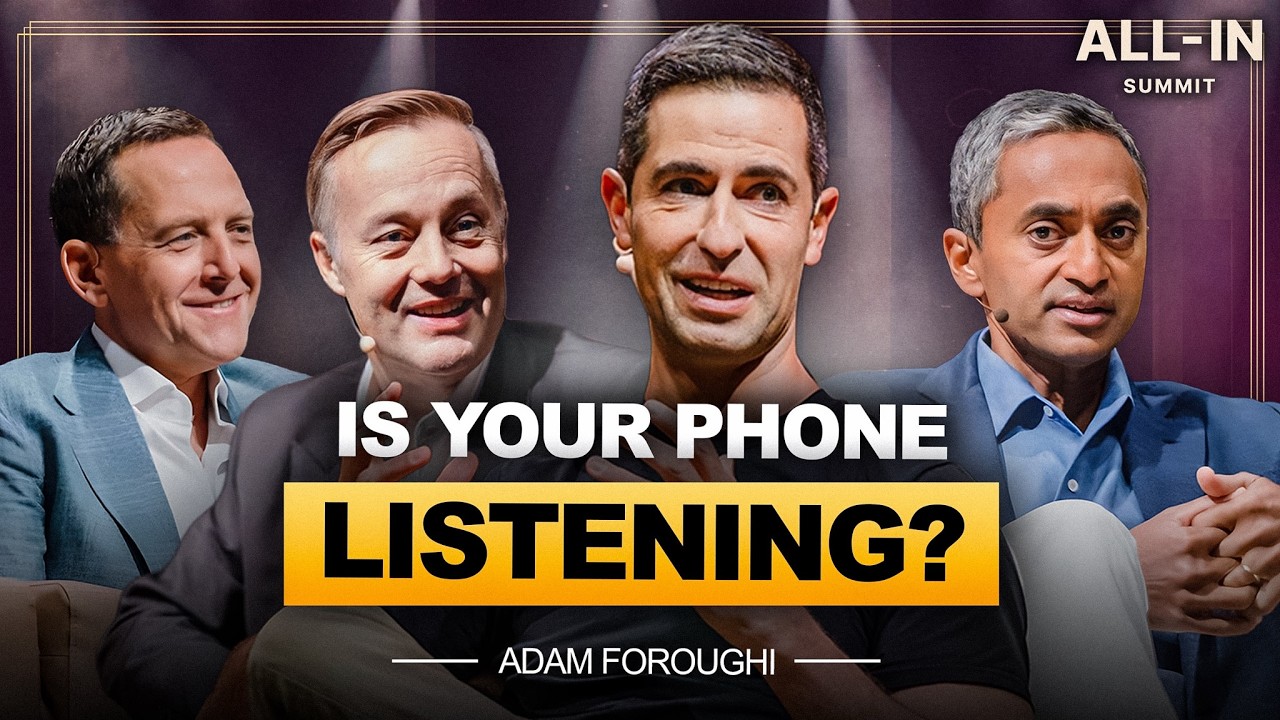
Adam Foroughi, Applovin CEO: Surviving a 92% Drawdown, Ads as ML 1.0 & the $50B Game Ad Market
All-In Podcast
86,432 views • yesterday Save 18 min 5 min read
Video Summary
While many tech giants dominate the headlines, AppLovin has quietly built a massive, high-margin advertising engine hidden within over 100,000 mobile games. By leveraging sophisticated deep learning models, the company has transformed mobile gaming from a simple entertainment space into a $50 billion ecosystem that drives significant e-commerce discovery and economic expansion, often outperforming traditional social media ad platforms.
Despite a volatile history that saw its market cap plummet to $3.8 billion during a 2022 downturn, the company executed an aggressive $6 billion share buyback program and pivoted to advanced ML 2.0 algorithms. This resilience, combined with an 84% EBITDA margin and a relentless focus on performance-based advertising, has propelled its valuation to new heights, proving that a lean, algorithm-first approach can successfully challenge established industry titans.
Short Highlights
- AppLovin operates an advertising platform integrated into over 100,000 mobile games, facilitating an estimated $50 billion in annual industry ad spend.
- The company utilizes advanced deep learning models to drive 'discovery'—showing users products they didn't know they needed, which creates new economic value.
- After a 2022 market crash, the company bought back $6 billion of its own stock, retiring 20-25% of shares and fueling a recovery from a $3.8 billion market cap.
- AppLovin maintains an 84% EBITDA margin by focusing on a lean, automated, performance-based model that allows advertisers to scale profitably.
- The company previously acquired game studios to secure proprietary training data for its algorithms, later divesting them once the model achieved sufficient scale.
- Contrary to concerns about 'creepy' tracking, the company does not track precise user geolocation or record microphone audio for ad targeting.
- The business model is built on a 'performance' foundation where advertisers only pay when their ads successfully drive transactional behavior.
Key Details
The Hidden Advertising Engine [0:15]
- AppLovin operates an ad platform embedded within 100,000+ mobile games, effectively serving as a major, quiet competitor to Facebook for e-commerce brands.
- The mobile gaming ecosystem is massive, with over a billion daily active users, representing a $50 billion annual advertising marketplace.
We disclosed last January, so nearly two years ago, that on our own platform, there was $11 billion a year of ad spend.
From Gaming to E-commerce [1:50]
- The platform has evolved from driving game-to-game installs to using deep learning to influence broader consumer shopping behavior.
- By creating 'discovery' moments, the company generates economic expansion rather than just capturing existing search intent.
But when you show a consumer an ad for something that they had no idea existed, they didn't know they needed to buy. Discovery, basically.
The Evolution of Ad Technology [2:40]
- Advertising is described as the original, highly profitable implementation of deep learning models that now underpin modern AI.
- Recommendation systems and large language models share similar research trajectories, with many experts moving between the two fields.
Advertising is like ML 1.0, but really was the first implementation of all these technologies that now are driving AI today.
Navigating the 2022 Market Collapse [6:15]
- Following a 2021 IPO, the company's stock suffered a massive decline, dropping from a $40 billion valuation to roughly $3.8 billion in 2022.
- Management responded by ignoring external investor pressure and initiating an aggressive $6 billion share buyback program.
I turned internal to the team and said, I'm not going to talk to investors at all anymore. They're not buying our stock. It's a waste of time. But guess what? We generate a ton of cash. Let's start buying our own stock.
Cultural Resilience During Crisis [7:45]
- The company maintained internal morale by implementing performance-based stock plans for key employees to ensure alignment during the downturn.
- The 'us against the world' mentality helped the team stay focused on algorithmic improvements rather than short-term market sentiment.
We built it by just saying, look, it's an us against the world mentality. Like, everyone's turned against us. We're going to buy back shares.
The Power of ML 2.0 [8:30]
- The company's recovery was driven by a successful transition from regression models to deep learning (ML 2.0) in April 2023.
- Once the performance of the algorithm improved, the company's growth accelerated, eventually leading to a valuation surge.
We went from ML 1.0, like we talked about a couple minutes ago, to ML 2.0. We went from a regression model to a deep learning model.
Addressing Privacy and Regulation [10:15]
- The company argues that privacy regulations actually help the industry by creating clear rules that technology can adapt to.
- Users often prefer relevant, personalized ads over generic 'spam,' which remains possible through sophisticated deep learning despite privacy shifts.
There is this notion that you need privacy regulation so that technology companies can do exactly what's expected of them. On the other side, consumers do want relevant ads.
Future of Agentic Commerce [12:10]
- While AI agents may optimize routine subscriptions, the company believes most consumers still value the 'dopamine hit' of manual window shopping and discovery.
- The company remains focused on its core strength: connecting advertisers with consumers through high-performance, automated discovery.
I think we really over-index on the Twitterverse and forget that the average shopper is not that.