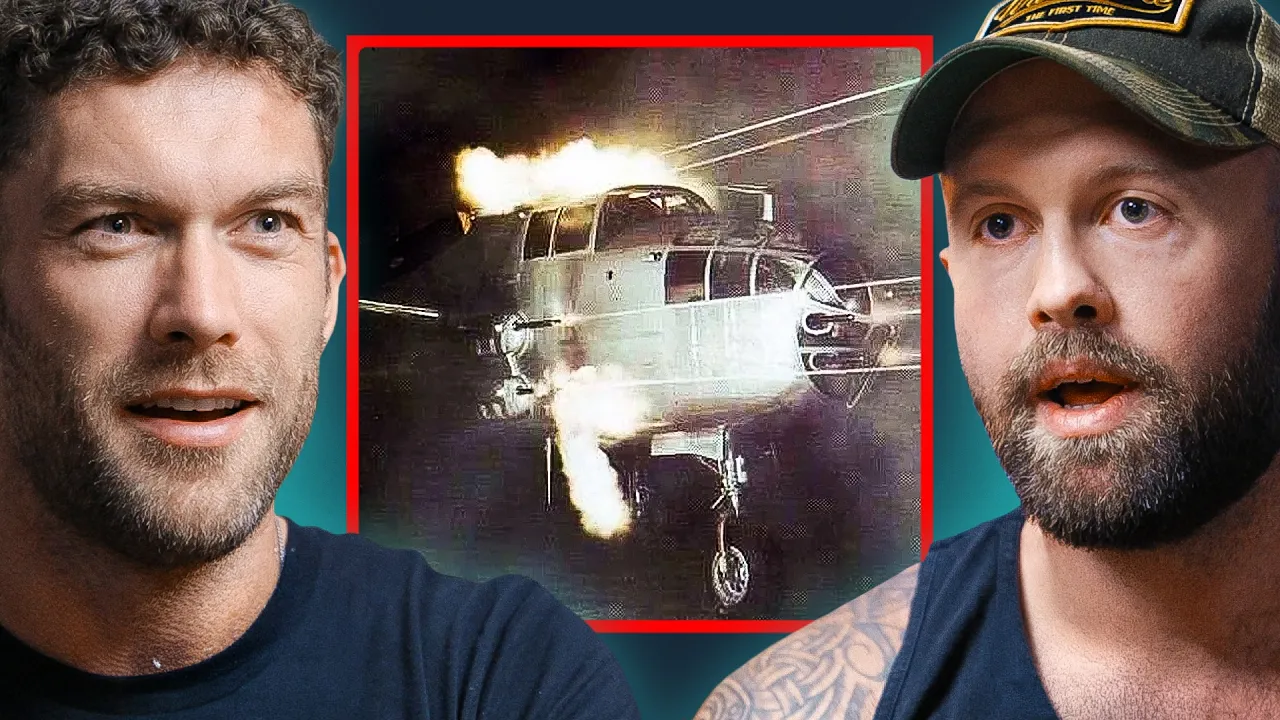
Joe Rogan Experience #2568 - Ross Edgley
PowerfulJRE
434,240 views • yesterday Save 146 min 17 min read
Video Summary
The speaker recounts extreme endurance challenges, including a 60-hour swim in Loch Ness that led to hypothermia and a severe staph infection, and a subsequent swim in Italy during a heatwave that caused heatstroke and rhabdomyolysis. He details the physical toll of these events, including muscle breakdown and kidney strain, and his recovery from near-fatal conditions.
Further into the conversation, the speaker delves into the psychological aspects of pushing human limits, drawing parallels to ancient warrior traditions and modern extreme sports. He discusses the mindset required for such feats, the role of pain and purpose, and the surprising physical adaptations that can occur through extreme training, touching on topics from biomimicry in athletic performance to the potential benefits of nootropics and recovery therapies. The conversation also touches on the cultural significance of endurance and resilience, citing examples from indigenous tribes to elite athletes, and exploring the philosophical implications of pushing one's boundaries.
Short Highlights
- Extreme Endurance Challenges:
- 60-hour swim in Loch Ness leading to hypothermia and staph infection.
- Swim in Italy during a heatwave causing heatstroke and rhabdomyolysis.
- 1,000-mile swim around Iceland.
- 510 km (60-hour) nonstop swim down the Yukon River.
- Physical and Psychological Toll:
- Experienced muscle breakdown (rhabdomyolysis) with creatine kinase levels at 19,000.
- Suffered from cellulitis and hypothermia in Loch Ness.
- Dealt with heat stroke in Italy.
- Discussed the mental fortitude required to overcome pain and continue during extreme challenges.
- Cultural and Philosophical Parallels:
- Drew comparisons to ancient warrior traditions (Berserkers, Viking chiefs).
- Explored the concept of self-discipline for self-discovery through extreme activities.
- Discussed the human drive to push boundaries and find personal limits.
- Athletic Performance and Recovery:
- Explored biomimicry in swimming, drawing inspiration from sharks and whales.
- Discussed the role of strength training and muscle mass in endurance sports.
- Touched upon the potential benefits of nootropics, creatine, and hypoxia training for performance.
- Mentioned advanced recovery therapies like stem cells and hyperbaric chambers.
- The Role of Nature and Adversity:
- Shared experiences with dangerous wildlife (bears, sharks) and extreme natural conditions (rapids, storms, glaciers).
- Discussed the respect for nature and its power, particularly in Iceland.
- Explored the concept of "getting wintered" and enduring hardship for preparation and resilience.
- Fatherhood and Motivation:
- Reflected on how becoming a father profoundly changed his perspective and motivation.
- Cited Dave Chappelle's quote on the increased capacity for love after having children.
- Discussed the shift in viewing people as dynamic rather than static.
- The Nature of Human Potential:
- Emphasized the idea that humans are capable of much more than they believe.
- Highlighted the importance of shifting one's personal barometer of what is possible.
- Stressed that extreme challenges can reveal one's true capabilities and resilience.
Key Details
Whiskey Deal and the Value of Time [0:00]
- The speaker recounts a potential whiskey endorsement deal that fell through.
- He realized he couldn't endorse a whiskey that wasn't aged long enough, after tasting a superior 18-year-old scotch.
- This led to the realization that "there's no substitute for time in those barrels."
"This is so much better. This is, there's no substitute for time. No, there's no substitute for time in those barrels."
Loch Ness Swim and Near-Death Experience [2:23]
- The speaker describes a 60-hour nonstop swim in Loch Ness for ocean conservation.
- He began hallucinating and eventually blacked out due to hypothermia and cellulitis (a skin infection).
- The experience was a combination of a staph infection, extreme cold, and prolonged exertion.
"Basically the only way I can describe it is, um, uh, you're like, you're looking through the eye of a needle. It's just getting smaller and smaller and smaller. And then it just went completely black."
Hospitalization and Recovery [6:02]
- After blacking out, the speaker woke up in the hospital, having been unconscious for approximately 13 hours.
- His mother and girlfriend were present, and he felt their disappointment.
- He describes the ordeal as a "bad place to be."
"I look, I basically opened my eyes. The next thing I know, I see my mom and my girlfriend at the head of the hospital bed. And I just went, oh, it's not going well, has it?"
Italian Swim and Heat Stroke [7:56]
- A year later, the speaker undertook another charity swim in Lake Tresemino, Italy, during a heatwave.
- The water temperature was 36 degrees Celsius (96.8 Fahrenheit), leading to heat stroke.
- He witnessed fish boiled alive in the water.
"So going in there, I had hypothermia before. Now I have hypothermia, so heat stroke. So you're like swimming in a hot bath. Basically."
Cellulitis and Rhabdomyolysis [10:34]
- The speaker explains that cellulitis from fresh water (Loch Ness) was likely due to bacteria, unlike saltwater swims.
- He also experienced rhabdomyolysis (muscle breakdown) in Italy, with creatine kinase levels reaching 19,000.
- He notes that such high levels are unusual for a water-based sport.
"So I had hypothermia and cellulitis in Loch Ness. Fast forward a year. Jeez, bro. Then I got rhabdomyolysis and heat stroke in Italy."
The "Bulletproof Swimmer" Mentality [13:25]
- Having experienced and researched these conditions, the speaker felt like a "bulletproof swimmer" before his swim around Iceland.
- He knew what to expect from rhabdomyolysis, hypothermia, and cellulitis.
- This mental preparation, despite the physical risks, was a key factor in his approach to extreme challenges.
"So I think, thankfully, my kidneys did an amazing job. Shout out to my kidneys. Filled me out and got me out of the hospital in a few days."
Amazonian Initiation Ritual [17:45]
- The speaker recounts an initiation ritual into manhood in the Amazon jungle with the Jamanawa tribe.
- As part of the ritual, he had to bite the tongue out of a freshly killed snake.
- He describes it as a "hard pass" but did it due to being young and impressionable.
"So I did it. Joe, I'm bit the tongue on you. I would have bit the tongue too. I'm just fucking around."
Cobra Bite and Astrologer's Advice [19:32]
- The conversation shifts to a story about a man who got bitten on the tongue by a cobra after an astrologer advised him to perform a ritual to stop nightmares.
- The venom caused hallucinations, and the man's tongue became necrotic.
- This highlights extreme rituals and the potential consequences of following unusual advice.
"Deadly snake bite bit a man's tongue after an astrologer told him that performing a ritual with the serpent would stop his nightmares."
Siberian Reindeer Castration Ritual [26:40]
- The speaker describes living with the Venki herders in Siberia and witnessing their methods of managing reindeer herds.
- To semi-castrate male reindeer and make them more docile, the herders bite their testicles with their teeth.
- The speaker participated in this ritual, though he expresses discomfort with it.
"We actually do a form of semi castration. So we just want to make them slightly more docile so they're not fighting as much. They do it with the teeth. Exactly that."
Swimming with Great White Sharks in Tasmania [31:55]
- The speaker shares an experience of swimming with great white sharks in Tasmania.
- He describes the sharks' ability to detect electrical impulses and their predatory instincts.
- During a dive, the sharks seemed to identify him as the "weakest link" and approached him, but he remained calm.
"And it was looking at me, came straight up to me. I sort of tried, again, I'm not saying I squared up to it, but kind of was like, can I help you? And then it just went, all right, you're okay. And just peeled off."
Yukon River Swim and Wildlife Encounters [37:51]
- The speaker broke the record for the world's longest nonstop river swim (510 km, 60 hours) down the Yukon River.
- He encountered significant wildlife, including bears and wolves, attracted by the blood from his leg injuries.
- He describes the different demeanors of black bears and brown bears.
"Ross, they can smell the blood. You're like an ice cream van. You're just advertising yourself to all the wildlife now in the Yukon. Really?"
Icelandic Swim and Viking Lore [44:12]
- During a swim around Iceland, the speaker learned about the concept of "Berserkers" (bear shirts) and wolf warriors.
- He heard stories of ancient Nordic warriors embodying animal spirits.
- The culture's respect for nature and folklore, including elves and trolls, was highlighted.
"Berserker obviously just meaning bear shirt saying that these berserkers, these ancient Nordic warriors would so often just try to embody the spirit of the animal."
The Elves of Iceland and Consciousness Rendering Reality [49:28]
- The speaker discusses the Icelandic belief in elves and how roads are rerouted to avoid their sacred land.
- He connects this to the theory that consciousness renders reality, suggesting that if consciousness can create reality, then elves could be considered real.
- He also recounts a story about the Northern Lights being interpreted as Valkyries deciding who makes it to Valhalla.
"And then all of a sudden you're in front of it. And if you're in a world where there's no explanations for anything because no one knows how to read. Okay? You have a bunch of fucking weird grunts for your language."
The Yukon Swim and a "Poo Flap" Mishap [1:15:54]
- During the 60-hour Yukon River swim, the speaker faced a challenging situation with a specially designed wetsuit's "poo flap."
- The flap malfunctioned, leading to him swimming in his own waste for approximately 55 hours.
- He describes the decision to continue despite the discomfort as a test of "grit or quit."
"I'm then faced with the decision. And this goes back to what we were talking about. Your anterior mid-cingulate cortex. In that moment, pain versus purpose. Grit or quit."
The Power of Fatherhood and Shifting Perspectives [56:35]
- The speaker reflects on how becoming a father changed his perspective on life, love, and empathy.
- He discusses how fatherhood made him more compassionate, viewing people as "somebody's baby" rather than static individuals.
- This shift in perspective also impacted his views on homelessness and his own motivations.
"And it also did for me this other very profound thing. It made me stop looking at people as a static thing. If I met a guy and he's 40 and he's an asshole, I'm like, fuck that guy's a fucking asshole."
The "Hero's Journey" and Pushing Limits [1:02:45]
- The speaker discusses the concept of the "hero's journey" and the drive to find oneself through extreme challenges.
- He contrasts his method of "a little bit every day" with the extreme challenges undertaken by others.
- He acknowledges that these extreme pursuits, while not always smart, are "noble quests."
"And I think I like to do it a little bit every day. That's my method. My method is do a little bit every day. When I say a little bit like a couple hours. That's what I like. Couple hours of torture every day."
The Science of Endurance: Brain Chemistry and Strategy [1:06:50]
- The speaker delves into the neuroscience of endurance, discussing the ventral striatum (reward and reality processing) and the anterior mid-cingulate cortex (grit vs. quit).
- He explains how the brain's response to failure and pain can be managed through discipline or strategy.
- He uses his experience of swimming in a whirlpool for hours without moving as an example of the brain "imploding" and how to overcome it.
"Anterior mid-cingulate cortex, grit or quit, pain and purpose, discipline. You just do it because you said you were going to do it. You just grit your teeth and get through it."
The Dangers of the Ocean and Human Fascination [1:11:30]
- The conversation touches on the extreme dangers of the ocean, including sneaker waves in Iceland and dangerous currents.
- The speaker notes the human fascination with the ocean's vastness and power, suggesting it has a calming effect by putting human concerns into perspective.
- He contrasts the "created shit" of urban environments with the humbling vastness of the ocean and stars.
"And then at night time you see the stars too. You see the fucking Milky Way. And then there's the ocean like alright this is clearly I'm not that important."
The Viking Spirit and "Getting Wintered" [1:19:45]
- The speaker discusses the concept of "getting wintered," inspired by ancient warriors and explorers who endured harsh conditions.
- He draws parallels between this and modern athletes who push their limits through extreme training and competition.
- The idea is that enduring hardship, especially in the "winter" of training, prepares one for future challenges.
"The Spartans as well famously would be given essentially a loincloth and just been told to endure the winter to fight, you know, for your food. You know, so you just create these crazy warriors."
ADHD as a Superpower and Nootropics [1:24:10]
- The speaker and guest discuss ADHD, reframing it not as a disorder but as a potential superpower that allows for intense focus on engaging tasks.
- They explore the use of nootropics like Cognizant and Alpha GPC, and supplements like creatine, to enhance focus and cognitive function.
- The speaker shares his personal experience using these to optimize his swimming performance.
"I don't believe it's a disorder. I think it's a superpower. I think it gives you the ability to concentrate on things that you love to an extent that most people cannot fathom."
The Role of Creatine and Weight Cutting in MMA [1:29:30]
- The conversation touches on the cognitive benefits of creatine, especially during sleep deprivation.
- They discuss the extreme weight cutting practices in MMA, with fighters gaining significant weight between weigh-ins and fights.
- The risks associated with high doses of creatine and extreme weight cutting are acknowledged.
"The results suggested that a single but high dose of creatine enhances thinking capacity and causes changes in the brain's energy reserves during sleep deprivation."
Altitude Training and its Impact on Performance [1:33:00]
- The importance of altitude training for endurance athletes is discussed, using Cain Velasquez's loss at altitude as an example.
- The use of hypoxia trainers and the physiological adaptations, such as increased red blood cell count, are explained.
- The speaker shares his positive experience with altitude training for a hunting trip.
"And I think that's a game changer. And so many of these, like, really high-level camps have chosen to train at altitude."
The Kenyan Kipsigis Tribe and Running Prowess [1:38:00]
- The speaker recounts learning from the Sam Bushmen in Namibia and their incredible running abilities.
- He discusses the Kipsigis tribe in Kenya, known for producing disproportionately many elite marathon runners.
- A theory is presented that their running prowess is linked to a painful circumcision ritual where boys must not flinch, passing on genetics for pain tolerance.
"And they put the mud as well. Yeah. And they don't pass on. Yeah. Circumcision as a grown boy with no, no, nothing, no water, no cleansedliness, no, no anesthesia. Just they cut it."
Emile Zatopek and Interval Training [1:41:30]
- The legendary endurance runner Emile Zatopek is discussed, highlighting his unprecedented Olympic achievements (5000m, 10000m, and marathon golds in the same Olympics).
- His unconventional training methods, including sprints for marathon training and running with his wife on his back, are mentioned.
- Zatopek's unique mindset and approach to racing are emphasized.
"And Emile goes, okay, no problem. What I do, I will run on his shoulder. And then just at the end, before we get into stadium, I go boop. And I run around and I will finish."
Backyard Ultras and "Soul Collecting" [1:45:00]
- The concept of Backyard Ultra races, where the last person standing wins, is explored.
- Mark Dowdle's victory in the "Last Soul Ultra" after 94 hours of running without sleep is highlighted.
- The mind games and psychological warfare involved in these races are discussed.
"Mark Dowdle, when this guy stopped to like tie his shoelace, Mark was behind him and just hunting him like prey. And they had them on the night vision and they're like, what is going on? It's just mind games."
The "Blood in the Water" Water Polo Match [1:53:00]
- The speaker shares a personal anecdote about a severe tongue injury sustained during a water polo match.
- He describes the "Blood in the Water" match between Hungary and the Soviet Union during the Olympics, where players fought amidst political tension.
- This highlights the intense physicality and combative nature of water polo, even at the Olympic level.
"And I remember you then have to defend. It's kind of like basketball constantly back and forth like that. It's that quick. Why you got a mouth full of blood? Oh, there we go. Yeah. Blood in the water. Yeah."
Animalistic Fighting Styles and Mind Games [1:58:00]
- The discussion touches on fighters mimicking animal movements and fighting styles, like Carlos Prates emulating mongooses.
- The importance of controlling distance and using mind games in combat sports is explored.
- Examples like Chael Sonnen and Conor McGregor's psychological tactics are mentioned.
"And they gave an example of these mongooses, they're essentially like juking with the cobra. They're fainting. They're trying to get the cobra to react and they move back when the cobra reacts."
John Jones and the Nature of "Outliers" [2:03:00]
- The conversation shifts to the complexities of fighters like Jon Jones, who possess immense talent but also have controversial personal lives.
- The idea of "outliers" in sports – individuals who defy conventional explanations for their success – is discussed.
- Jones's physical gifts, fight IQ, and ability to perform despite injuries are highlighted.
"There's outliers. There's outliers. There's outliers. There's outliers. There's outliers. It's exactly it. There's always like these Bo Jackson characters that could do anything."
The Role of Pain Tolerance and Resilience in Sports [2:09:00]
- The speaker and guest discuss the importance of pain tolerance and resilience, referencing special forces training and wrestlers.
- The concept of "seeing how well you can lose" in training is presented as a key to mental toughness.
- Water polo players are also mentioned for their endurance and toughness.
"He said, Ross, in the special forces, we're not seeing how well you can win. We're seeing how well you can lose. Time and time again."
The Influence of Pharmaceuticals and Recovery Therapies [2:14:00]
- The conversation explores the use of peptides, stem cells, and hyperbaric chambers for athletic recovery and performance enhancement.
- The speaker shares his positive experience with these therapies after severe injuries.
- The potential for these therapies to extend athletic careers and improve general health is discussed, alongside concerns about regulation and accessibility.
"And that got me back to the start line, ready for Iceland. I think without it, I might have needed them reattached with surgery. So that's how good they were for me."
The Yukon Swim and the "Poo Flap" Incident [2:23:30]
- The speaker recounts the extreme discomfort of the Yukon River swim, compounded by a malfunctioning "poo flap" in his wetsuit.
- He describes the decision to continue swimming in his own waste for 55 hours as a test of mental fortitude.
- The story highlights the extreme conditions and the physical and mental challenges faced during his record-breaking swim.
"I'm then faced with the decision. And this goes back to what we were talking about. Your anterior mid-cingulate cortex. In that moment, pain versus purpose. Grit or quit."
The Purpose of Extreme Endeavors [2:28:00]
- The speaker clarifies that his extreme lifestyle is not necessarily a recommendation but a means to inspire others.
- He aims to help people shift their "barometer" of what they believe is physically and humanly possible.
- The ultimate goal is to encourage a broader understanding of human potential.
"I think my purpose is people to get them to shift their barometer, their own personal barometer, just one degree of what they think they're capable of."