Leaders Eat Last: A Journey of Service and Sacrifice | Simon Sinek
Simon Sinek
18,873 views • 4 days ago Save 12 min 5 min read
Video Summary
A trip to a war zone transformed a business writer's understanding of leadership, shifting his perspective from self-interest to the profound power of service. While embedded with the Air Force in Afghanistan, he experienced the paralyzing fear of rocket attacks and the crushing weight of helplessness, only to find clarity through a radical surrender to the mission. By volunteering for any task—no matter how menial—to serve those who serve others, he discovered the true essence of leadership: a culture built not on bonuses, but on the unconditional love of brothers and sisters in arms.
The experience culminated in a harrowing journey home accompanying a fallen soldier's casket, an encounter that revealed the stark difference between corporate environments and military camaraderie. While civilian culture often rushes to dismiss or "fix" displays of vulnerability, the military community holds space for it. The realization that true leadership is the choice to serve others, even in the face of death and fear, became the foundation for his philosophy that leaders must prioritize their people above all else.
Short Highlights
- The concept of "leaders eat last" originates from military officers prioritizing their troops' needs over their own.
- True service is defined by the choice to serve those who serve others, rather than serving everyone.
- Military culture fosters deeper bonds than corporate settings by viewing colleagues as brothers and sisters.
- Vulnerability and emotional expression are accepted and supported within military communities.
- The author's journey included three primary experiences that shaped his philosophy:
- Surviving a rocket attack at Bagram Air Base.
- Transporting a fallen soldier's casket home on a cargo plane.
- Witnessing medical professionals treat wounded troops with profound honor.
Key Details
The Origin of Sacrifice [0:00]
- The title "Leaders Eat Last" stems from a conversation with a Marine who explained that officers eat only after their subordinates have been fed.
- The author contrasts military culture, where medals reward those who sacrifice for others, with business culture, where bonuses often reward those who sacrifice others for personal gain.
In the military they give medals to people who are willing to sacrifice themselves so that others may gain and in business we give bonuses to people who are willing to sacrifice others so that we may gain
Under Fire in Afghanistan [1:42]
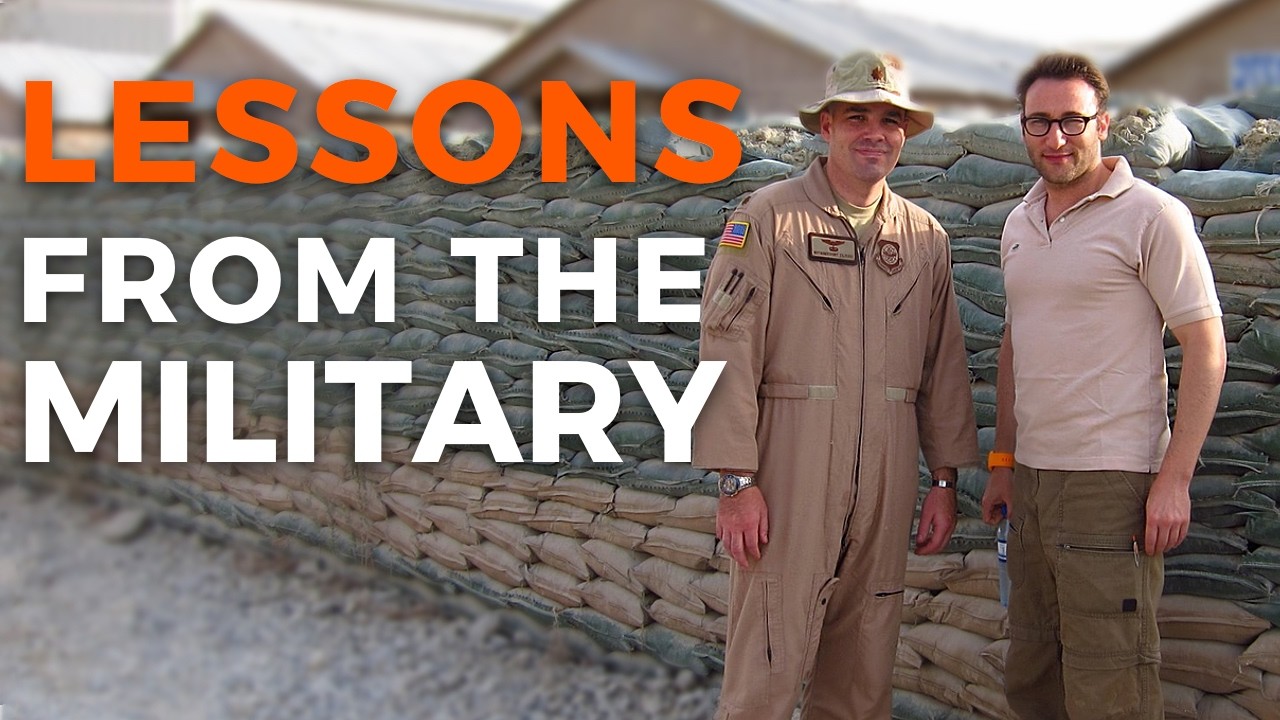
- The author traveled to Bagram Air Base with the Air Force, facing an immediate rocket attack upon landing that left him feeling vulnerable and fearful.
- He struggled with the lack of control and the realization that his previous sense of purpose was insufficient in a life-or-death environment.
I am now convinced I wouldn't bet money I'm a hundred percent convinced that there's going to be another rocket attack it's definitely going to land wherever I am
The Moment of Surrender [4:06]
- After cycling through various rationalizations to cope with his fear, the author finally surrendered to his powerlessness.
- This surrender brought a sudden, intense calm and a desire to serve in any capacity, including menial tasks, to support the troops.
I just gave up I surrendered and in that moment of surrender this intense calm came over me
Honoring the Fallen [6:25]
- While waiting to leave the country, the author and his escorts were bumped from a flight to make room for a fallen soldier's casket.
- The flight home was solemn and quiet, with the author sleeping near the casket, an experience he describes as the greatest honor of his life.
On every other flight I was on we joked we talked we had a blast on every other flight I went on this flight barely a word was spoken
The Reality of Trauma Care [8:26]
- On a medical evacuation flight, the author spoke with a doctor who highlighted the immense difference between civilian emergency rooms and military trauma care.
- The doctor noted that the honor of serving wounded soldiers far exceeds the rewards of his civilian career.
The honor I get on these missions doesn't equate to an entire career
A Lesson in Leadership [10:35]
- During a debriefing with military leadership, the author struggled to speak while recounting the story of the fallen soldier.
- A four-star general encouraged him to continue with the simple command "go on," demonstrating the power of a culture built on support rather than dismissal.
In a time of pain in a time of fear in a time of overwhelm he did not say stop he said go on
The Power of Love [11:13]
- The author concludes that the strength of the military lies in the genuine love service members have for one another.
- He now applies the lesson of "go on" to his own life and relationships whenever friends face struggles.
If you ask folks in the military I've talked to the hardest of hardcore warriors and I say what is it that makes you good at what you do and they say love