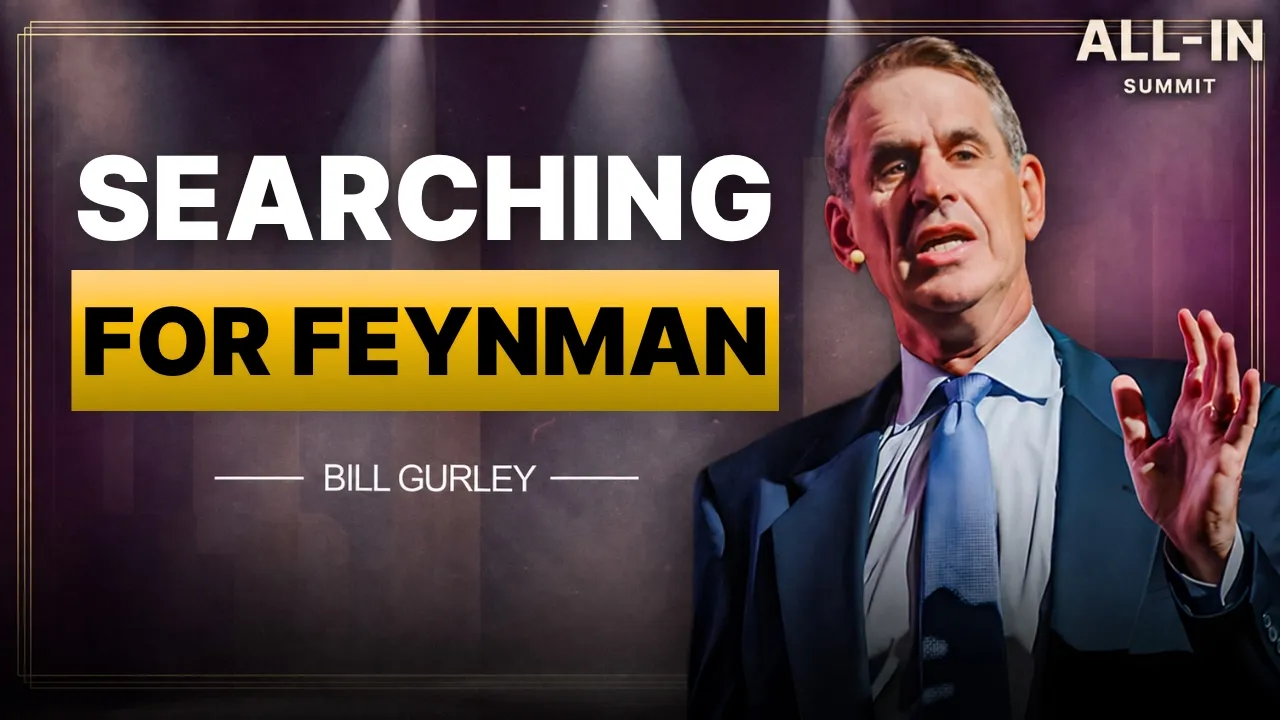
Bill Gurley: Searching for Feynman
All-In Podcast
98,263 views • 14 hours ago Save 32 min 6 min read
Video Summary
Investor Bill Gurley draws a stark parallel between past catastrophes and the COVID-19 pandemic, arguing that a failure to rigorously investigate the pandemic's origins has left the world vulnerable to future crises. He highlights how events like the Surfside condo collapse, the 737 MAX crashes, Hurricane Katrina, Fukushima, and the Challenger disaster, despite their severity, were met with dedicated investigative efforts by journalists, scientists, and government bodies, leading to crucial preventative measures.
In contrast, Gurley contends that the COVID-19 pandemic, which dwarfs these past events in scale and cost, has suffered from a lack of genuine investigation. He identifies key figures in the scientific and public health communities as "blockers" who allegedly perpetuated misinformation, stifled inquiry, and promoted a specific narrative, preventing the discovery of the root cause. This deliberate obstruction, he argues, has eroded public trust and left humanity ill-equipped to handle the next global health emergency, emphasizing that true prevention hinges on uncovering the truth, no matter how uncomfortable.
Short Highlights
- The COVID-19 pandemic, with 15 million deaths and $45 trillion in costs, lacks a determined root cause, unlike past catastrophes.
- Key figures in the scientific community acted as "blockers," hindering investigations through misinformation and suppressing alternative theories.
- A lack of dedicated investigative journalism and independent commissions for COVID-19 contrasts sharply with efforts for previous disasters.
- The "Proximal Origins" paper and similar efforts successfully framed animal spillover as the determined cause, labeling lab leak theories as conspiracy.
- The "diffuse proposal" document, suggesting a gain-of-function experiment, was largely ignored by major journals and the scientific community.
- Institutions like the University of North Carolina are reportedly blocking access to crucial documents related to the pandemic's origins.
- Gurley urges support for "searchers" and independent commissions to uncover the truth for future prevention, emphasizing scientific inquiry over partisanship.
Key Details
Introduction and Past Catastrophes [00:00:00]
- Bill Gurley, a seasoned investor, contrasts the investigative responses to past major catastrophes with the current situation regarding COVID-19.
- He uses examples like the Surfside condo collapse, 737 MAX crashes, Hurricane Katrina, Fukushima, and the Challenger disaster to illustrate effective root cause analysis and prevention.
"The thing to do right now is to run as fast as you can."
Surfside Condo Collapse: A Model of Investigation [00:03:30]
- The collapse of the Chamberlain Towers in Surfside, Florida, resulted in 98 deaths due to design flaws and poor maintenance.
- Multiple entities, including the New York Times, NIST, the town of Surfside, and the Miami Herald, conducted thorough investigations, with the Miami Herald winning a Pulitzer Prize.
"The technical failure was different, and you can see it here."
737 MAX Crashes: Searchers and Blockers [00:08:00]
- Two fatal crashes of the 737 MAX were linked to secret MCAS software designed to compensate for engine placement.
- Investigations involved government commissions, the press, whistleblowers, and victim families, but faced resistance from Boeing and the FAA, accused of "regulatory capture."
"And one thing I would tell you about these big organizations, when you put a spotlight on them, they can feel the weight of that spotlight, and they circle the wagons."
Hurricane Katrina: Man-Made Error [00:15:00]
- Hurricane Katrina caused immense devastation, but investigations revealed the levees gave way due to man-made errors, not just natural disaster.
- Despite initial claims by the Army Corps of Engineers, multiple investigations, including by the NSF and LSU, concluded it was a preventable accident.
"What in fact happened was the levees gave way from underneath. They washed under."
Fukushima Daiichi Nuclear Disaster [00:19:00]
- The Fukushima disaster was caused by a seawall insufficient to withstand tsunamis, leading to meltdowns.
- Internal documents revealed prior knowledge of potential tsunami heights, but a report was buried, indicating institutional failure.
"The accident at the power plant cannot be regarded as a natural disaster. It was profoundly man-made and it could have and should have been prevented."
Challenger Space Shuttle Disaster [00:23:00]
- The Challenger disaster was attributed to O-ring failures on solid rocket boosters in cold weather, a known flaw.
- Richard Feynman, a key member of the Rogers Commission, conducted independent investigations, highlighting technical and institutional failures.
"The O-rings on the solid rocket boosters weren't designed for cold."
The COVID-19 Catastrophe: Unanswered Questions [00:27:00]
- Gurley contrasts the extensive investigations into previous catastrophes with the lack of a determined root cause for COVID-19, which caused 15 million deaths and $45 trillion in costs.
- He expresses concern over the inability to identify the cause of COVID-19, questioning the capabilities of AI if fundamental truths remain elusive.
"Six years later, we don't know. So forgive me if I'm unafraid of what some AI guy's chatbot is going to do to humanity when you can't tell me what this thing already did."
The "Blockers" of COVID-19 Investigation [00:33:00]
- Gurley identifies five individuals—Francis Collins, Anthony Fauci, Peter Daszak, Jeremy Farrar, and Ralph Baric—as "blockers" rather than experts.
- He cites their insider status, promotion of misinformation, advocacy for gain-of-function research, and failure to initiate searches as reasons for their obstruction.
"What I'm here to tell you is they weren't experts. They were blockers."
The Misinformation Campaign and "Manufactured Consensus" [00:37:00]
- The "blockers" allegedly orchestrated a successful misinformation campaign to promote animal spillover as the cause and label lab leak theories as conspiracy.
- Papers like "Proximal Origins" and statements from The Lancet created a "manufactured consensus," influencing public and scientific discourse.
"They leveraged the scientific journal community, which they understood."
The "Diffuse Proposal" and Institutional Obstruction [00:43:00]
- The "diffuse proposal," a document from EcoHealth Alliance detailing a potential gain-of-function experiment, was largely ignored by scientific journals.
- Gurley criticizes institutions like the University of North Carolina for reportedly blocking access to related documents, hindering further investigation.
"Had this document been exposed in January of 2020, we would have had a very different conversation back then."
The Importance of Searchers and Prevention [00:48:00]
- Gurley praises individuals like Alina Chan, Catherine Ebon, Emily Kopp, Zeynep Tufekci, and Allison Young as "searchers" who have pursued the truth despite attacks.
- He emphasizes that finding the root cause is essential for prevention and urges support for scientific inquiry, independent commissions, and investigative journalism.
"We have to find a root cause to this thing. We don't want this to happen again."
Personal Impact and Call to Action [00:53:00]
- Gurley expresses the personal toll the pandemic's impact on children has taken on him, linking it to the need for prevention.
- He critiques the erosion of trust due to misinformation and stresses the importance of investigative journalism in uncovering truth.
"My P second COVID is way higher than my P doom."
Conclusion: Fear of the Light [00:59:00]
- Gurley concludes by quoting Plato, suggesting that the real tragedy is not being afraid of the dark, but being afraid of the light – the truth.
- He calls for a renewed commitment to scientific inquiry and transparency to prevent future catastrophes.
"We can easily forgive a child who's afraid of the dark. The real tragedy in life is when men are afraid of the light."