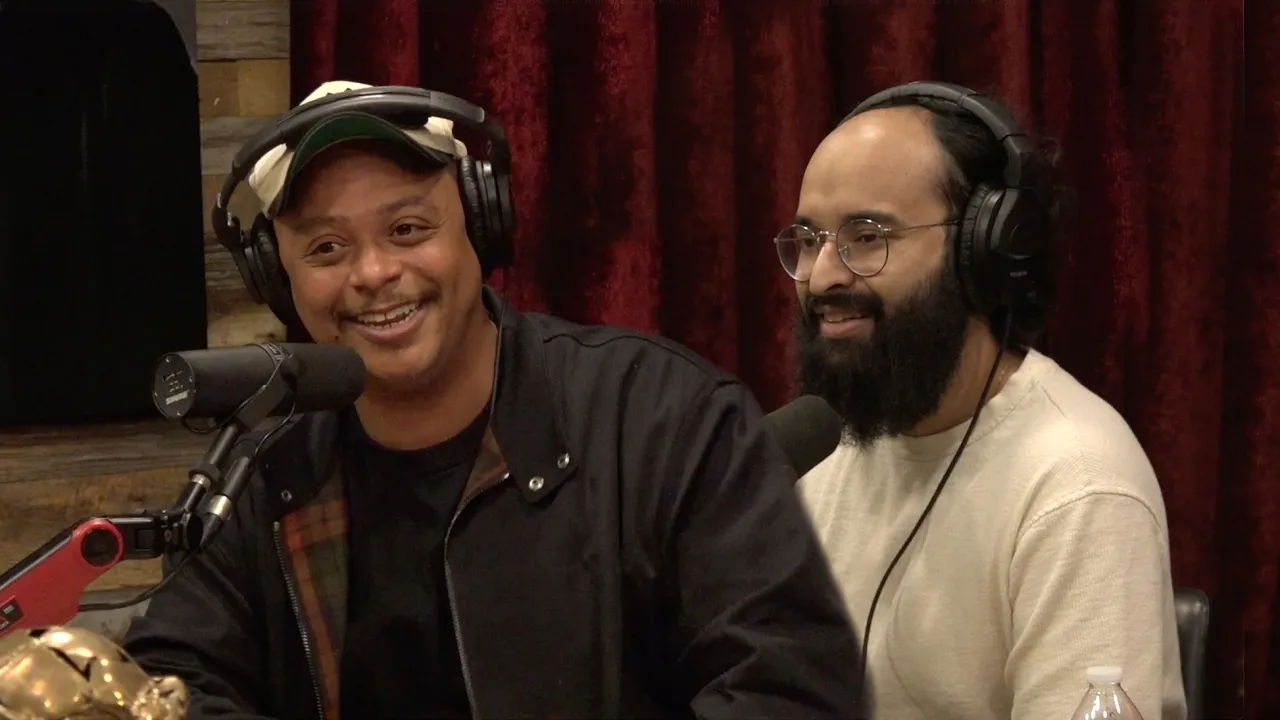
Jensen Huang Returns, GTA VI & Hailey Bieber’s Rhode Rage - Rabbit Hole #7
Chris Williamson
6,403 views • yesterday Save 107 min 5 min read
Video Summary
The discussion explores the profound impact of "sliding door" moments—small, arbitrary events that drastically alter the course of history and personal lives. From the near-assassination of Margaret Thatcher to the critical timing of Donald Trump’s survival, the participants analyze how fragile reality is and how one slight shift could have rewritten global politics. They also examine the "great man" theory through the lens of NVIDIA’s Jensen Huang, debating whether individual leaders are truly indispensable or if they are merely products of their environment.
Beyond history, the conversation dissects the cultural divide between the UK and the US, contrasting British cynicism with American "optimistic delusion." The group argues that this American audacity, while sometimes bordering on toxic, acts as a competitive advantage in innovation. They conclude by reflecting on the power of storytelling, the rise of AI, and the unsettling possibility that we are all living in a simulated reality, questioning whether our lives are defined by agency or by the code of a higher architect.
Short Highlights
- Sliding door moments are small, delicate events that can fundamentally change the trajectory of history or personal life.
- The "great man" theory remains a central tension in tech, with debates on whether leaders like Jensen Huang are irreplaceable or replaceable assets.
- British culture is often defined by cynicism, while American culture thrives on "optimistic delusion," which serves as a significant competitive advantage.
- AI doomerism is often viewed as a social signaling mechanism for intelligence rather than a purely rational assessment of existential risk.
- The simulation hypothesis suggests that if advanced civilizations inevitably create ancestor simulations, we are statistically likely to be living in one.
- Media dramatizations, such as biopics, can unfairly shape public perception and create lasting, inaccurate narratives about real people.
- True grit is relative to one's generation, and modern complaints about difficulty often ignore the historical ease of current living standards.
Related Video Summary
Key Details
Sliding Door Moments [00:15:35]
- The concept of "sliding doors" refers to small, arbitrary moments that change the course of history or personal life.
- A significant historical example is the 1984 IRA bombing of the Grand Hotel; if Margaret Thatcher had been in the bathroom just a few seconds earlier or later, the UK's response to Ireland might have been a ground force invasion.
- The near-assassination of Donald Trump is cited as a modern sliding door moment that could have pushed American politics toward extreme authoritarianism.
If she would have been in the bathroom, so she had a slightly more fiber that day or slightly, just a slight tweak. We would have probably gone ground force invasion into Ireland because it would have killed our prime minister.
The Great Man Theory [00:27:08]
- The panel debates whether the success of NVIDIA is entirely dependent on Jensen Huang or if the company would thrive regardless.
- There is a clear conflict between media discourse, which often rejects the "great man" theory, and the tech industry, which embraces it as a necessity for national security.
- The discussion highlights the danger of losing technological edges to rivals like China, emphasizing the importance of individual leadership in maintaining supply chains.
I think that it's too critical a juncture and too critical a technology to slow down even a bit, right? You don't want to lose a lead. You don't want to lose the supply chain.
British Cynicism vs. American Optimism [00:46:12]
- The UK is characterized as having a "vice of cynicism," where success is often met with jealousy rather than curiosity.
- American culture is described as having a "vice of bullshit," but its "optimistic delusion" is a powerful driver for innovation and business success.
- The panel suggests that blending British humility with American audacity would create a more balanced and effective approach to life and work.
If you have a nice car in America, people ask you, what did you do? How did you do that? If you have a nice car in the UK, they wait for you to leave it. And they scratch their key down the side.
AI Doomerism as a Social Signal [01:08:15]
- AI doomerism is analyzed as a potential intelligence signal in Silicon Valley, where adopting extreme existential risk positions acts as a social club membership.
- The panelists express skepticism toward the "doomer" narrative, noting that many of the core assumptions—such as rapid, uncontrollable AI takeoff—lack concrete evidence.
- The debate highlights the tension between those who see AI as a god-like threat and those who view it as a manageable, albeit powerful, tool.
Because it's an intelligence signal. Because the smartest people in Silicon Valley to peacock their own intelligence have to make it seem like they take this risk which only smart people can actually see.
The Simulation Hypothesis [01:21:40]
- The simulation hypothesis is framed as a logical inevitability: if we can eventually simulate consciousness, we likely already are in one.
- The "pixel size" of the universe, or the Planck length, is discussed as a potential physical limitation that could mirror the resolution constraints of a simulated world.
- The panel notes that simulation theory is essentially a secular version of religious belief, replacing God with a programmer.
It's the smallest distance that that can be. How did they discover that? I assume it's named after Max Planck, if I had to guess. No, it is sometimes described as the pixel size of the universe.