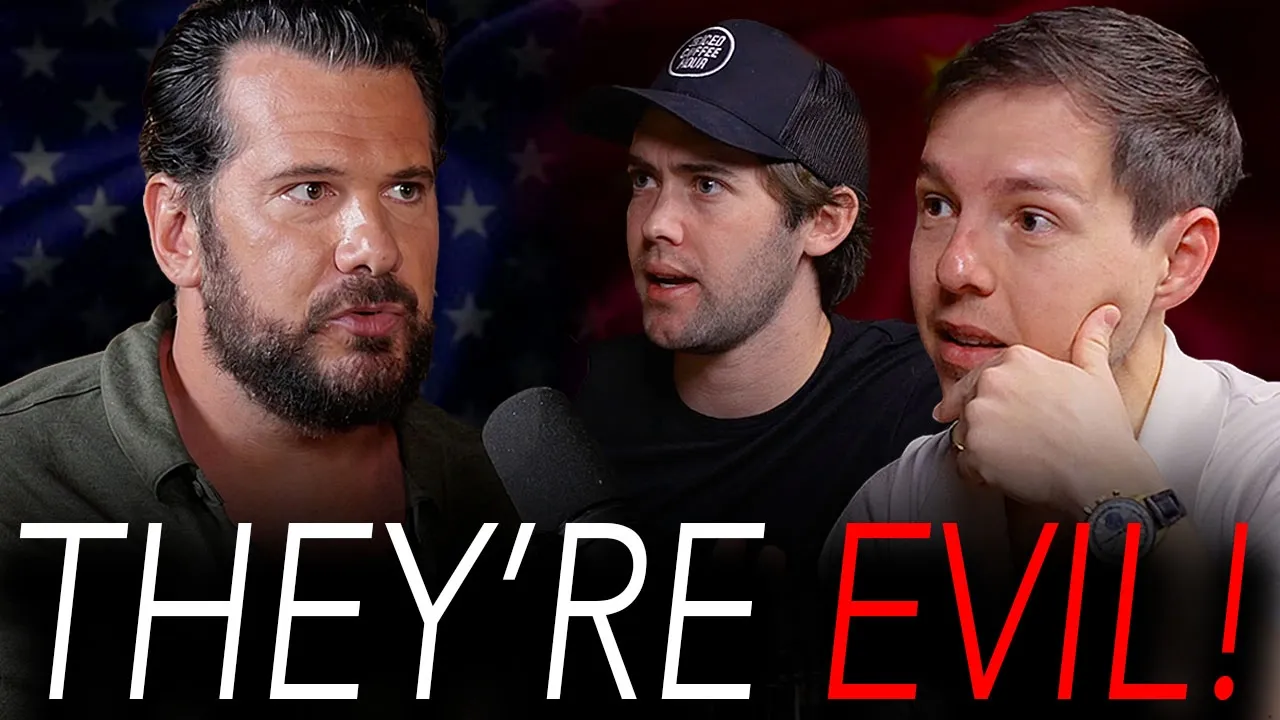
“I Got Banned For Saying This!” Steven Crowder Reveals Who’s REALLY Running The US Economy
The Iced Coffee Hour
7 views • 22 hours ago Save 141 min 18 min read
Video Summary
Steven Crowder, a conservative commentator, shares his views on political discourse, media bias, and personal experiences in an interview. He argues that the left has no fundamentally right ideas that the right should acknowledge and criticizes the media's role in shaping narratives, citing examples like the Journal List and the Anthony Weiner scandal. Crowder also discusses his own career trajectory, including his time at Fox News and his decision to become independent, emphasizing the importance of authenticity and avoiding beholden relationships for financial support.
Crowder delves into the challenges of changing minds, differentiating between those open to persuasion and those entrenched in propaganda. He reflects on his "Change My Mind" series, noting how his own views have become more radicalized through these interactions. The conversation touches on the politicization of issues, the influence of Marxism on leftist thought, and the perceived lack of good ideas from the left. He also shares insights on the business side of media, the profitability of various political stances, and the impact of foreign influence on narratives.
Short Highlights
- Steven Crowder asserts that the left offers no fundamentally correct ideas that the right should acknowledge.
- He criticizes media outlets for controlling narratives and pushing agendas, citing examples of coordinated talking points.
- Crowder explains his "Change My Mind" series, distinguishing between individuals whose minds can be changed and those who are purveyors of propaganda.
- He reflects on his career, including his departure from Fox News and his commitment to financial independence from external pressures.
- Crowder argues that leftist ideology is rooted in Marxism, viewing issues through an oppressor/oppressed lens.
- He discusses the challenges of building a media career outside of traditional, often left-leaning, structures.
- Crowder believes that meaningful relationships require shared political beliefs, though casual relationships may differ.
Key Details
The "Ice Coffee Hour" Name Origin [00:01:05]
- The podcast's name, "Ice Coffee Hour," was a viewer suggestion that stuck, despite the hosts not always having ice coffee.
- The name was adopted seven years ago, and changing it now is impractical due to its established brand.
"So people think that the name means something. It hardly means anything. And it was just our viewers said, hey, we kind of like this. It's kind of got a ring to it. We signed up for it and we can't change it now because it's been like seven years."
The "Change My Mind" Series and Mind-Changing [00:02:25]
- Crowder's "Change My Mind" series involved setting up a sign on college campuses for political and philosophical discussions.
- He categorizes people into two groups: default liberals whose minds can be changed through Socratic methods, and propagandists whose minds are unlikely to change.
"There are two kinds of separate groups of people. This was the book treatment that I wrote. There are those who are default liberal. Less so today. But back in the day when we were raised, right, it was rock against Bush, uh, you know, a symbol on all the Republicans."
Identifying Political Stances and Approach [00:06:10]
- Crowder identifies "dead giveaways" for political leanings, such as nose rings and blue hair, which he associates with not liking someone.
- He uses intensity matching from jujitsu as a metaphor for gauging how to approach a debate, matching the other person's energy.
"You come a switch with me, I'm going to be switch with you. You come a spicy. I'm going to be spicy. Meaning he matches intensity."
Affirmative Action and Soft Prejudice [00:10:15]
- Crowder recounts a "Change My Mind" encounter where a student benefiting from affirmative action expressed doubt about her own merit.
- He describes this as the "prejudice of soft expectations," where policies intended to help can create self-doubt.
"And I said, well, like, what were your SAT scores or something like that? GPA X. And they were stellar. And I said, well, that's, that's really sad to me."
The Left's Worldview and Marxism [00:20:00]
- Crowder asserts that the core of the left's worldview is Marxism, which he believes views everything through the lens of oppressor versus oppressed.
- He argues this framework leads to judging individuals based on success, wealth, or group identity rather than character.
"They view every single individual issue through the lens of oppressor, oppressed. An oppressor is just the byproduct of success, of whatever gains you've made."
Media Control and Narrative Shaping [00:34:00]
- Crowder discusses how media companies control narratives, citing the "Journal List" from the Obama administration as an example of journalists receiving talking points.
- He contrasts this with Fox News, which he saw as an exception, and criticizes the media's stranglehold on information.
"Andrew Breitbart has sort of highlighted that. So ABC, NBC, CBS, MSNBC, CNN, they're kind of all one and the same."
Andrew Breitbart's Influence and Media Scandals [00:37:00]
- Crowder credits Andrew Breitbart for influencing his early career and introducing him to "Big Hollywood."
- He recounts the Shirley Sherrod incident and the Anthony Weiner scandal, highlighting how media outlets can shape public perception and destroy reputations.
"Andrew Breitbart was there. People will tell you, they said, Andrew Breitbart's in the building, yelled it out. And he took that podium."
The "Conference Call" of Media Control [00:44:00]
- Crowder argues that media control isn't a vast conspiracy but a "conference call" of about ten people making business decisions to preserve a narrative.
- He uses the de-platforming of Alex Jones as an example of coordinated action.
"That's not a conspiracy. That's a business decision that makes sense for people to preserve a narrative."
The Business of "Louder with Crowder" [01:06:00]
- Crowder's primary revenue comes from subscriptions to "Mug Club," with sponsorships making up a smaller portion.
- He created his own supplement company to offer trusted products, as a "screw you" to the supplement industry's often misleading practices.
"We sell two things. We sell multivitamin and we sell creatine because it's the most proven supplement. And that's effectively like a de facto subscription, but it's the best multivitamin on the planet."
The Daily Wire Offer and Contractual Issues [01:15:00]
- Crowder declined a $50 million offer from The Daily Wire over four years due to unfavorable contract terms, including penalties for platform suspensions and the ownership of his name, image, and likeness.
- He emphasizes that the offer was not just for him but for his entire operation, including employees and production costs.
"And, uh, there were a lot of reasons. I don't, I don't want young people to sign that. You shouldn't sign away your name, image, and likeness."
Perceived Intelligence of Political Figures [01:22:00]
- Crowder assesses various political figures' intelligence, calling Kamala Harris and Joe Biden unintelligent, while crediting Barack Obama and Donald Trump with intelligence, though he questions Obama's perceived brilliance and Trump's decision-making.
- He distinguishes between intelligence and wisdom, noting that some intelligent individuals lack the latter, citing Dan Crenshaw's perceived lack of self-awareness.
"Kamala Harris, I think, I think she's a fundamentally unintelligent person. Um, and I don't say that about everyone on the left, by the way."
The Importance of the First and Second Amendments [01:30:00]
- Crowder emphasizes the foundational importance of the First Amendment (free speech) and the Second Amendment (right to bear arms) for defending ideas.
- He argues for the expansion of digital rights to protect against censorship and the elimination of voices in the digital space.
"Because the First Amendment is how all great ideas take hold, are discussed, are pressure-tested, and the Second Amendment is how they're defended."
Section 230 and Platform Neutrality [01:32:00]
- Crowder explains Section 230, which provides safe harbor for platforms acting as neutral conduits rather than publishers.
- He criticizes platforms like YouTube for enforcing speech codes and promoting certain content, effectively acting as publishers while claiming neutrality.
"The problem is when they start editing. The problem is when they enforce speech codes, where they are acting as a publisher."
YouTube Demonetization and Censorship [01:36:00]
- Crowder recounts being demonetized by YouTube for borderline content, including using terms like "gay Mexican" and criticizing socialist economies.
- He notes the creation of new guidelines to penalize content that might not technically violate existing rules but is deemed undesirable by the platform.
"So that was the Vox Apocalypse, and their stock took a nosedive as a result, because it resulted in demonetizing a bunch of history channels as well."
The Cost of Not Being "PC" [01:41:00]
- Crowder estimates losing "many tens of millions of dollars" due to not adhering to political correctness and being demonetized or removed from platforms like YouTube.
- He states this loss is worth it for the ability to speak truthfully.
"So when we were on YouTube, like we had months that were 60, 80 million plays on YouTube. This is pre-shorts. Um, now zero monetization, none."
The Problem of "Money in Politics" [01:44:00]
- Crowder dismisses "money in politics" as a solvable issue, arguing that both the left and right benefit from it and use it as a campaign platform without genuine intent to change it.
- He cites examples of high spending in political races and the lack of genuine reform.
"People are like, you have to overturn Citizens United, which a lot of people don't even know what that was."
Generational Hardships and Economic Disparities [01:46:00]
- Crowder acknowledges that younger generations face unique economic challenges, particularly with the rising costs of housing, education, and healthcare, which he attributes to government intervention.
- He contrasts this with the conveniences and lower costs of consumer goods, arguing that government policy has negatively impacted essential sectors.
"Schooling, you can directly attribute it to the federal government and all of these grants and these scholarships, right? Because if you don't overcharge for education right now, basically forcing someone to take out a lot, you're leaving money on the table."
Immigration's Impact on the Economy [01:53:00]
- Crowder links the cost of living crisis for young Americans partly to immigration, suggesting that the inflow of labor, particularly undocumented, drives down wages and strains social services.
- He praises the current administration's efforts to curb illegal immigration, viewing it as a significant step, despite its imperfections.
"And stopping the mass importation of third world labor, often people who are off the books who don't pay taxes and cost the taxpayer anywhere from $100 billion to $400-plus billion a year."
Celebrity Political Stances and Hollywood's Influence [02:03:00]
- Crowder attributes celebrities' strong political stances to a combination of fundamental unintelligence, industry incentives, and a lack of genuine faith or understanding of business.
- He notes that historically, aligning with the left benefited careers in Hollywood, while conservatism was often penalized.
"Many of them are fundamentally unintelligent. They're insulated. They're out of touch. Then you look at the entertainment industry. For the longest time, it was only a net benefit to come out as a leftist."
The Role of Culture and Celebrity Influence [02:07:00]
- Crowder believes that culture, particularly pop culture, is the United States' biggest export and that people's political beliefs are often determined by celebrities due to this cultural influence.
- He advises individuals to form their own opinions rather than blindly following celebrity endorsements.
"Because everything is downstream from culture. And so that's our biggest export in the United States. It's not iron ore. It's not oil. It's pop culture."
Personal Beliefs and Conservatism's Roots [02:12:00]
- Crowder shares two formative experiences that led him to conservatism: a communist drama teacher's flawed ideas about returning land to Native Americans and a flawed nuclear disarmament argument.
- He also mentions learning about taxes from his father as a logical basis for his fiscal conservatism.
"And I said, this is the stupidest thing I've ever heard in my life. That made me conservative."
The Nature of Political Corruption [02:23:00]
- Crowder defines political corruption as promising constituencies ill-gotten gains at the cost of others, essentially robbing Peter to pay Paul.
- He argues that this practice, while immoral and illegal in other contexts, is normalized in politics to secure a voter base.
"I think that is the definition of political corruption. I'm going to take from him to give to you."
Tax Rates and the Flat Tax Proposal [02:24:00]
- Crowder discusses Hauser's Law, suggesting that total tax revenue remains relatively consistent between 16-21% regardless of tax rates.
- He expresses support for a flat tax, believing it would be fairer and simpler, though acknowledges it's unlikely due to political incentives.
"Morally, I would say 10%, but that's a conversation for another day."
Tier List of Media Personalities [02:27:00]
- Crowder ranks various media figures based on their effectiveness in their chosen endeavors, placing Joe Rogan and Charlie Kirk in S tier.
- He assigns low tiers to figures like AOC and Bill Maher, while acknowledging the effectiveness of some, like Candace Owens, in building markets.
"Joe Rogan would be S list because he was a pioneer. I remember watching, oh, sorry, I'm doing it. I'm reaching across here."
The Nature of Steven Crowder's On-Camera Persona [02:45:00]
- Crowder states that his on-camera persona is an amplified version of himself, turned up to an "11," and that his close relationships within his company foster a culture of hard-hitting comedy.
- He believes misconceptions about him stem from disgruntled former employees rather than his true nature.
"The people who I'm closest with are the people I give the hardest time and vice versa."
Personal Criticisms and Intensity [02:47:00]
- Crowder acknowledges that a fair criticism of himself is being too intense and "tightly wound," a trait he attributes partly to his stressful upbringing.
- He found an outlet for this intensity in jujitsu.
"Why are you so tightly wound? I don't know. Maybe because I don't see the sun for six months out of the year."
Difficulty of Dating with Different Political Beliefs [02:50:00]
- Crowder believes that for a meaningful, long-term relationship or marriage, shared political beliefs are essential, though casual relationships might differ.
- He cites James Carville as a rare exception, attributing it to his political approach being a "game."
"If you mean to have a casual relationship? Sure. I mean, you could be with a fat chick and do that. If you're talking about meaningful relationship? No."
Views on Traditional Marriage and Family Roles [02:51:00]
- Crowder advocates for traditional gender roles, believing men should be the "head of the household" and women should "submit in all things."
- He favors single-income households with a mother focused on childcare over dual-income households with children in daycare.
"I think that single-income households with the people who have been a mom taking care of the children as opposed to paying a caretaker."
Lessons Learned from Divorce and the Legal System [02:53:00]
- Crowder learned about the legal system's biases, particularly in custody cases, and the importance of prenuptial agreements.
- He emphasizes that his children's well-being and respect for both parents are paramount, despite public perception.
"I definitely learned a lot about the, about the system and how it exists. And so, uh, not losing, you know, giving up primary custody to another party. That's very rare for a man."
The Value of Prenuptial Agreements [02:55:00]
- Crowder strongly advocates for prenuptial agreements, likening them to a "seatbelt" for marriage.
- He argues that the legal system incentivizes women to break marriage contracts and that prenups protect against financial exploitation.
"I think people should have prenups. Yeah. I think people should absolutely have prenups."
Rapid Fire Questions: Political Beliefs and America's Future [02:58:00]
- Crowder's views on international trade have changed due to perceived unfairness.
- He admits to considering stepping away from politics frequently and finds covering it "soul-sucking" but ultimately optimistic about America's future.
- He identifies Donald Trump as the best president of his lifetime and Barack Obama as the worst due to "corrosive policy."
"Optimistic or pessimistic about America in 10 years? Optimistic."
Advice for Young People: Meaning and Self-Esteem [03:01:00]
- Crowder advises young people to find meaning and purpose by excelling at something they have an aptitude for, building self-esteem through mastery and service to others.
- He stresses the importance of developing skills to make a living and contribute to society.
"Find something that you maybe have an aptitude for. Get really good at it. Get excellent at something."
Hypothetical Questions for Public Figures [03:03:00]
- Crowder poses questions to public figures: to AOC about her authenticity, to Tucker Carlson about his "flip," to Ben Shapiro about a missed debate, and to Hillary Clinton about alleged killings.
- He also asks Elon Musk about his "blood bag" usage and Nick Fuentes about bridging divides.
"Hillary Clinton. What'd you kill that guy? Why is the question? Yeah."
The "Ice Coffee Hour" Hosts' Dynamic [03:06:00]
- The hosts, Graham and Jack, describe their relationship as loyal, with internal criticisms that outsiders might perceive as serious conflict.
- They emphasize their comfort and camaraderie, even sharing hotel rooms to save money.
"But if someone else comes in, you're going to defend your bully and you're going to defend your guy."
Graham's Priorities and Career Focus [03:09:00]
- Crowder suggests Graham, one of the hosts, should focus on his career for a few more years before prioritizing dating, believing success will make him more attractive.
- He argues that priorities shift significantly by age 30, leading to a clearer understanding of what one wants.
"He's going to be more attractive to a woman because he'll be wealthier and more successful."
The "Vulture Companies" and Early Stage Socialism [03:14:00]
- Crowder criticizes "vulture companies" that prioritize profit over consumer value, leading to a loss of service and a form of "early stage socialism" where losses are absorbed by a larger entity.
- He contrasts this with the traditional free enterprise model of serving the consumer.
"The problem is you'll see a lot of these vultures, these vulture companies come in and just go, you know what? We'll take a loss on this one and it'll become part of a portfolio."
Individual Actions vs. Systemic Issues [03:17:00]
- Crowder advises individuals to spend less than they earn, consider trade schools or community colleges, and make sacrifices to improve their lives.
- He acknowledges that systemic issues, like the high cost of housing and education exacerbated by government policy, create significant challenges.
"Spend less than you make. Go to a trade school. If you don't know what you wanna do, go to a community college, make some sacrifices now."
The Problem with "Useless" College Degrees [03:19:00]
- Crowder criticizes the government's role in inflating college costs through loans, particularly for degrees he deems "useless," like gender studies.
- He believes this policy exacerbates the affordability crisis for essential needs like housing and healthcare.
"Schooling, you can directly attribute it to the federal government and all of these grants and these scholarships, right? Because if you don't overcharge for education right now, basically forcing someone to take out a lot, you're leaving money on the table."
Immigration and its Economic Impact [03:21:00]
- Crowder argues that a significant number of illegal immigrants negatively impact the economy by driving down wages, taking jobs, and utilizing social safety nets.
- He credits the current administration with reducing illegal immigration, calling it a "multi-pronged approach."
"And stopping the mass importation of third world labor, often people who are off the books who don't pay taxes and cost the taxpayer anywhere from $100 billion to $400-plus billion a year."
The "Jew Contract" Misconception [01:17:00]
- Crowder clarifies that the Daily Wire contract issues were not related to religious affiliation but to unethical business practices and penalties tied to big tech censorship.
- He emphasizes that the core objections were the ownership of name, image, and likeness and the penalties for platform suspensions.
"And people have a way of doing business. In my view, it's unethical to do that. It's not standard."
Celebrity Authenticity and Motivations [02:05:00]
- Crowder suggests celebrities' political activism stems from a combination of genuine passion, industry incentives, and a "godless" worldview, leading to a "blue job" mentality for career advancement.
- He contrasts this with business owners who understand the value of hard work and genuine exchange.
"It's the same thing as like the blue job. Yeah. No, exactly right. It only helps your career."
The "Court of Public Opinion" vs. Actual Court Records [02:54:00]
- Crowder highlights the disparity between public perception and court findings regarding his divorce, stating that court records show no infidelity on his part.
- He emphasizes the importance of his children's well-being and their relationship with both parents.
"It says a matter of record, uh, in court, never cheated, never. Uh, but you have people who believe that, you know, it's like a lifetime movie."