“TYPICAL LIBTARD!” Trump 007 Escape, Greta PRAISES Piers Morgan + Mao Debate w/ Victor Davis-Hanson
Piers Morgan Uncensored
289,812 views • 1 month ago Save 81 min 9 min read
Video Summary
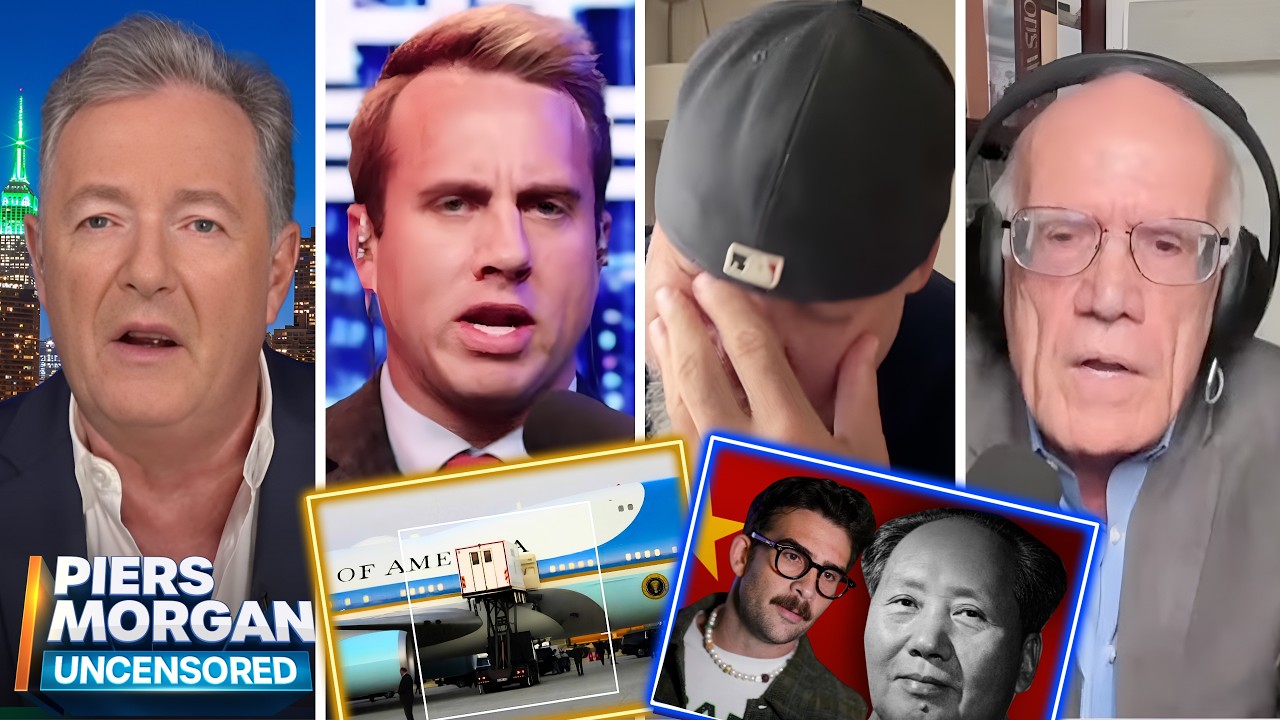
The discussion centers on the controversial extraction of Donald Trump from Air Force One due to an alleged Iranian assassination plot, raising questions about the safety of the press and staff left behind. Panelists debate the unprecedented nature of the maneuver, the media's role, and the political motivations behind the narrative.
Further, the conversation shifts to the rise of democratic socialism in the U.S., with differing views on whether it's a genuine grassroots movement or an elite-driven agenda. The debate touches on economic anxieties, housing affordability, student debt, and the appeal of charismatic socialist figures to younger voters. Finally, the panel tackles the contentious issue of transgender athletes in women's sports, with strong opinions on fairness, biology, and the weaponization of culture wars.
Short Highlights
- Donald Trump's alleged secret departure from Air Force One to evade an Iranian assassination plot.
- Debate over whether the media and staff were intentionally left in danger.
- The rise of democratic socialism among young Americans and its political implications.
- Concerns about economic inequality, housing affordability, and student debt fueling socialist appeal.
- The contentious issue of transgender athletes competing in women's sports.
- Arguments for and against the fairness of trans athletes in women's sports based on biology and advantage.
- Discussion on the legacy and historical assessment of Mao Zedong.
Key Details
Trump's Secret Air Force One Exit [00:00:00]
- Reports suggest Donald Trump slipped out of Air Force One via a catering container to secretly leave the G8 summit.
- This maneuver followed intelligence of an Iranian plot to attack the president's plane.
- The decoy strategy involved switching to an older Air Force One, leaving traveling press and some staff unaware of the direct threat.
"Donald Trump has confirmed extraordinary reports that he slipped out of Air Force One in a hydraulic catering container before secretly leaving the G8 summit in Turkey on a small military plane."
Media Left in Danger? [00:00:00]
- Panelists question the ethics of leaving journalists and staff on a plane potentially targeted by Iran.
- The Secret Service's priority is the President's safety, but the decoy plan's execution is debated.
- Some argue that informing the media would have compromised the decoy operation.
"And while many people assume this means that 007 will now be played by Elliot Page or Joy Reid, there is at least an outside chance they're taking inspiration from the United States president."
Precedent for Deception [00:00:00]
- Historical instances of presidents using decoy aircraft or secret travel are cited, including Bill Clinton and George W. Bush.
- A key difference highlighted is that in past cases, the media was informed of the deception and asked not to report it in real-time.
- Barbara Starr of CNN described the Trump incident as "completely unprecedented" due to the media's unawareness.
"And in 2023, Joe Biden was also secretly taken to Ukraine with a slimmed-down press pool of one reporter and one photographer."
Political Partisanship in the Debate [00:00:00]
- The discussion is framed as partisan, with accusations of hypocrisy regarding how such events would be treated if they involved Joe Biden.
- Some argue that opposition to Trump is a "religion" that overshadows objective analysis.
- The validity of intelligence and the motivations behind Trump's actions are questioned.
"This is the bipartisan BS, where you have JoJo taking this left wing. Yeah, she has this left wing, you know, oh, this is bad because Trump's bad."
The Rise of Democratic Socialism [00:00:00]
- The panel discusses the growing influence of democratic socialists in American politics, particularly among younger voters.
- Figures like Francesca Hong and Abdul El-Sayed are mentioned as examples of candidates gaining traction.
- The core question is whether this movement represents a viable general election strategy for Democrats.
"And while many of you were selfishly stealing her dreams, it turns out that I was making them come true."
Economic Grievances Fueling Socialism [00:00:00]
- Arguments are made that economic factors like stagnant wages, unaffordable housing, and massive student debt are driving young people towards socialist ideas.
- The perception that the current capitalist system is failing is a key theme.
- Concerns about wealth inequality and the hoarding of wealth by a select few are raised.
"But the economy's not working for younger millennials and down. And you cannot refute the way that young people feel."
Elite vs. Grassroots Socialism [00:00:00]
- Victor Davis Hanson argues that the current socialist movement is largely "top-down," driven by affluent, degreed individuals who feel entitled.
- He contends that many socialist candidates come from wealthy backgrounds and are not representative of a true grassroots movement.
- The historical success of socialist revolutions is questioned, with claims that they often originated from educated elites.
"And so what we're seeing at least as the leadership in this one category which is about half of the movement are people who are from the middle and upper middle class who got degrees but they're not marketable degrees."
Mao Zedong: A Controversial Figure [00:00:00]
- Hassan Piker's comments about Mao Zedong being "one of the great leaders of this world" spark debate.
- Victor Davis Hanson labels Mao as the "greatest mass murderer in history," responsible for tens of millions of deaths.
- Professor Mobo Gao defends Mao, calling the "butcher" label a "cliche" and arguing for his role in founding modern China.
"Mao Zedong, one of the great leaders of this world."
Historical Revisionism and Famine Tolls [00:00:00]
- The discussion delves into the Great Leap Forward and the famine it caused, with differing estimates of the death toll.
- Professor Gao suggests the numbers are controversial and potentially inflated by anti-communist sentiment.
- Hanson dismisses this, citing the Black Book of Communism and the Chinese government's own eventual rejection of Maoist economic policies.
"The great leap forward you are talking about from 1958 to 1961 was a failure there was a famine I myself admit that in my writings in my talk okay but exactly the number of the famine toll is still very controversial."
Trans Athletes in Women's Sports [00:00:00]
- WNBA player Sophie Cunningham's statement opposing trans women in women's sports ignites a heated debate.
- The core argument revolves around fairness, biology, and whether trans women have an unfair physical advantage.
- The United Nations is cited as identifying nearly a thousand cases where trans athletes may have deprived biological females of medals.
"Do you understand, Jojo, that the vast majority of people left and right in America and around the world actually, but in America the vast majority think it is completely unfair purely from a science stroke biology perspective for trans athletes to compete in women's sport?"
Biology vs. Inclusion in Sports [00:00:00]
- Arguments are made that biological differences between men and women create an inherent unfairness in sports.
- The concept of "protecting women's sports" is central to the anti-trans participation stance.
- Conversely, some argue that focusing on this issue vilifies a marginalized group and distracts from more pressing women's rights issues like abortion access.
"I want to protect young girls in a locker room or young girls in sport who shouldn't have to go against biological men."
The "Race Card" and Double Standards [00:00:00]
- A controversy involving WNBA player Dijoné Carrington, who posted "white privilege" after a foul, is discussed.
- Accusations are made that Carrington played the race card and that it's become socially acceptable to be racist against white people.
- The panel contrasts this with instances of alleged racism by Donald Trump against Somali Americans.
"One of the side effects in America is it's okay to be racist against white people. It's not."
The James Bond Debate [00:00:00]
- The producer of the next James Bond film suggests a "very different creative spin" on the character.
- Panelists debate who should play Bond, with preferences for a return to the character's more traditional, politically incorrect, and morally ambiguous persona.
- Suggestions range from a "white middle-aged British guy" to a woman from Senegal.
"I would like him to go back to what James Bond was supposed to be rather than a weeping crying vulnerable imbecilic creature who isn't allowed to do any of those things."
Elite vs. Working-Class Appeal [00:00:00]
- The argument is made that socialist candidates, despite their rhetoric, often come from privileged backgrounds.
- The appeal of these candidates is seen as stemming from a disconnect between the "1%" and the "99%."
- The rising cost of living, particularly housing, is presented as a major driver of discontent.
"The average age to get a home, do you know what the average age is now in 2026? 41."
Culture Wars and Political Polarization [00:00:00]
- The panel discusses how issues like LGBTQ+ rights and trans participation in sports are used as "culture war" tools to divide the electorate.
- Elijah Schaefer suggests these issues distract from more fundamental economic concerns.
- The polarization of American politics is seen as a significant challenge.
"The establishment does. They introduce the culture war."
The Future of American Politics [00:00:00]
- There's a sense that both major parties are struggling to define their identity and connect with voters.
- The appeal of charismatic outsiders and populist movements on both the left and right is noted.
- The potential for continued political extremism and polarization is a recurring theme.
"And extremism is the only other thing, and extreme polarization will continue forward."
The Role of Media and Social Media [00:00:00]
- The influence of media, both traditional and social, in shaping narratives and amplifying controversies is discussed.
- Accusations are made that media outlets contribute to polarization by taking sides.
- The speed at which information (and misinformation) spreads online is highlighted.
"And the fact that we've allowed it, that American, that American media allows this to happen, to, her statement was, I mean, I'm just straight up, no one's saying it. You're lying."