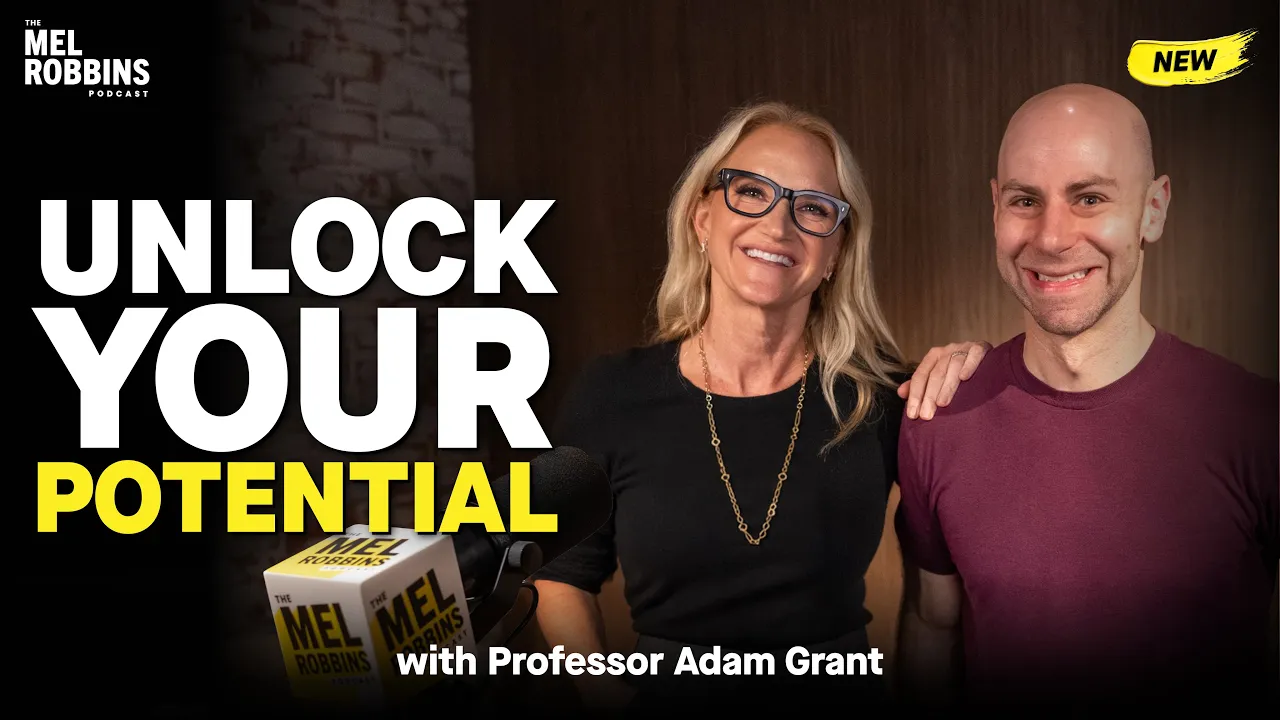
How to Unlock Your Full Potential with #1 Professor Adam Grant
Mel Robbins
189,325 views • 5 days ago Save 66 min 11 min read
Video Summary
Dr. Adam Grant, a professor at the Wharton School of Business, joins Mel Robbins to discuss unlocking hidden potential and becoming more effective in life. Grant emphasizes that negative emotions like disappointment and frustration are valuable data points, signaling that a current approach isn't working and prompting a search for alternative paths. He challenges the notion of being
Short Highlights
- Embrace Negative Emotions as Data: Disappointment, frustration, and regret are not failures but signals to adjust your approach and learn for the future.
- Escape Escalation of Commitment: Avoid doubling down on losing courses of action by setting pre-defined conditions for re-evaluation, utilizing a "challenge network," or employing Solomon's Paradox by advising yourself as if you were advising others.
- Expand Your Options: When overthinking, consider a "third option" or even a ridiculous one to break tunnel vision and foster creative problem-solving.
- Redesign Your Job: Instead of quitting a dissatisfying job, explore opportunities to "craft" or "tinker" with your current role to align it with your passions and values.
- Potential is About Growth, Not Innate Ability: True potential is revealed not by starting ability but by the drive and motivation to learn and improve, as exemplified by world-class achievers who weren't necessarily child prodigies.
- Action Builds Confidence: Confidence doesn't precede action; taking the leap, even when scared, is what builds self-assurance.
- Cultivate "Pebbling" for Stronger Connections: Strengthen relationships by sending small, thoughtful pieces of information (memes, links, articles) that show you remember and care about the other person's interests.
Key Details
The Power of Negative Emotions as Motivation [00:00:00]
- Negative emotions like disappointment, frustration, and regret are not signs of failure but valuable data points.
- These feelings signal that your current approach may not be working and motivate you to find a different path toward your goals.
- Instead of ruminating on past negative emotions, focus on the message they hold for future decisions and actions.
"And those unpleasant feelings that you're describing, those are actually sources of motivation, right?"
Escaping the "Escalation of Commitment" Trap [00:03:00]
- Many people get stuck by becoming too attached to a specific path rather than focusing on the ultimate goal.
- "Escalation of commitment to a losing course of action" occurs when individuals double down on a failing plan due to sunk costs and a desire to prove their initial decision was correct.
- Recognizing early that a path is wrong is more beneficial than continuing to invest time and energy into it, allowing for quicker pivots.
"It's better if we think about this in the career context, for example, Mel, you're stuck in a dead end job. A lot of people don't want to admit that they wasted the last two years. I would say it's much better to recognize quickly that you wasted the last two years than to waste the next 20."
Strategies to Avoid Escalation [00:05:00]
- Pre-commit to conditions: Set specific criteria in advance for when you will re-evaluate a decision or plan.
- Utilize a "Challenge Network": Rely on trusted friends or mentors who can act as a sounding board and identify when you've hit a plateau.
- Leverage "Solomon's Paradox": Give advice to someone else in a similar situation, as you tend to be more objective and wise when advising others than when making your own choices.
"And so I think anytime you're not sure if you're in an escalation situation, you should start giving advice to somebody else who's either in that trap or imagine that you're talking to somebody who is and give them some guidance."
The Pitfall of "Overthinking" vs. "Underthinking" [00:09:00]
- Often, "overthinking" is actually a symptom of "underthinking" because it involves ruminating on the same limited options.
- Research shows that considering only two options is a strong indicator of a potentially poor decision.
- Introducing a "third option," even a ridiculous one, can break the "this or that" cycle, expand thinking, and reveal new dimensions of the original choices.
"And it turns out the clearest leading indicator that you are about to make a dumb decision is you've only considered two options."
Redesigning Your Job, Not Just Quitting [00:12:00]
- Many people facing job dissatisfaction consider only two options: stay or quit.
- A powerful third option is to "craft" or "redesign" your current job by focusing on tasks that align with your passions, values, and skills.
- Studies show that quitting a dissatisfying job doesn't always lead to greater happiness, and transitions can be difficult; innovating within your current role can be a more effective strategy.
"You don't have to choose between keeping your job and quitting your job. You can craft your job. You can try to tinker on the margins and say, what are tasks that I would love to spend more time on that align with my passions and my values and my skills?"
Redefining Potential: Drive Over Ability [00:15:00]
- The biggest mistake in judging potential is focusing too much on current ability and not enough on motivation and opportunity.
- Child prodigies rarely become adult geniuses, suggesting that innate talent at a young age is not the best predictor of long-term achievement.
- World-class achievers often stood out not for extraordinary talent, but for extraordinary drive, a love for the activity, and a consistent desire to practice and improve.
"It turned out that most of these super achievers, they were not the best child in their own neighborhood when they first took on piano lessons or when they started painting or sculpting, or when they picked up a tennis racket."
The "Geode" Metaphor for Potential [00:18:00]
- People often judge themselves and others based on their starting point, failing to see the potential for growth within.
- Like a geode, which appears as a plain rock on the outside but contains sparkling crystals within, individuals have hidden potential.
- The greatest sign of potential is not where you start, but the distance you are capable of traveling.
"And I think people show up in our lives and we show up to new challenges and new tasks and we kind of look like this. A hunk of rock."
Overcoming Fear Through Action [00:22:00]
- A common mistake is waiting to feel confident before taking action, but confidence is built through action.
- Fear of trying new dives (or new things in life) can be overcome by the realization that readiness comes from taking the leap, not the other way around.
- This principle applies to various challenges, from writing a book to public speaking; asking "What are you waiting for?" can be a catalyst for action.
"And Mal, in that moment, I realized that I was waiting until I felt ready to take the leap, but I could only become ready by taking the leap."
The Role of a "Challenge Network" and Feedback [00:26:00]
- Support networks are crucial, but a "challenge network" of thoughtful critics is also essential for seeing blind spots.
- Great coaches, mentors, and partners see more potential in us than we see in ourselves and provide honest feedback.
- Asking for a score (0-10) on performance and then inquiring "How can I improve my score?" is a powerful way to solicit constructive feedback and drive improvement.
"And Eric said to me on the first day of tryouts, I will never cut a diver who wants to be here. Oh, and I will invest as much as you do."
"Pebbling": The Art of Connection [00:30:00]
- "Pebbling" is the modern digital equivalent of penguins presenting pebbles to a mate, signifying care and connection.
- It involves sending thoughtful, personalized pieces of information (memes, links, articles) that resonate with someone, saying "I thought of you."
- Pebbling strengthens existing bonds and is an effective way to reconnect with "dormant ties" – people you've lost touch with.
"Every pebble is a bid for connection. Every single pebble you send to another, another person is a gesture of care."
Dormant Ties: Your Future Friends [00:33:00]
- Your future friends are often the people you used to know but have lost touch with.
- Most dormant ties are not dormant for a good reason; life circumstances often lead to drifting apart.
- Reaching out to reactivate these connections is highly rewarding, with research showing 90% of reconnections are enjoyable and beneficial.
"Your future friends are the people you used to know."
Reconnecting with Dormant Ties [00:35:00]
- Reconnecting with dormant ties is often easier than forming new connections due to shared history, goodwill, and nostalgia.
- Dormant ties can provide better advice and help than current contacts because they have different experiences and perspectives.
- Strategies for reconnection include sending a relevant article, mentioning a shared memory, celebrating milestones, or reaching out as a giver or with gratitude.
"And also, by the way, you get better advice and help from your dormant ties than from your current context."
Allies, Pals, and Companions: Understanding Relationship Vibes [00:39:00]
- A "vibe" is more than just chemistry; it's about synchronized brainwaves and heartbeats, but it's built through routines and rituals.
- Connections can be categorized into three types: Allies (share goals), Pals (share interests), and Companions (share values).
- Misaligned expectations about the type of connection lead to disappointment; understanding these categories helps manage expectations and build more satisfying relationships.
"Allies are people who share your goals. You're on a mission together. Pals are people who share your interests and hobbies. You have fun together. Companions are people who share your values. You care about each other."
The "Milk in a Hardware Store" Analogy [00:43:00]
- Seeking a specific type of connection (e.g., companionship) from someone who primarily functions as a different type of contact (e.g., an ally or pal) is like looking for milk in a hardware store.
- It's not the fault of the "hardware store" (the person) but a mismatch in expectations and needs.
- Accepting people for who they are and what they can offer, without judgment, leads to deeper connections and less frustration.
"And my first reaction was, you're dead to me. How dare you not show up? Like the least you could do is care enough to ask again."
Three Critical Skills for the Future of Work [00:47:00]
- Connecting Dots: In an era of information abundance, synthesizing information and reconciling competing ideas is more valuable than collecting facts.
- Agility: The ability to learn and adapt quickly is crucial in a dynamic world, surpassing mere ability or expertise.
- Human Experience: Understanding people's needs, goals, being a good friend, and asking curious questions are skills that machines cannot easily replicate.
"I think if the past belonged to the fact collectors, the future belongs to the dot connectors."
Inverse Charisma: Making Others Shine [00:50:00]
- "Inverse charisma" is the ability to make others feel more charismatic by asking thoughtful questions and listening attentively.
- This involves shortening your talking time, asking questions that elicit interesting one-to-two-minute answers (e.g., "What surprised you most today?"), and actively listening to spark new thoughts.
- Asking questions that you genuinely can't wait to hear the answer to is key to creating these engaging interactions.
"Inverse charisma starts with asking people a question that you cannot wait to hear their answer to."
Addressing Gender Disparities in the Workplace [00:53:00]
- Women often perform a disproportionate amount of "office housework" – thankless tasks like taking notes or planning parties – which are not valued in performance reviews or promotions.
- Women are penalized more for saying "no" to these tasks due to gender stereotypes, while men are praised for saying "yes" and face no penalty for saying "no."
- To combat this, women need permission to say "no" effectively, often by highlighting their current workload and seeking clarity on strategic priorities.
"And I think that this is a huge problem. It's a big problem because these are tasks that need to be done, but they are not considered strategic."
Navigating the "Likability Penalty" [00:56:00]
- Women often face a "likability penalty" when asserting their ideas, advocating for skills, or asking for promotions.
- This backlash is often due to perceived violations of expectations for kindness and humility, rather than a lack of competence.
- To counteract this, women are advised to assert their ideas while also showing openness to others' views and framing requests in terms of how they will benefit the team or organization.
"But what that means is you have to work extra hard when you assert your ideas to also show openness to other people's views."
The Enduring Message: It's Never Too Late [00:59:00]
- The overarching message is that it is never too late to find hidden potential, reconnect with people, or pursue opportunities.
- We often write ourselves off prematurely, believing we've missed our chance, but windows of opportunity can be opened or even created.
- The key is to look for possibilities, break apart the "rocks" of self-doubt, and build doors when necessary.
"It is never too late to find your hidden potential and unlock it. It is never too late to reach out to somebody that you lost contact with and get back in touch."