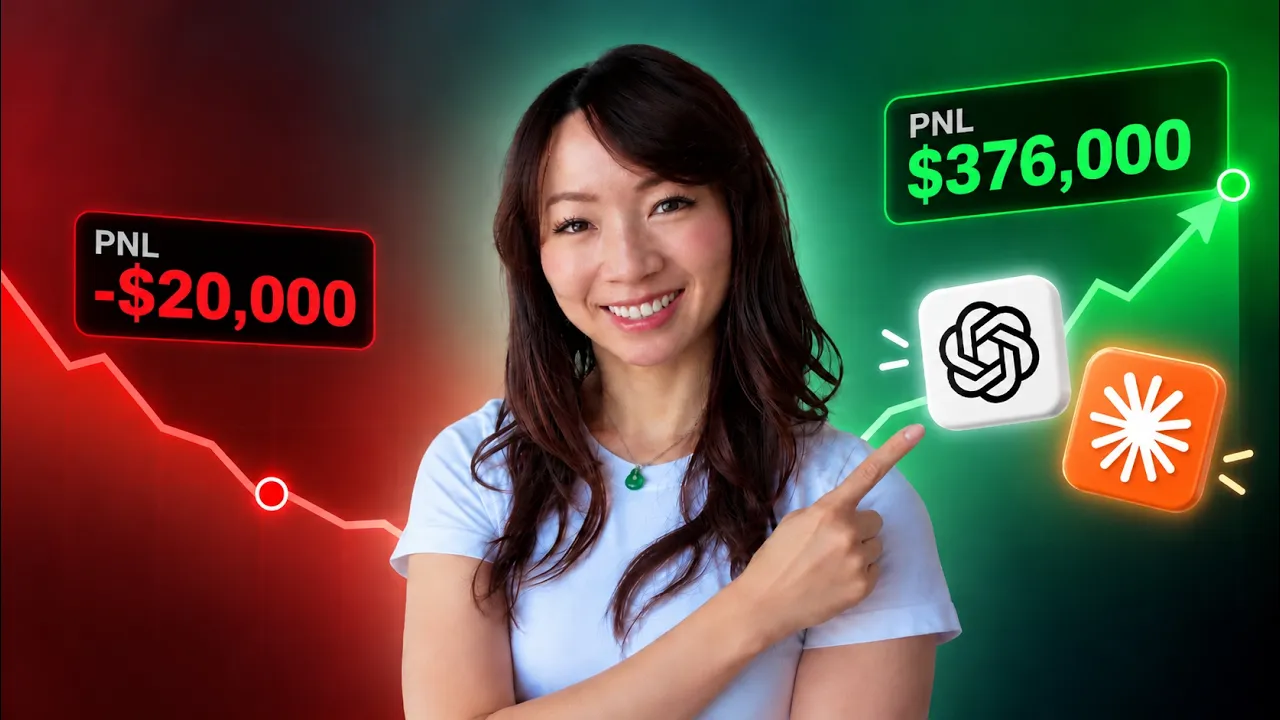
I made $376K in 2026... Here’s how I use AI for Trading
Humbled Trader
538 views • 22 hours ago Save 7 min 5 min read
Video Summary
A trader reveals how AI helped him achieve over $400,000 in verified profits by analyzing his trading data, uncovering behavioral patterns, and identifying his true edge. Instead of asking AI for stock picks, he used tools like Claude to dissect his performance across various metrics such as holding periods, stock selection, and entry/exit patterns. This analysis revealed that his overnight and swing trades were more profitable than day trades, and that short-selling as a swing trade was a losing strategy. The AI also highlighted a strong correlation between high Average Daily Range (ADR) stocks, particularly in semiconductors and memory sectors, and his biggest winners.
The trader emphasizes that AI doesn't create an edge but refines existing ones by focusing on what works. He learned to allocate more capital to high-conviction trades—those with high volatility, liquidity, sector momentum, and fitting specific criteria—which historically had a 72% win rate, compared to only 35% for trades outside these parameters. He advocates for "exponential bet sizing," investing more in "A-plus" setups and less in average ones. Finally, AI tools like TradingView's Co-Pilot and Tengi.io are presented as ways to optimize the trading process, making research faster and surfacing missed information, ultimately enabling traders to work smarter, not just harder.
Short Highlights
- AI analyzes trading data to identify profitable strategies and behaviors, leading to over $400,000 in verified profits.
- Focus on high-conviction trades: AI identified that trades with high volatility, liquidity, and sector momentum had a 72% win rate, compared to 35% for others.
- Optimize risk by "exponential bet sizing": Allocate more capital to "A-plus" setups and less to average ones.
- AI tools like Claude, TradingView Co-Pilot, and Tengi.io streamline research and pre-market planning.
- Key trading insights: Overnight/swing trades outperform day trades; avoid short-selling as swing trades; focus on high ADR stocks in sectors like semiconductors.
Key Details
Finding Your Real Trading Edge with AI [0:00]
- Achieved over $400,000 in verified profits this year using actionable AI-driven strategies.
- AI analyzed trading data to uncover behavioral truths and identify the source of trading edge.
- AI helps narrow down effective strategies, focus stocks, risk sizing, and eliminate time-wasting trades.
"I couldn't have gotten here without these three actionable tips and strategies that I'm about to share with you today."
Building a Sophisticated P&L Dashboard [0:51]
- Use broker CSV files to build a P&L dashboard with AI tools like Claude or Codex.
- Analyze performance across holding period (day, overnight, swing), stock selection, winners vs. losers, and entry/exit patterns.
- AI identified that overnight and swing trades performed better than day trades, and same-day short trades outperformed swing shorts.
"By the way, if you want to do this yourself, you can just copy this exact prompt on my blog."
Identifying High-Performance Stocks and Sectors [2:12]
- Strongest results came from high Average Daily Range (ADR) stocks with strong liquidity, typically above 4% ADR.
- Semiconductors, memory stocks, and storage-related names showed the biggest winners (e.g., SanDisk, MU).
- The key lesson is to focus on a few working strategies rather than seeking more strategies or trades.
"So that's where Claude told me that pretty much I lose money or break even at best on everything outside of the momentum sectors this year."
Knowing When to Increase Risk [3:30]
- Analyze trading data to discover that nearly the same capital was allocated to best and worst trades.
- Strongest trades often involved semiconductors and memory stocks (MU, SMDK, CHOR) with high volatility, liquidity, and sector momentum.
- Leveraged ETFs like BetaPro's can offer amplified exposure for short-term trading in high-momentum sectors, but require understanding risks.
"My analysis showed that I was using almost the same amount of position size on winning and losing trades."
Optimizing the Trading Process with AI Tools [7:27]
- Utilize AI tools to optimize trading strategies and processes, saving time and reducing repetitive work.
- Tools like TradingView's Co-Pilot can screen stocks based on preferred conditions and analyze charts.
- Tengi.io is a trading research tool for organizing swing trade ideas and surfacing market signals.
"The idea here isn't to ask AI, oh, what stock should I buy today?"
The Power of Exponential Bet Sizing [5:21]
- AI-identified "focus group" trades had a 72% historical winning rate, while "avoid group" trades had only 35%.
- Maximize opportunities on "A-plus" setups by sizing in more, and trade smaller on average setups.
- The best setups don't appear every day; smart trading involves waiting for the right opportunities.
"AI cannot predict that for you, right? It's up for you as a trader to execute on those strategies."
AI as a Support, Not a Decision-Maker [8:26]
- AI trading tools should support, not make, trading decisions.
- Traders must validate information, understand setups, and manage risk independently.
- AI helps trade smarter, not necessarily harder, by optimizing the process and surfacing information.
"AI will not magically make you profitable, but it can help you trade smarter instead of simply trading harder."