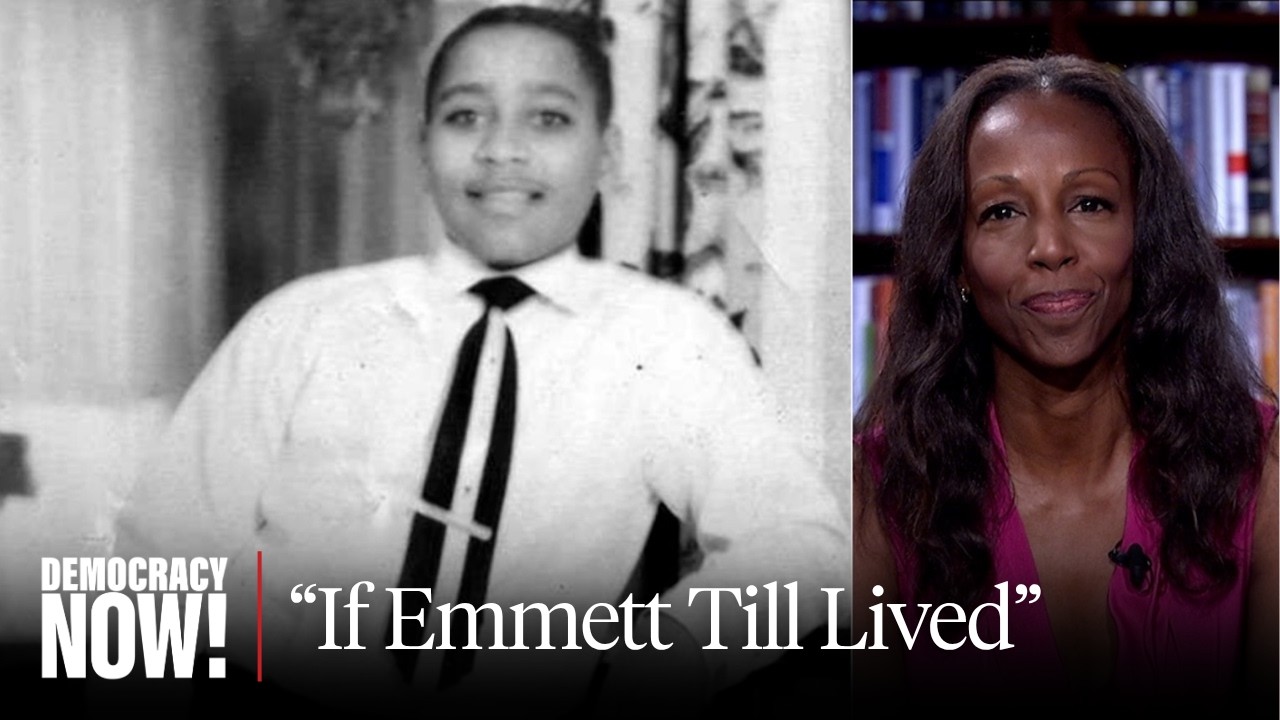
"If Emmett Till Lived": Cultural Historian Sarah Lewis on New Book/Exhibit, Visit to Mississippi
Democracy Now!
9,577 views • 1 month ago Save 43 min 6 min read
Video Summary
What if Emmett Till had lived to turn 85? A new exhibition and book, If Emmett Till Lived, confronts the haunting void left by the 14-year-old’s 1955 lynching by inviting visitors to imagine the life he was denied. Curated by Sarah Elizabeth Lewis alongside Till’s cousin and last living witness, Reverend Wheeler Parker Jr., the project uses a collection of photographs to create a "creative monument" to his unlived potential. By mapping out the milestones of a life that never happened—from family moments to civil rights activism—the exhibit challenges the public to reckon with the ongoing struggle for freedom on American ground.
The project arrives as cultural institutions face mounting pressure from anti-DEI initiatives that seek to censor historical reckonings with racism. By centering Till’s humanity rather than just his murder, the exhibition serves as an arena for truth and reconciliation. The effort includes the transformation of the Mississippi barn where Till was tortured into a public memorial, a site previously held in private hands, symbolizing a broader, urgent push to secure the history of American democracy against erasure.
Short Highlights
- The exhibition 'If Emmett Till Lived' opens September 10th at the Museum of Contemporary Photography in Chicago.
- The project features approximately 70 photographs curated to represent the nearly 70 years since Till’s murder.
- The barn where Till was tortured has been moved from private ownership to public trust for transformation into a memorial.
- President Biden announced a tri-site national monument honoring Mamie Till Mobley and Emmett Till in 2023.
- Illinois Governor J.B. Pritzker declared July 25th, Till's birthday, as Emmett Till Day.
- The exhibition serves as a "creative monument" to Till’s unlived life, using proxy imagery to invite viewers to contemplate his lost future.
- The project highlights the necessity of cultural witnessing, echoing Mamie Till Mobley’s original decision to hold an open-casket funeral.
- Reverend Wheeler Parker Jr. collaborated on the curation, providing a direct link to the events of 1955.
Related Video Summary
Key Details
The Premise of Unlived Life [0:00]
- The exhibit asks what American life would require of us if Emmett Till had survived his 1955 kidnapping and returned home to Chicago.
- Curator Sarah Elizabeth Lewis frames the project as a "creative monument" to the decades denied to him.
What if Emmett Till lived? What if he had returned home still a child alive and free? What would that life have required of us all?
The Murder and the Witness [1:30]
- Till was kidnapped, tortured, and lynched at age 14 after allegedly whistling at a white woman in Mississippi.
- His mother, Mamie Till Mobley, insisted on an open casket to expose the brutality of racism to the world.
We don't have time to cry now, we've got to do something, I don't know what to do, and you've got to help me come to make some decisions.
Resistance at the River [4:40]
- Markers at the Tallahatchie River site where Till’s body was found have been repeatedly defaced or shot.
- The current fourth marker is bulletproof and weighs 500 pounds to protect it from ongoing violence.
The bullet shots on each marker, to me, indicate a symbol of why bravery is required in American democracy today.
The Power of Cultural Monuments [6:40]
- Cultural historian Sarah Elizabeth Lewis argues that museums and monuments are essential pillars for truth and reconciliation.
- She notes that legal action alone is insufficient to transform a society that has historically dehumanized its citizens.
One of the hidden forces in American democracy is the power of culture, right?
Curating the Unlived Life [8:40]
- The book and exhibit cover features a 1988 photograph by Stephen Mark of a father tossing his son into the air.
- Lewis chose images that act as proxies for the life Till might have led, including moments of joy and fatherhood.
It is not constructed. It is a real-life event that he witnessed on a beach in Chicago, the father tossing his young boy up in the air.
Journey to Mississippi [10:20]
- Lewis and Reverend Wheeler Parker Jr. traveled to the sites of Till's final days, including the barn where he was held.
- Parker, Till's cousin, continues to share his testimony despite the survivor's guilt he carries.
He thought of what his best friend was going through, but he also describes this fundamental fact that Emmett Till did not end in the casket.
The Barn as a Memorial [12:30]
- The barn where Till was tortured was held in private hands for over 30 years until a donation from Shonda Rhimes facilitated its sale.
- It is now under the stewardship of the Emmett Till Interpretive Center.
That barn is now out of private hands, and it is in really the hands of an organization that can steward it to transform it into a memorial to honor Emmett Till.
The Catalyst for Civil Rights [13:50]
- Figures like Rosa Parks, John Lewis, and Muhammad Ali cited Till's death and the funeral photographs as pivotal moments in their own politicization.
- His murder provided undeniable evidence of the fatal nature of Jim Crow rule in the South.
It's what offers evidence that the Jim Crow rule of the South has this fatal force to it.
Photographic Proxies [15:10]
- The exhibition uses works by photographers like Dawoud Bey and Barbara Crane to represent the life Till never lived.
- The images are sequenced to "unfurl" his life in reverse, creating a speculative narrative of his potential future.
The images are sequenced to unfurl, as if a reverse wake, Emmett Till's life.
The Truth of the Whistle [18:20]
- Reverend Wheeler Parker Jr. confirms that Till did whistle, but emphasizes that this was not a justification for murder.
- The legal system failed to provide justice, as the murderers were acquitted despite their later public confessions.
You should not be killed in the United States for whistling so many people state allegedly whistled no he did whistle but the point is that Jim Crow rule determined that this was a fatal crime.
Honoring the Legacy in Chicago [20:30]
- The exhibition opening includes the illumination of the Roberts Temple Church of God in Christ, where Till's funeral was held.
- The event invites the public to view the museum not as a display, but as an arena for contemplation.
I hope people then can greet the photographs and the show and enter the museum not as a display but as an arena to contemplate what freedom has cost us.
The Ongoing Work [22:00]
- Lewis continues to work with organizations like the Emmett Till Interpretive Center to ensure the history is preserved.
- The project remains a call to action regarding the current state of American democracy and the work that remains.
Have we made good on the sacrifice of Emmett Till's life and what work remains?