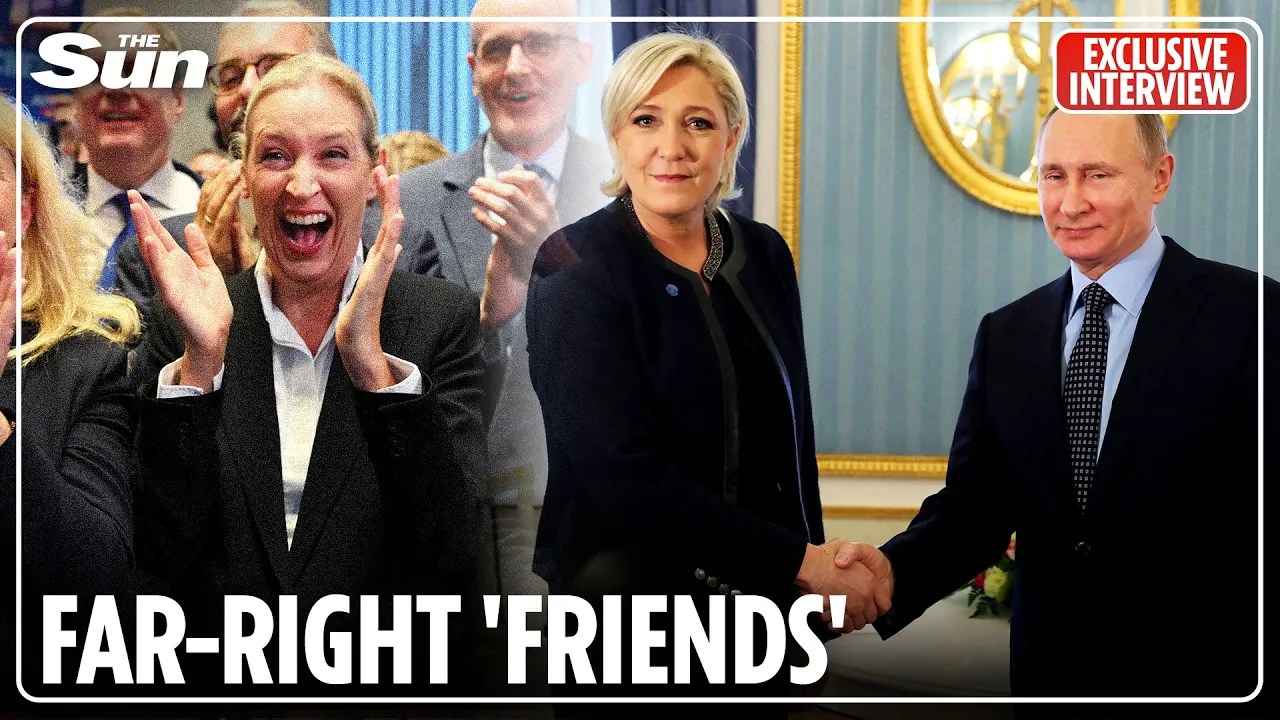
How Putin's using Kremlin-friendly governments to break Europe's will to defeat Russia
The Sun
296 views • 22 hours ago Save 7 min 3 min read
Video Summary
Russia's influence on European far-right parties is not about direct control but rather exploiting pre-existing domestic crises within liberal democracies. While not initiating the rise of the far-right, Russia amplifies divisions and distrust through political and information warfare. Parties like Germany's Alternative for Germany are seen as increasingly pro-Russian, with some leaders visiting Moscow and fostering relationships that offered an escape from perceived political marginalization.
Following the 2022 invasion of Ukraine, the far-right faced a dilemma. Russia's actions became unpopular, forcing many parties to shift their rhetoric away from overt pro-Russian stances. Some adopted a "peace" narrative, which often translates to Ukraine's surrender, while others, like Italy's League, moderated their positions to align with coalition partners. Despite these shifts, Russia continues to bet on political influence and psychological warfare, aiming to break Ukraine's will to resist through continued infrastructure attacks and the exploitation of internal European divisions.
Short Highlights
- Russia leverages existing crises in liberal democracies to its advantage, rather than creating the far-right.
- The "peace" narrative promoted by some far-right parties effectively demands Ukraine's surrender.
- Germany's Alternative for Germany is identified as a leading pro-Russian party in Europe.
- The 2022 invasion of Ukraine made overt pro-Russian stances electorally disadvantageous for many far-right parties.
- Some far-right parties have shifted from overt pro-Russian support to ambiguity or "peace" messaging.
- Russia's strategy focuses on psychological warfare and political influence over costly military attacks.
Key Details
Russia's Strategic Approach to European Politics [0:08]
- Russia's aim in political warfare is to break the will and morale of adversaries.
- The rise of the far-right in Europe is a domestic issue, a manifestation of a crisis in liberal democracy, not a Russian creation.
- The European far-right has been on the rise since the 1990s.
Russia although is using this problem to make things worse
Marine Le Pen and French Elections [0:47]
- France faces a crucial electoral cycle next year with a strong chance for Marine Le Pen to win the presidency.
- Le Pen is skeptical of financial support for Ukraine and the European Union, institutions that defend against Russian aggression.
- Her stance is problematic not necessarily because she is pro-Russian, but due to her skepticism of anti-Russian institutions.
and all and those institutions that do defend europe against russian aggression or against you know russian political warfare
Pro-Russian Parties in Europe [1:24]
- The Alternative for Germany (AfD) is considered the largest pro-Russian party in Europe currently.
- Hungary's Fidesz was previously considered the largest, but the AfD now leads this race.
- Russia bets on the further rise of the AfD as a classical progression party.
and i think that uh russia really bets on the even further rise of the alternative for germany because that is a classical progression party
Russia's Cost-Effective Strategy [2:09]
- Launching kinetic attacks against European states is expensive and elicits a response.
- Russia finds it less expensive to influence political parties, stoke distrust, and amplify divisions.
- This political and information warfare is Russia's predominant strategy.
it is much less expensive if you try to do this in a political way you know um trying to influence political parties stalk you know stoking kind of distrust and amplifying divisions in european countries