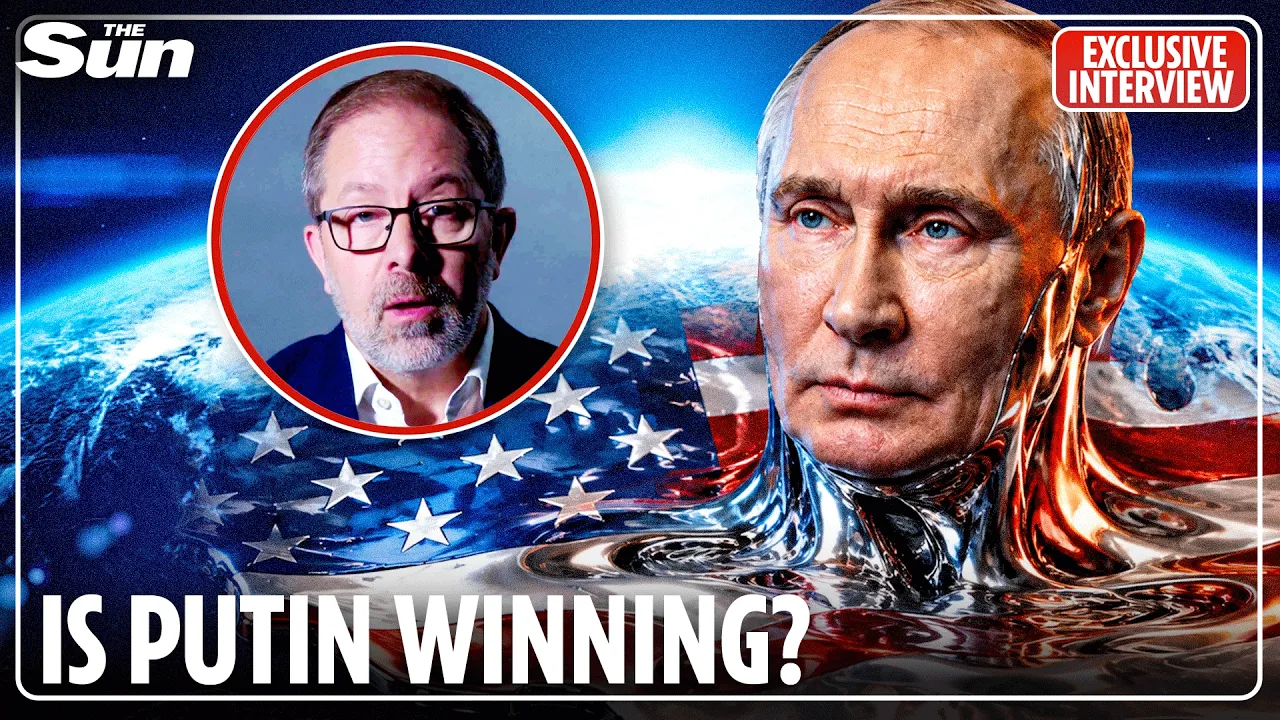
I wrote the NATO handbook - here's how Russia is subverting the West | Keir Giles
The Sun
1,603 views • 16 hours ago Save 4 min 4 min read
Video Summary
Russia has long employed a strategy of "information warfare" and subversion to achieve regime change and undermine sovereignty without direct invasion, a process that can span decades. This approach, detailed in works like Alexander Dugin's "Foundations of Geopolitics," aimed to foster isolationism in the U.S. and weaken alliances.
Recent U.S. foreign policy shifts appear to align with these Russian aspirations, alarming allies. This includes a perceived move towards viewing Russia as a partner rather than a threat, a potential politicization of U.S. institutions, and a withdrawal of American protection from Europe. These developments, while alarming, are presented as the culmination of long-term Russian influence operations, rather than a sudden anomaly.
Short Highlights
- Russia has historically utilized information warfare and subversion as tools to influence foreign politics and achieve regime change without direct invasion.
- Alexander Dugin's 1997 book, "Foundations of Geopolitics," outlined strategies for Russia to regain influence, including promoting U.S. isolationism and weakening European alliances.
- Current U.S. foreign policy shifts are seen as aligning with these long-term Russian objectives, causing concern among U.S. allies.
- The U.S. administration's approach has shifted, with a perception of Russia being treated as a partner rather than a threat.
- Concerns exist about the potential politicization of U.S. institutions and the withdrawal of American security guarantees for Europe.
- Motivations for these shifts are varied, including perceived economic benefits from Russia and a misguided cultural affinity for its traditional values.
Related Video Summary
- Russia Puts The UK On Notice, AI Companies Call For Digital Safety, & IG Updates For Teens
- Alastair Crooke: Iran DESTROYS THREE F-35s as US Attacks BACKFIRE, Trump in PANIC MODE
- Inside Putin's submarine fleet enhancements as new threats emerge to NATO security
- Massive fire in Voronezh! Ukrainian drones strike ANOTHER Wildberries hub
Key Details
Russia's Strategy of Subversion [00:00:00]
- Russia has a long history of using information space and subversion to exert malign influence.
- This includes recruiting agents and "useful idiots" to promote Russian narratives and influence politics in other countries.
- The ultimate goal of this subversion can extend to regime change, allowing countries to lose sovereignty without realizing it.
"Russia's always had a wide range of tools to exert its malign influence through information space."
The Long-Term Vision of Information Warfare [00:01:00]
- The concept of information warfare and subversion extending to regime change was recognized by Russia decades ago.
- This process is described as long-term, potentially spanning decades, not just months or years.
- The emergence of "troll farms" sowing Russian opinions on social media was an early manifestation of this strategy.
"And in it, I explained how one of Russia's realizations was that the ambition that they could achieve through information, through subversion, actually extended right up until regime change."
Alexander Dugin's "Foundations of Geopolitics" [00:01:45]
- Alexander Dugin, a Russian political philosopher, outlined a vision for Russia's resurgence in his 1997 book.
- The book proposed regaining empire and reasserting Russia as a great power at the expense of former subjects and Europe.
- Specific strategies included activating the right wing of the Republican Party to promote isolationism and a new Monroe Doctrine, withdrawing U.S. power globally.
"And some of the things that he laid down in that book are now matching exactly what the United States is doing 30 years later."
Alignment with Current U.S. Policy [00:03:00]
- Current U.S. national security strategy and language in American documents mirror those previously common in Russian ones.
- This includes a policy shift where the U.S. administration views Russia as a partner, not a problem, which alarms allies.
- This shift is seen as the culmination of long-term Russian influence processes, though it should not have been a complete surprise given past actions.
"The basic policy shift that is such a problem for allies and partners of the United States around the world is the way that the current U.S. administration is seeing Russia as a partner, not as a problem."