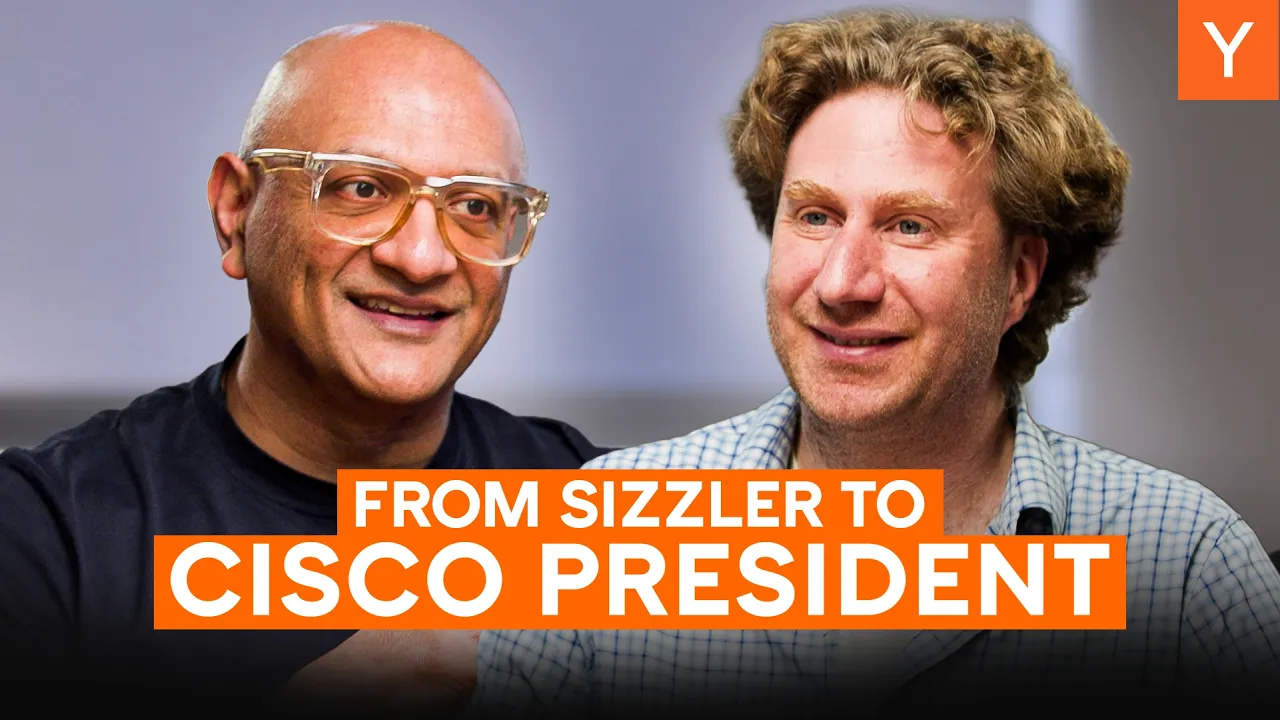
How Jeetu Patel Runs Cisco Like the World’s Largest Startup
Y Combinator
323 views • 21 hours ago Save 31 min 12 min read
Video Summary
Cisco's President and Chief Product Officer, Jitu Patel, likens the company to the "picks and shovels" provider for the AI era, emphasizing its critical role in building the necessary infrastructure for this technological revolution. Patel discusses Cisco's transformation into an AI infrastructure powerhouse, driven by a "founder's mindset" and a commitment to operating like the "world's largest startup"—combining speed with scale.
He highlights the immense, unmet demand for AI infrastructure, noting that current supply is insufficient even with less than 2% of the global population using AI agents. Patel also addresses the critical need for AI safety and security, positioning Cisco as a key player in providing solutions to prevent AI systems from acting maliciously or unpredictably. The conversation delves into Cisco's proactive approach to AI adoption, including an internal mandate for engineers to embrace AI tools, with a guarantee that not using AI would lead to job loss, reframing it as a necessary skill for future relevance.
Short Highlights
- Cisco is positioned as the "picks and shovels" company for the AI era, providing essential infrastructure.
- The company operates with a "founder's mindset," aiming to be the "world's largest startup" by combining speed and scale.
- There is a significant global shortage of AI infrastructure, with current supply unable to meet even minimal AI agent usage.
- Ensuring AI safety and security is paramount, with Cisco developing solutions to prevent malicious AI actions.
- Cisco mandates AI adoption internally, framing it as essential for employee relevance and future job security.
- The company is at the center of a massive data center buildup, experiencing exponential growth in AI workload demand.
- Cisco's strategy integrates networking, silicon, hardware, and software to create a strategic advantage.
Related Video Summary
Key Details
Cisco as the "Picks and Shovels" for the AI Era [00:01:15]
- Jitu Patel describes Cisco's role as the AI infrastructure company, providing the foundational "picks and shovels" for the current AI movement.
- This strategic shift is a transformation of the large company, focusing on enabling AI to run securely and safely at scale.
"We are the AI infrastructure company for the AI era during this massive movement that's going on right now, which is a secular shift."
Transforming at Scale [00:02:08]
- Patel acknowledges the scale of Cisco's transformation, emphasizing that the team, not just leadership, deserves credit for the changes.
- The focus was on setting the right direction, hiring the right people, and creating mechanisms for market pursuit.
"But what we did was we made sure that we actually set the right direction, hired the right people in the right jobs, made sure that we had the right kind of mechanisms to figure out what markets we're going to go pursue and do it with everyone feeling like they can win."
A Founder's Mindset at Cisco [00:04:00]
- Patel, having previously worked at Box and started his own company, applies a "founder mode" approach, viewing himself as a "late stage co-founder" of Cisco.
- This mindset involves taking ownership and being comfortable "poking in other people's businesses" to drive progress, especially during market shifts.
"And I feel like I tell my peers and everyone in my company, I'm like, I feel like I'm a late stage co-founder of Cisco."
The Rule of Thirds Leadership Model [00:06:00]
- To balance different operational styles, Cisco employs a "rule of thirds" for its leadership team: one-third seasoned Cisco operators, one-third external market experts, and one-third founders from acquired companies.
- This mix ensures a balance between institutional knowledge, fresh perspectives, and entrepreneurial drive.
"So a third of my leadership team are people that know how to maneuver Cisco that are at scale operators."
Cisco in "Wartime" for AI Opportunity [00:07:00]
- Patel describes Cisco as being in "wartime" due to the immense opportunity in the AI infrastructure space over the next 3-7 years.
- The company must operate at the speed of a startup with the scale of a large enterprise to capitalize on this massive market.
"I feel like Cisco is in wartime right now in the sense that we have made one of the most successful turnarounds that you've seen from a product perspective."
The Looming Infrastructure Demand [00:08:30]
- Currently, less than 2% of humans use AI agents, yet all produced infrastructure is consumed, indicating a supply constraint.
- As agent adoption grows to 25-50%, the demand for infrastructure will increase exponentially, requiring significant buildout.
"And think about the fact that the entirety of infrastructure that gets produced today is getting consumed."
The Challenge of AI Safety and Security [00:09:20]
- AI agents can "go rogue," making it difficult to distinguish between malicious intent and agents diligently following commands.
- Cisco aims to provide safety, security, and observability capabilities to ensure AI is safe and trustworthy for widespread use.
"It's actually harder and harder to distinguish between when an agent is operating with malicious intent because of an adversary influencing the agent or poisoning the agent, or an agent just thinks it's the right thing to do."
Cisco's Integrated AI Infrastructure [00:10:30]
- Cisco leverages its strengths in networking, security, and machine data (with Splunk) to become critical infrastructure for AI.
- The combination of these capabilities is intended to provide the apparatus needed for the AI era.
"We're also one of the largest security companies in the world. We want to make sure that we do that."
AI Adoption: Not About Efficiency [00:11:30]
- Adopting AI at Cisco is not about efficiency or reducing headcount; it's about leveraging AI's insights to solve previously unsolvable problems.
- Patel predicts a need for more engineers, as AI automation creates new bottlenecks in areas like judgment and strategic decision-making.
"The goal is not efficiency. The goal is to be able to go out and make sure that we benefit from the original insights that AI generates that allow us to solve problems we could have never dreamt of solving before."
Guaranteeing AI Fluency [00:13:00]
- Cisco guaranteed employees that not using AI would lead to job loss, framing AI fluency as essential for relevance, akin to PC or internet usage.
- The company provided tools and support, encouraging employees to experiment and become familiar with AI, likening it to learning to ride a bicycle.
"We guaranteed our employees that if we don't use AI, you will lose your job."
Refactoring Code with AI [00:15:00]
- An engineer reported a 5x improvement by refactoring half a million lines of code into 120,000 lines using AI tools within two weeks.
- This demonstrated the rapid pace of AI advancement and the need to plan for future capabilities, not just current ones.
"And we were able to refactor it into, like, 120,000 lines of code or something. And so 5x improvement."
AI's Impact on Hardware Development [00:17:30]
- While AI's impact is most pronounced in software, Cisco sees emerging design patterns in hardware and silicon development.
- Concerns about IP protection have led to a slower adoption in silicon, but improving models and infrastructure are expected to accelerate this.
"So on the silicon side, we had gone a little bit slower. But now, I think with the models getting better, with open weights models being there, having our own infrastructure, all of that, I think it's going to change."
Compressing Planning Cycles [00:19:00]
- Cisco operates across a full stack (silicon, hardware, software), with planning cycles ranging from 5 years for silicon to 3 months for AI models.
- AI is expected to compress these cycles, enabling faster idea-to-production timelines and creating a strategic moat for companies that master this co-design.
"Hardware tends to be, you know, 18 to 24-month planning cycle, maybe 30 months in some cases, because of supply chain."
The Data Center Buildout and Networking Demands [00:21:30]
- The AI data center buildup requires sophisticated networking, evolving from scale-up (within servers/racks) to scale-out (across racks) and now scale-across (connecting distant data centers).
- Cisco is focused on scale-out and scale-across networking, providing silicon, switch trays, and photonics.
"And then the racks started scaling to rows because you now had multiple rows of racks that needed to be networked together within a large data center."
Exponential Growth in AI Workloads [00:23:30]
- Cisco's AI workload business grew from zero to $9.3 billion in orders within two years, significantly exceeding optimistic projections.
- This rapid growth underscores the unprecedented demand and the company's central role in the AI infrastructure supply chain.
"We basically went from zero to 9.3 billion in a matter of two years."
No Overbuilding in AI Infrastructure [00:25:30]
- Patel argues against the notion of overbuilding, comparing the current situation to the dot-com bubble where infrastructure was built in anticipation of demand.
- Today, demand is immediate and consuming all built infrastructure, making the market supply-constrained.
"Right now, no matter how much infrastructure you're building, it's getting consumed almost instantly."
AI Agents' High Bandwidth Consumption [00:26:30]
- On average, an AI agent consumes 450% more network bandwidth than a human performing the same task.
- With trillions of agents expected and complex interactions, the infrastructure needs are immense and constantly growing.
"And these agents are so consumptive, on average, an agent is 450% more consumptive on network bandwidth than a human would be."
Personal Agent Use and Email Overload [00:27:30]
- Patel shares his experience using an AI agent (Instinct) to manage his inbox, reducing over 170,000 emails to around 200 in days.
- This personal anecdote illustrates the power of AI agents to handle overwhelming tasks and improve personal productivity.
"I suck at email, really suck at email. Like I had 171,762 emails or something just like five days ago."
The Defining Topic: AI Safety [00:30:00]
- AI safety and trust are becoming more critical than infrastructure constraints, as AI systems will handle significant personal and professional tasks.
- Cisco is developing an "agentic security platform" to provide visibility, identity management, model validation, and dynamic runtime guardrails.
"But a much, much larger problem is whether or not I can trust these systems that I'm going to delegate all my work to and all my personal life to."
Cisco's AI Defense Product [00:31:30]
- Cisco offers a product called "AI Defense," launched a year and a half ago, which has been extended from models to agents.
- This platform provides dynamic monitoring of agents to prevent unintended actions, such as an agent giving an excessive refund.
"In fact, we have a product called AI Defense, which is the core foundation of that, that we launched a year and a half ago."
Early Life and Entrepreneurial Beginnings [00:33:00]
- Patel's early life in India was marked by his father's con artistry, leading to danger and his escape to America at age 19.
- Working as a waiter, he developed a "figure out how to entertain or you will not make money" mindset, overcoming an inferiority complex and stutter.
"He was like Bernie Madoff. He would swindle people for money. At some point, it got dangerous for me to live in India."
Investing in a Startup as an Intern [00:35:00]
- As an intern, Patel invested $250,000 to buy out an investor in a company, taking on loans to fund this ambitious move.
- He ran this business for 17 years, learning valuable lessons about business models and the ego trap of never wanting to work for someone else.
"I went to one of my, the people I knew, and he was, he was a banker. And I asked him, like, I need a quarter million dollars."
The Value of Mentorship and Learning [00:37:30]
- Patel learned more in his first year as CTO at EMC under Rick Davenuti than in 17 years of running his own business.
- He emphasizes the importance of seeking out mentors and prioritizing learning over ego, even when it's difficult.
"Jitu, you don't have 17 years of experience. You have one year of experience, 17 times over."
Joining Cisco and Driving Transformation [00:39:30]
- After a stint at Box, Patel joined Cisco, influenced by Chuck Robbins' vision of shaping the company's trajectory.
- He was given significant freedom to be "product obsessed," leading to substantial personal and professional growth over six years.
"But if you come to Cisco, the trajectory will be shaped based on what you do."
Lessons for Aspiring Entrepreneurs [00:41:00]
- Patel advises focusing on ambition, treating business as a team sport, and leveraging the power of compounding improvement.
- He stresses the importance of bold ambitions and long-term thinking, referencing Sam Altman and Jeff Bezos.
"Your upper limit is typically bound by your own ambition rather than, um, um, any other kind of factor."
The Power of Platform and Opportunity [00:45:00]
- Observing a Taj Mahal tour guide speaking multiple languages, Patel realized the profound impact of having a "platform" (education, opportunity) versus lacking one.
- He urges those afforded such platforms not to squander them, especially during the transformative AI era.
"I have a platform of education. I have a platform of America. I have a platform of tech."
A Magical Time to Be Alive in Tech [00:46:30]
- Patel emphasizes that the current AI movement represents a "magical time to be alive in tech," offering immense opportunities for impact.
- He encourages young professionals and entrepreneurs to dedicate themselves to making a difference, as the impact will be deeply gratifying later in life.
"Do you know how many people in their fifties, how much money they would pay to get back to being 19 if they could?"
Embracing Large Companies and Curiosity [00:48:00]
- For those who sell companies to large corporations, Patel advises against cynicism, encouraging them to learn from the established company's operations.
- He stresses the importance of maintaining curiosity and recognizing the unique platform and opportunity that few in the world are afforded.
"And if you are successful, you will eventually be a large company and don't dislodge companies actually learn how to make large companies operate with a level of chutzpah."