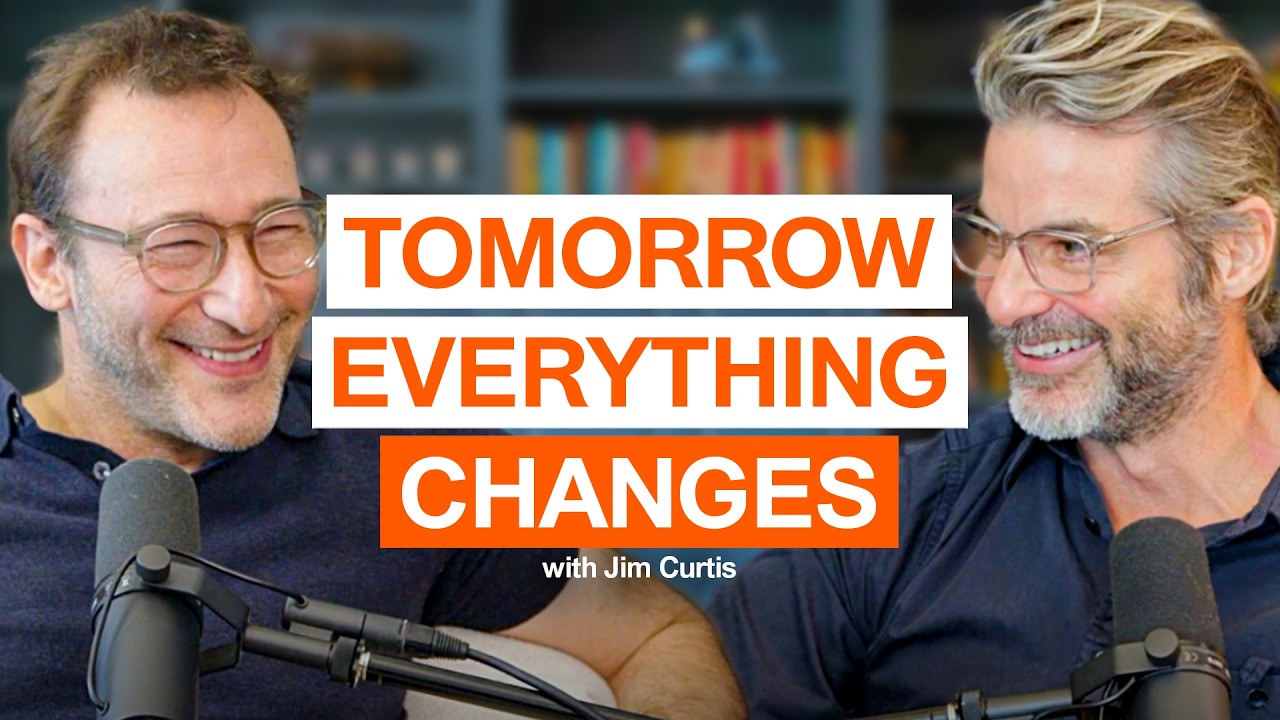
The Secret to Change That Lasts | Transformational Coach Jim Curtis
Simon Sinek
398 views • 18 hours ago Save 42 min 12 min read
Video Summary
After a health crisis forced him to re-evaluate his life, Jim Curtis left a lucrative executive career to become a hypnotherapist and transformational coach. He shares how he found purpose by helping others overcome fears, a journey detailed in his book, "The Book of Possibility." Curtis emphasizes that true change stems from purpose, not just pain, and that embracing love over fear is key to moving forward.
Curtis's own transformation began in a New York City emergency room, where his body was shutting down from stress. This near-death experience, coupled with a condemned apartment building and personal losses, propelled him to abandon his high-paying job. He returned to school, pursuing hypnotherapy and coaching, and discovered a passion for helping people heal. His work now focuses on guiding individuals to reframe their narratives, shifting from victimhood to heroism, and ultimately finding joy and fulfillment beyond material success.
Short Highlights
- Purpose over Pain: True, lasting change arises from a sense of purpose, not solely from enduring pain.
- The Power of Love: Love, not just courage, is the true opposite of fear, enabling one to move through challenges.
- Career Transformation: Jim Curtis left a high-paying executive role after a health scare to become a hypnotherapist and coach.
- Finding "The Why": Discovering one's personal "why" provides passion, joy, and confidence.
- Reframing Narratives: Hypnotherapy helps individuals re-imagine difficult experiences, shifting from victim to hero.
- Beyond Material Success: True fulfillment comes from service and connection, not solely from wealth or status.
- Earning Relationships: Continuous effort and presence are key to maintaining fulfilling relationships, both personal and professional.
Key Details
The Opposite of Fear is Love [00:00:00]
- The idea that love, not courage, is the opposite of fear is explored.
- Combat veterans are said to rush into battle for their comrades, not for abstract ideals like God or country.
- This deeply personal and human motivation is highlighted as a powerful force.
"It is deeply, deeply personal and deeply, deeply human."
Pain as a Catalyst for Change [00:00:00]
- Many people only make significant life changes when faced with pain or crisis.
- Examples include starting exercise after a health scare or leaving a job after burnout.
- The speaker suggests that while pain can initiate change, purpose is essential for that change to last.
"Most of us don't make a change until it hurts."
Jim Curtis's Crisis and Decision [00:00:00]
- Jim Curtis experienced a life-altering moment in a New York City emergency room due to stress.
- He decided that "everything changes" the next day, marking a turning point.
- Curtis left a high-paying job with stock options to return to school and study healing.
"Tomorrow, he said to himself, everything changes."
From Executive to Hypnotherapist [00:00:00]
- Curtis is now a hypnotherapist and transformational coach.
- His book, "The Book of Possibility," offers tools to release fears.
- The podcast host expresses admiration for Curtis's ability to connect and engage.
"And in his book, The Book of Possibility, he shares tools to help us release the fears that hold us back."
The Pursuit of Money vs. Happiness [00:00:00]
- Society often conflates money with success and happiness.
- Curtis discusses leaving a well-paying job for a different path, facing skepticism.
- He questions whether one needs to be in pain to choose a different direction away from wealth.
"And you left a good paying job or at least something that was on the road for fun and traditional success. And you walked away from it."
Pain as the Primary Driver [00:00:00]
- Curtis argues that pain, rather than pleasure, is the main driver of significant life decisions.
- He lists various life changes—exercise, diet, relationships, jobs—as often being pain-induced.
- Pain can fuel both self-sabotage and success.
"You know, it was always pain."
Curtis's Corporate Background [00:00:00]
- Curtis was a successful executive for 25 years, specializing in turning around tech startups.
- He was hired by private equity and venture capital firms and was excellent at driving revenue.
- The cynic's view is addressed: it's easier to pursue happiness after accumulating wealth.
"And I was excellent at what I did. And I did it for 25 years."
The Relativity of Wealth [00:00:00]
- Curtis questions the definition of wealth, noting it's relative and aspirations can grow.
- What one person considers wealthy, another might see as insufficient, especially in high-cost areas.
- Gratitude is presented as key to appreciating existing wealth.
"And so I think that our aspirations keep growing so that we get used to the amount of wealth that we have."
A Confluence of Painful Events [00:00:00]
- Curtis describes a period of intense personal hardship.
- His apartment building in New York City was condemned due to structural issues, requiring a $15 million fix.
- His mother died, and his dog became sick, contributing to immense stress.
"And so the department of buildings says you need to be out this week, this week."
A Health Scare in the ER [00:00:00]
- Curtis found himself in a New York City emergency room at 2 AM, experiencing severe pain and numbness.
- He was potentially diagnosed with Neuromyelitis Optica (NMO), a serious condition.
- Overwhelmed by anxiety and the chaotic ER environment, he decided to leave against medical advice.
"And they're like, you're going to die."
Deciding "Everything Changes" [00:00:00]
- Despite medical warnings, Curtis left the hospital, driven by a need to care for his dog and avoid a painful spinal tap.
- He took an Uber home and vowed, "Tomorrow, everything changes."
- This marked the beginning of a profound shift in his life priorities.
"And I said, tomorrow, everything changes. Absolutely everything changes tomorrow."
Embracing a New Path [00:00:00]
- Curtis adopted an anti-inflammatory diet, cut out alcohol and fast food, and began exercising.
- He sought new doctors and decided to pursue hypnotherapy and counseling, finding purpose.
- He left the high-stress corporate world, despite the financial implications.
"And so now I'm cooking my own food, exercising, watching the sunset, in care of new doctors, and going to school for something that has purpose."
The Organic Growth of Purpose [00:00:00]
- Curtis began sharing his journey and hypnotherapy techniques through video content, which gained a massive audience.
- This led to one-on-one clients and the realization that he would not return to the corporate world.
- He emphasizes that this path was not planned but emerged organically from finding his "why."
"And hundreds of thousands of people started watching."
Shared Experiences of Transformation [00:00:00]
- The podcast host shares a similar story of feeling unfulfilled despite superficial success.
- He highlights the importance of confiding in others when in a dark place, as isolation worsens it.
- A friend's intervention was crucial in breaking the cycle of pretending and seeking a solution.
"And if you're in a dark place and you don't tell anybody, it gets darker."
The Power of "Why" [00:00:00]
- Both speakers discuss the addiction to the question "Why am I doing this?"
- They differentiate between goals (like being one's own boss) and purpose.
- The pursuit of growth or shareholder value without a deeper purpose is likened to a hamster wheel.
"I knew what I did and I knew how I did it, but I didn't know why I was doing it."
Purpose as a Guiding Force [00:00:00]
- Curtis explains that his "why" initially saved him and gave him purpose, passion, and joy.
- He began sharing this discovery with friends, who then shared it with their friends.
- This organic sharing led to workshops and a deeper commitment to this purposeful work, despite it not paying better or having status.
"You know, the why it was only meant for me to save me. And it did save me."
Hypnosis: Language and Perception [00:00:00]
- The speaker discusses how language shapes perception, using different terms for spiritual vs. corporate audiences.
- Curtis chose to embrace the word "hypnosis" despite its theatrical connotations.
- He explains his reasons, including a positive personal experience with a hypnotherapist and mentorship from Dr. Brian Weiss.
"And so two reasons why I decided to do that."
Redefining Hypnosis [00:00:00]
- Theatrical hypnosis targets highly suggestible individuals (somnambulists).
- However, everyone can enter a trance state and be introspective.
- Curtis's method involves guided visualization to re-imagine difficult life experiences, empowering individuals.
"And so what I do, which is different is more of a transcendental meditation where we go into a state of trance and instead of trying to clear our mind or focus on one mantra, we'll do a visualization in which we re imagine difficult parts of our lives."
Shifting from Victim to Hero [00:00:00]
- The goal is to change the internal story, transforming individuals from victims to heroes of their experiences.
- This process helps overcome fears, like the example of Jack Osbourne's fear of spiders, which was linked to fear of abandonment.
- Another example shows a woman overcoming a fear of snakes, which was actually a fear of missing out on family activities.
"So you're changing the story in our head so that we are no longer the victims of our experiences, but the heroes of our experiences."
Self-Hypnosis and Subconscious Mind [00:00:00]
- Self-hypnosis is presented as a tool for personal change, similar to meditation.
- It involves guiding oneself into a trance state to access the subconscious mind.
- This taps into intuition and a deeper awareness beyond the rational, analytical mind.
"So we're moving from rational brain to subconscious brain."
The Role of Spirituality and Faith [00:00:00]
- The speaker acknowledges that some may find the spiritual aspects of his work "woo-woo."
- He defines faith as a deep sense of obligation and service to something larger than oneself.
- This higher purpose provides a moral compass for decision-making, especially in business.
"I think spirituality is a good thing."
Purpose in Business and Life [00:00:00]
- A higher purpose in business can prevent unethical actions, like those seen at Wells Fargo or with EpiPen price hikes.
- People are less likely to compromise their values when connected to a cause greater than themselves.
- Money is identified as a common false idol that leads to loneliness and unfulfillment if pursued as the sole purpose.
"And this is the reason to have purpose at work because the purpose of our company is bigger than any authority, any fiduciary duty, any investor."
The Joy of Service [00:00:00]
- The story of a valet at a cancer treatment center illustrates profound joy and fulfillment through service.
- This individual, despite low pay, brings immense positivity to patients, demonstrating that true currency is fulfillment, not money.
- Human purpose is found in helping one another, fostering relationships, and connection.
"And when they talk to him, he says, I mean, it brings me to tears. I am here to serve."
Money as a By-Product [00:00:00]
- Money is not the purpose but an unintended by-product of being part of something larger than oneself.
- When one steps into their purpose, money tends to follow.
- Desperation in seeking relationships or business is unattractive; a focus on purpose is more appealing.
"Money is the unintended by-product of being a part of something larger than yourself."
Earning Relationships and Trust [00:00:00]
- The concept of "earning" relationships is explored, contrasting it with "winning."
- Winning implies a finite goal, while earning suggests ongoing effort and commitment.
- In business, creating relationships and being genuinely curious about others leads to greater success than aggressive selling.
"The purpose of a first meeting is to create the conditions that if I call them again, they'll take another meeting."
Love as the Core of Connection [00:00:00]
- The speaker argues that love, defined broadly, is central to successful relationships and organizations like the Marines.
- The "intangibles" like loyalty, trust, and love are what motivate people, even in extreme situations.
- The opposite of fear is love, which enables individuals to move through challenges by deeply caring for others.
"He will say, love of country, love of Corps, love of your fellow Marine."
Shared Struggle and Connection [00:00:00]
- Shared struggle can produce oxytocin and build strong bonds, as seen in military units or documentaries about bridging divides.
- Dia Khan's work with white supremacists shows how understanding and empathy can lead individuals to leave extremist movements.
- Motivations for extreme actions are often rooted in a misdirected love for a cause, rather than pure hate.
"And what she says in all of her work, all of her experience, there's not a single person who does what they do motivated by hate. They're motivated by love."
Earning vs. Winning in Relationships [00:00:00]
- The idea of "earning" a relationship daily is contrasted with the initial effort to "win" someone over.
- Sustained effort and presence are crucial for long-term happiness in relationships.
- The nuance of whether one earns love out of insecurity or out of a joyful commitment is explored.
"And I'm learning that, that, that mentality is good just for winning, but to stay in a happy relationship, a happy friendship, there's a courtship and an earning to earn your relationship every day."
Contemplating Mortality for Clarity [00:00:00]
- Thinking about death, not morbidly, can provide clarity on how to live life more fully.
- The speaker reflects on his business, "The Business of Possibility," and decides he wants it to continue after his death.
- This contemplation leads to strategic decisions about hiring and empowering others to carry the vision forward.
"And so I said, okay, so let's think about my death. What would I need for this business to go on if I was to die?"
Building Something Bigger Than Oneself [00:00:00]
- The ultimate goal is to build something that survives oneself, driven by purpose and common cause.
- This requires making decisions and hiring people who align with that larger vision.
- Contemplating difficult things, like mortality, leads to clarity on true desires.
"It's not a bale stone force of personality. Right."