The Playbook I Used To Hit $10K/Month
Starter Story
370 views • 18 hours ago Save 11 min 7 min read
Video Summary
Frederick James built a simple habit tracker app that now generates over $10,000 per month, achieving financial freedom and allowing him to pursue a second app. Despite the app's seemingly ordinary nature, James attributes his success to a strategic approach focusing on premium design and a well-defined growth playbook. He details his journey from a software developer in big tech to an independent app builder, driven by a desire for more control over his life after a health scare. His strategy involved leveraging AI for design elements, meticulously mapping out app architecture, and utilizing a combination of Apple Search Ads and TikTok Ads for rapid scaling.
James outlines a clear roadmap for app growth, starting with optimizing the App Store page and targeting competitor keywords on Apple Ads to gain initial traction. The significant leap from $5,000 to $10,000 per month was fueled by TikTok Ads, where he identified viral organic content, remade it, and strategically scaled ad spend using goal-based budgeting. He emphasizes the importance of understanding profitability, managing ad spend meticulously, and the necessity of risk tolerance in the early stages of paid advertising. James also advocates for a diversified marketing approach, warning against relying solely on one acquisition channel due to its inherent risks.
Short Highlights
- App Success: Frederick James's habit tracker app generates over $10,000 per month.
- Core Strategy: Focus on premium design and a clear growth playbook.
- Background: Transitioned from big tech software development to independent app building after a health scare.
- Development Process: Utilized AI (ChatGPT, GPT Image 2.5) for design and coding, Figma for mockups, and Cloudflare for backend infrastructure.
- Growth Channels: Initially scaled with Apple Search Ads, then achieved rapid growth via TikTok Ads.
- Key Learnings: Emphasizes risk tolerance, meticulous ad spend analysis, and diversifying marketing channels.
- Advice: "Success is just failure on a long enough timeline." Be willing to fail fast and treat entrepreneurship as a marathon.
Key Details
App Idea and Background [00:00]
- Frederick James built a habit tracker app focusing on premium design and UI.
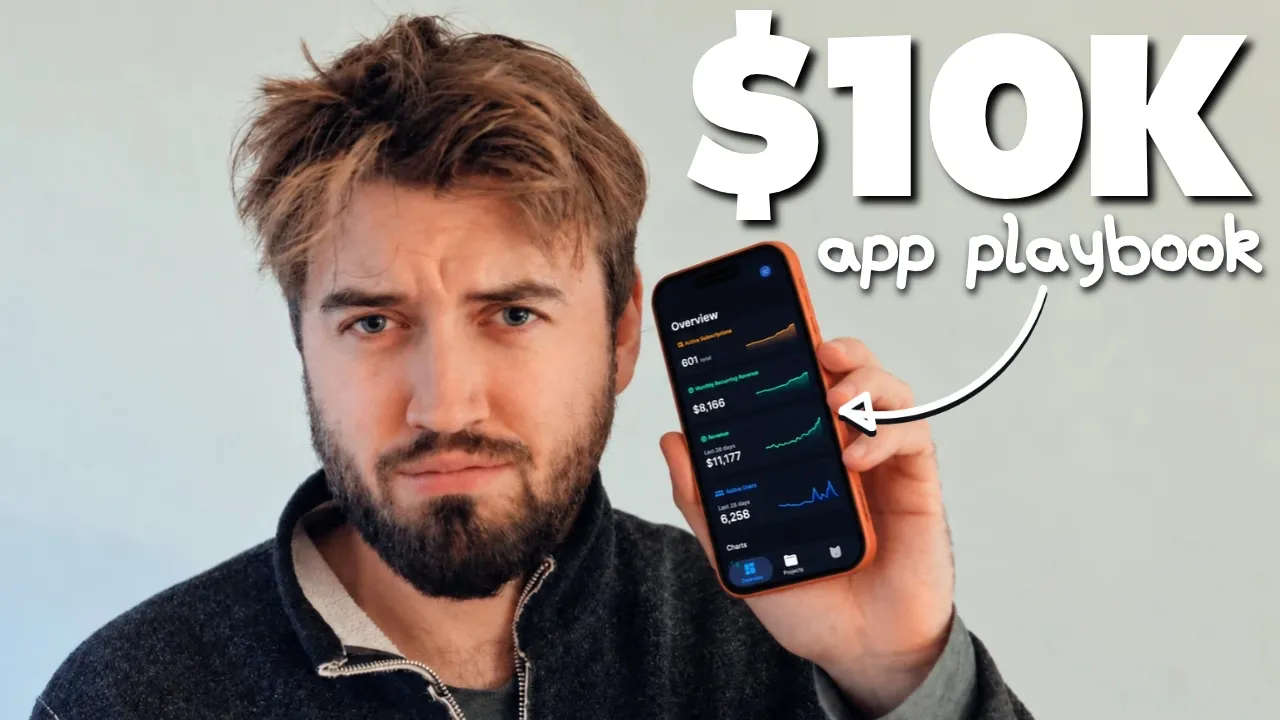
- The app currently generates around $10,000 per month, peaking at $13,000, and has provided financial freedom.
- James is currently building a second app using a similar strategy.
"I built an app that peaked at about $13,000 per month. It's hovering around $10,000 right now."
Revenue and Performance Metrics [00:00]
- The app has generated approximately $25,000 in revenue over the last 90 days.
- Peak Annual Recurring Revenue (ARR) was just under $100,000.
- Current Monthly Recurring Revenue (MRR) is around $8,000, with a recent spike to $11,000 in the last 30 days.
- The download-to-paid conversion rate is 7%, with a low refund rate of 0.7%.
"The download to paid ratio, I have about 7%, which is pretty good for the niche that I'm in."
Developer Background and Motivation [00:00]
- James has a background as a software developer, working in big tech in London for five years.
- Dissatisfaction with the "regularness" of a 9-to-5 job and a health scare last year motivated him to "start maxing life" and pursue his own ventures.
- He decided to "go all in" on building apps and sharing his journey publicly.
"I had a health scare last year, and I realized I needed to pretty much start life maxing, basically."
App Idea Generation and Value Proposition [00:00]
- The app idea originated from seeing a breakdown of an app onboarding process on X (formerly Twitter).
- James identified an opportunity to create his own angle by improving an existing app concept.
- The core value proposition is its premium design and user interface, differentiating it in the crowded health and fitness habit tracker niche.
"I knew I could take this app, make the design premium, add a couple of features, and it would likely sell itself."
Development Process and Tools [00:00]
- Stage 1 (Prep): Mock UI in Figma, map out ERD (entity relationship diagram), and infra diagram. Create MVP screenshots in Figma.
- Stage 2 (Asset Creation): Download assets from Pinterest, customize them with GPT Image 2.5. Use ChatGPT to build out the app flow and UI based on mockups.
- Stage 3 (Iteration): Conduct A/B testing and iterations post-launch, particularly on paywalls and pricing.
- Tech Stack: Cloudflare (R2 for assets, D1 for databases, Workers for compute), AppsFlyer (MMP), RevenueCat (monetization tracking), ChatGPT ($100/month for coding agent), Cloud Pro plan for Opus 5.5.
"The backend for all of my apps is Cloudflare. R2 for asset storage is free. I use D1 for my databases."
Growth Strategy: Zero to $5K/Month (Apple Ads) [00:00]
- The initial growth phase heavily relied on Apple Search Ads, utilizing a $100 starting credit.
- Key elements include a strong App Store page (AI-generated or designer-created screenshots), and precise keyword targeting.
- Strategy: Turn off search match, use only exact keywords, focusing on competitor names.
- Bidding starts with Apple's recommended max bid, monitoring spend for a couple of days.
- If spending is low, increase bids; if still not spending, someone else is bidding higher.
- Daily analysis of ad performance by exporting data from RevenueCat and Apple Ads, feeding it to an AI agent to identify top performers.
"And the keywords are going to be the names of your big competitors. So when people are searching for Duolingo, your app comes up as the advertisement."
Growth Strategy: $5K to $10K/Month (TikTok Ads) [00:00]
- The "hockey stick" growth occurred rapidly via TikTok Ads within about a week.
- Strategy involved identifying viral organic videos in the niche, remaking them, and running them as ads.
- Started with five different ad formats, allocating $50 ad spend per post.
- Continued running ads that showed conversions or were slightly unprofitable to gather targeting signals for the algorithm.
- Emphasized the importance of being willing to "loss lead" initially to train the algorithm.
"In the beginning, it's more important that your account understands what users it needs to target."
Profitability, Scaling, and Diversification [00:00]
- Initial paid ad campaigns were not profitable for the first couple of weeks, requiring risk tolerance.
- Profit margins on paid ads are estimated around 30% after accounting for app store fees, small business programs, and potential VAT.
- James advocates for paid ads as a way to "pay with your money" rather than time, contrasting it with managing influencers or creating founder content.
- He stresses that relying solely on paid ads is non-optimal; a combination of marketing approaches (UGC, influencer, founder content, paid ads) is more reliable and sustainable.
- Diversification mitigates risk, such as an account ban on a platform like TikTok.
"I would recommend doing this again, same with the Apple ads. Every morning is part of your routine."
Entrepreneurial Advice and Mindset [00:00]
- James advises trying everything and anything, drawing from past experiences like reselling and music production.
- He views success as "failure on a long enough timeline" and encourages failing fast.
- Entrepreneurship is framed as a marathon requiring pacing for physical and mental health.
- Persistence and willingness to fail are crucial, as success rarely happens overnight.
"I think success really is just failure on a long enough timeline. You know, you've got to be willing to fail and fail fast."
Building in Public and Authenticity [00:00]
- James's journey, shared on X, is highlighted as a smart strategy for gaining attention and standing out.
- His authentic and "human" storytelling is seen as a differentiator in an age of AI and automation.
- Building in public, though challenging, serves as a springboard for future ventures.
"And I think in an age of automation and AI images and fake people, dead internet theory, he like really stands out as like a real person who's building online."
Takeaways on App Ideas and Marketing [00:00]
- There are numerous ways to succeed in the app space, with diverse marketing strategies available.
- James's success with a seemingly "saturated" app idea like a habit tracker proves that "any idea works" with the right execution.
- The video promotes a database of proven iOS app ideas as a resource for aspiring builders.
"So if you want to start building off of proven app ideas at the link in the description you can download our free database of successful proven iOS app ideas."