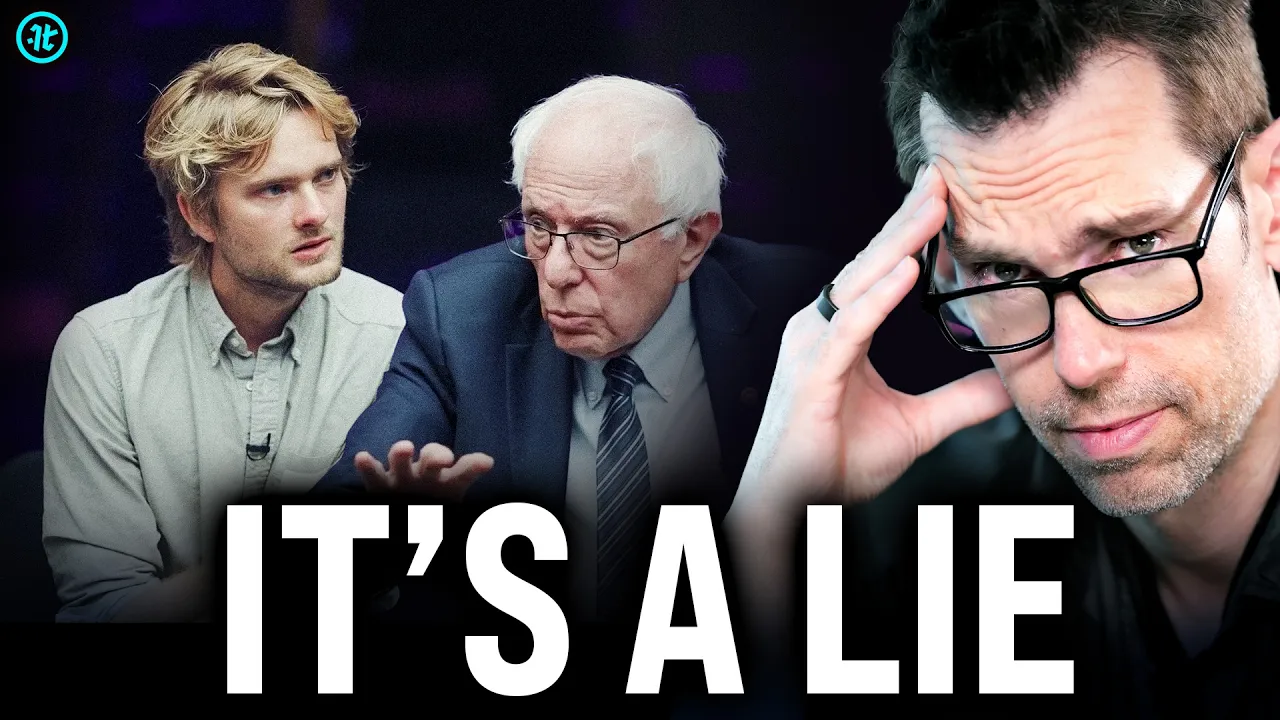
'No One Is Coming To Save You': The Brutal Truth About AI And Your Job
Tom Bilyeu
56,547 views • 1 month ago Save 45 min 7 min read
Video Summary
The rapid rise of AI has sparked a fierce debate over whether this technology will empower the workforce or lead to economic obsolescence. While critics argue that AI is a tool for corporate exploitation and job displacement, the central tension lies in whether society will choose to adapt by acquiring new skills or succumb to a passive reliance on automated systems. The outcome depends on whether individuals can leverage AI to enhance their own capabilities rather than outsourcing their thinking to corporate-controlled algorithms.
Ultimately, the path forward requires a balance between innovation and regulation. While some propose radical wealth redistribution or government-led control of AI, these approaches risk stifling the very competition needed to drive progress. Success in an AI-driven future hinges on maintaining a competitive market, fostering individual agency, and establishing clear moral frameworks that protect the individual while allowing for the necessary economic growth to sustain a thriving middle class.
Short Highlights
- AI serves as a powerful, commodified intelligence that individuals can leverage to outcompete others or build new skills.
- Economic stagnation and poor policy decisions, rather than AI alone, are the primary drivers of current job market instability.
- The most effective way to protect workers is to break up corporate monopolies and foster competition, not to implement government-led wealth redistribution.
- True progress requires individuals to remain 'adaptation machines' who use AI to enhance their own abilities rather than outsourcing them.
- Proposed solutions for AI regulation:
- Mandatory labeling of AI-generated content to ensure transparency.
- Light-touch regulation for data center construction to protect local communities.
- Anti-monopoly enforcement to prevent corporate tyranny.
- Public commissions with subpoena power to hold AI leaders accountable.
Related Video Summary
Key Details
The Market Choice [00:00:19]
- Consumers ultimately dictate the success of AI in service industries through their spending habits.
- If AI-driven efficiency lowers costs or provides a superior experience, it will naturally displace human-centric alternatives that fail to compete.
You're going to decide if you would rather go to a restaurant with AI or without. There is not an invisible force at play.
The Friction of Change [00:01:21]
- Market shifts only occur when consumers find the current experience intolerable enough to switch providers.
- If users do not care enough about the human element to pay a premium, industries will inevitably prioritize efficiency.
If you're like, oh God, I really hate this, but I'm going to stay. Then what you're saying is, yeah, the friction of this thing isn't that big of a deal to me.
The Danger of Convenience [00:03:07]
- Removing all friction from life, as depicted in the movie WALL-E, risks eroding human capability and resilience.
- Necessity is the mother of invention, and humans must intentionally seek challenges to grow stronger.
I would be very worried about a world where AI does everything for us and friction is removed.
Global Competition [00:04:47]
- AI is an inevitable global development because countries that refuse to adopt it will be at a massive disadvantage.
- The challenge for individuals is to use AI to empower their own understanding rather than outsourcing their thinking.
Therefore, any country that tries to compete without AI will lose to a country with AI.
Corporate Experimentation [00:06:55]
- Businesses often run flawed AI experiments to find efficiencies, which creates friction with frontline workers.
- Failure is an information-rich data stream that allows companies to innovate and eventually control their space.
Failure is the most information rich data stream on planet Earth.
The Goal of Efficiency [00:08:44]
- Efficiency is not inherently evil; it is a response to consumer demand for lower prices and faster delivery.
- The tension between human connection and efficiency is a choice made by the market, not just by corporate bosses.
The reason that you want to get more efficient is you have people that don't want to wait in line or they want something cheaper.
The Reality of Employment [00:11:06]
- Companies are not families; they are entities focused on survival and profitability.
- Employees should maintain their own value by keeping their skills sharp and being willing to seek employment elsewhere if conditions are poor.
The goal of the business is to be profitable. The goal of the business is to survive into the future.
AI as the Great Equalizer [00:15:37]
- AI provides access to intelligence, which is the most powerful commodity on Earth.
- Those who view AI with a default negative bias trap themselves, while those who learn to leverage it gain a competitive advantage.
AI is the very thing that will let you build something to be able to compete with these guys that you otherwise wouldn't be able to compete with.
The End of Entry-Level Jobs [00:17:15]
- AI is highly effective at performing entry-level tasks, which disrupts traditional career pipelines.
- Success now requires demonstrating actual skills and the ability to use AI to perform work rather than relying on credentials.
You've got to make something. You've got to show people what you can do.
The Resilience of Adaptation [00:20:53]
- No one is coming to save individuals from economic disruption; personal resilience is the only viable path.
- Young people have a unique advantage in adopting technology if they avoid being crippled by fear.
No one is coming to save you. No one has ever come to save you.
The Economic Context [00:23:04]
- Current economic weakness is masked by debt and entitlements, making AI a convenient scapegoat for broader systemic issues.
- True growth requires a thriving middle class and a commitment to making things domestically.
We've been masking a very sick economy for a very long time.
The Role of Values [00:28:44]
- Society has lost the ability to engage in public discourse around moral philosophy and foundational principles.
- Without a clear moral framework, political and economic arguments devolve into meaningless slogans and tribalism.
We've lost an appetite for public discourse around philosophy, ideas of morality, meaning systems of morality more aptly.
The Danger of Redistribution [00:33:48]
- Proposals to have the government seize AI wealth represent a path toward economic disaster and communism.
- Innovation requires competition and the incentive for companies to thrive, not just the extraction of their profits.
That is the, we're going to take all of your money. And if he wants to let people vote on it, which it sounded like earlier he did, this is exactly how you kill industry full stop altogether.
The Need for Competition [00:37:05]
- Breaking up monopolies is a valid strategy to ensure competition and protect the individual.
- A healthy economy requires multiple companies running different experiments to find the best solutions.
We need to address that. We need these kinds of checks and balances.
AI Transparency [00:38:52]
- Mandatory labeling of AI-generated content is a necessary, light-touch regulation to combat misinformation.
- Blockchain technology could be used to verify the source of content, increasing trust in digital media.
It is crazy to me that you aren't at a minimum putting things on an account so that I can know this was generated by this account.
The Trust in Government [00:41:24]
- The belief that government is the only entity capable of protecting citizens is historically dangerous.
- While corporations tend toward tyranny, governments have been responsible for the vast majority of mass casualties in the 20th century.
The government is the most abusive of the organizations that you've ever encountered ever in your life.