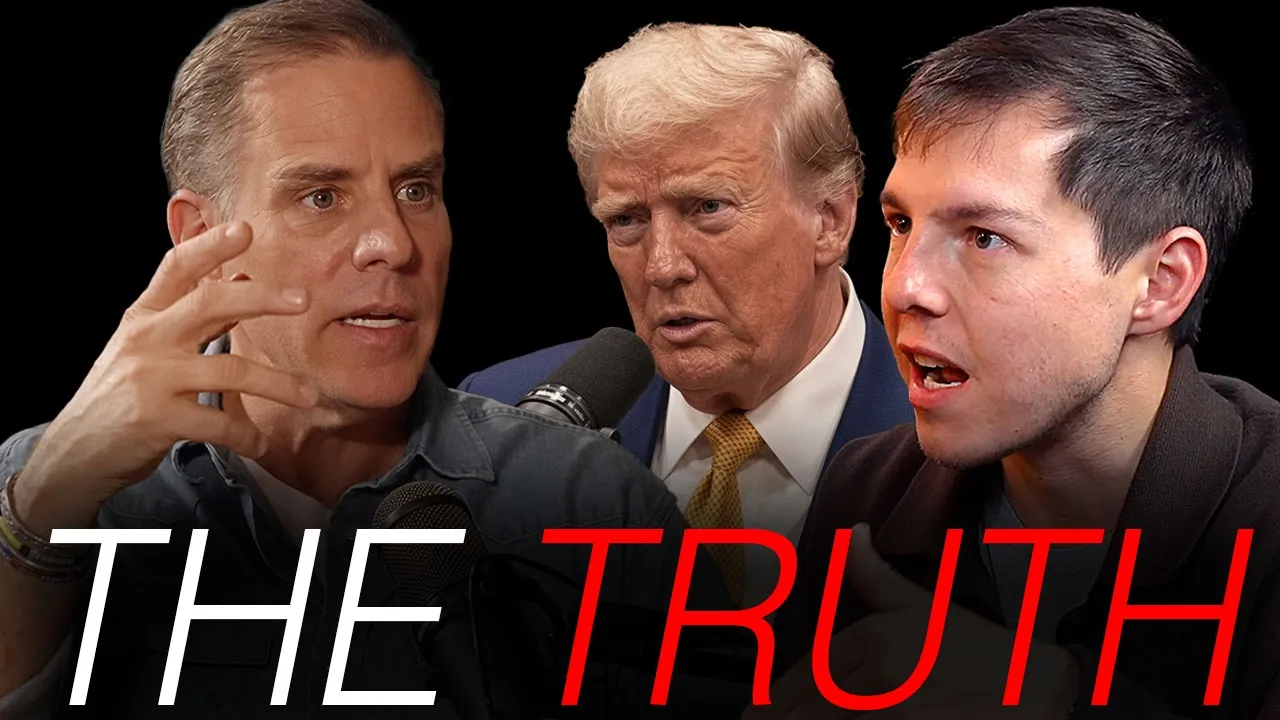
We Audited Hunter Biden: $15 Million Owed, $0 Stocks, & Going Broke
The Iced Coffee Hour
24,863 views • yesterday Save 94 min 15 min read
Video Summary
Hunter Biden discusses his turbulent financial journey, revealing a current debt of approximately $15 million primarily due to legal battles. He shares his aspiration for a better relationship with money, contrasting his upbringing with the financial complexities he now faces. Biden also touches upon his father's vow to never own stock due to potential conflicts of interest and his own experiences with financial literacy, student loans, and early real estate investments.
Further into the conversation, Biden delves into the controversial launch of his crypto coin, "Laptop," which experienced a dramatic crash. He explains the tokenomics designed to be different from typical celebrity coins, aiming for community development and charity, but acknowledges the launch was marred by a market maker's insufficient liquidity, causing a volatile price surge and subsequent fall. He maintains that despite the initial setback, the coin has stabilized and he intends to be transparent about the events and make amends.
Short Highlights
- Financial Status: Rates his current finances as a "zero" out of ten.
- Debt: Carries approximately $15 million in debt, primarily from legal defense.
- Crypto Coin "Laptop": Launched a crypto coin that experienced a rapid surge to a $316 billion market cap before crashing due to insufficient liquidity from a market maker.
- Art Sales: His art prices have not fluctuated, with the highest sale being $85,000 through a gallery.
- Career Path: Has held various roles, including a principal at a recovery center, working with tenant rights organizations, and as an artist and writer.
- Financial Goals: Aims to pay off his debts and create a stable environment for his family, rather than accumulating excessive wealth.
Key Details
Intro and Initial Discussion [0:00]
- The episode begins with an unusual introduction acknowledging its "spicy" nature and the need for a repost, emphasizing the value of diverse conversations.
- Hunter Biden is introduced, and the conversation immediately dives into finances.
"How would you rate your finances one out of ten?"
Financial Rating and Debt [0:40]
- Biden rates his current financial situation as a "zero" out of ten.
- He reveals significant debt, stating it's "about $15 million" for legal battles.
"How much is that debt for fighting those legal battles? Like about $15 million."
Motivation for Appearing [2:02]
- Biden explains his willingness to appear on the podcast, citing the hosts' guests, insightful questions, and the opportunity to connect with a different audience.
"And the truth of the matter is, is that I usually learn something when I'm listening to you."
Universal Pain and Grief [4:45]
- Biden discusses the topic of universal pain and grief, suggesting it's a more profound connector than often acknowledged.
- He believes that pain, in its various forms, is a guaranteed human experience and a means of identifying with others.
"The pain is the universal connector."
Public Perception and Misconceptions [6:15]
- Biden addresses the public's perception of him, attributing misunderstandings to a narrative spun before he could speak for himself.
- He explains that his past reticence was partly due to being under Department of Justice investigation and a desire not to complicate his father's political career.
"Oh, I think that they get a lot of things wrong based upon a narrative that has been spun for close to seven years before I started to speak for myself."
Father's Financial Stance [8:10]
- The conversation shifts to his father's vow never to own stock, stemming from a commitment to avoid conflicts of interest as a senator.
- Biden explains the context of Spiro Agnew's resignation and his father's decision to maintain this commitment throughout his career.
"And so, he had made a commitment not to own a stock or a bond to never have that conflict of interest. And he kept that commitment."
Conflict of Interest and Financial Literacy [11:00]
- Biden agrees with the principle of avoiding conflicts of interest for public servants, suggesting blind trusts as a solution.
- He notes that while his father's stance was noble, index funds could have achieved a similar effect without complete stock ownership avoidance.
"And if people that have that kind of authority cannot set aside and put in like blind trust, truly, truly blind trust while they serve, then I don't think that they should be serving."
Senatorial Salary and Wealth [12:15]
- Biden discusses the salary of senators in 1972 and the average salary during his father's 36-year tenure, suggesting it wasn't a path to personal wealth.
- He points out that many senators enter office already wealthy, as it's not a place to make money unless one engages in side dealings, like stock trading.
"Um, well, 90% of them that come into the United States Senate come in already rich because of the fact that it is not a place to go to make money."
Money in Politics [14:00]
- Biden asserts that real power in Washington D.C. is money, influencing policy through lobbying and PACs rather than direct personal financial gain for politicians.
- He highlights the staggering amounts spent by industries and the impact of Supreme Court decisions allowing unlimited political spending.
"The real power in Washington D.C. is money."
Relationship with Money and Early Life [16:30]
- Biden expresses a desire for a better relationship with money, recalling his upbringing where it wasn't a central dinner table topic.
- He shares the anecdote of his family having to mortgage their home for his first semester tuition at Georgetown University.
"And that's kind of the way that my brother and I were raised."
Student Debt and Early Career [18:00]
- Biden details his student loan debt after Georgetown and his time in the Jesuit Volunteer Corps, earning $80 a month.
- He incurred further debt for Yale Law School, graduating with around $165,000 in debt.
"And then I got married and had Naomi, my first child. And then I got in law school and I took out, I think at the time it was all in for law school when I graduated from Yale, about another $130,000, $120,000 for that."
Real Estate Investments [19:30]
- Despite his debt, he was able to buy, fix up, and flip houses, accumulating some savings.
- He identifies real estate as his best investment, sharing a personal anecdote about working on an old DuPont estate with his father and brother.
"And that's the way that I had put a little money away in terms of, uh, and having savings and giving myself a little bit of a cushion to be able to send three daughters to, you know, to, to school and, and, you know, and have a house and ultimately in Washington DC for 20 years."
Career in E-commerce and Education [21:00]
- Biden recounts his career path, working at a bank, then the Department of Commerce to understand the internet and e-commerce.
- He planned to open an e-commerce policy law firm but the dot-com bubble burst, impacting his friends' businesses.
"And I got a really incredible view into what was coming next in terms of a new technology and particularly as related to at the time being called e-commerce and the internet."
Transition to Education Sector and Business [23:00]
- A Jesuit priest suggested he help St. Joseph's University secure federal dollars for a program.
- This led to him building a business representing Jesuit universities, which he voluntarily gave up when his father became Vice President due to potential conflicts of interest.
"And I, uh, unilaterally and volunteered to give up that business, which was really hard for me."
Current Work and Multiple Jobs [26:30]
- Biden describes his current situation as working "four different jobs."
- These include being a principal at Peak Path Health (a recovery center), working with Basta Universal (a tenant rights and homeless prevention organization), being an artist, and writing.
"So right now I am a, um, a principal at a recovery center here in Los Angeles called peak path health."
Art Business and Pricing [29:00]
- Biden explains that his art prices are set by third-party galleries, not himself, and have not fluctuated.
- He clarifies that the New York Post's reported prices of $100,000-$500,000 were inaccurate and that no piece sold for that amount.
"However, no piece of art that I've ever sold has been close to what the New York Post said."
Art Sales Transparency and Controversy [31:30]
- He details the controversy surrounding his art sales during his father's presidency, including impeachment hearings and legal fees for buyers and the gallerist.
- Biden states he made it clear he would not sell to anyone outside the United States and that sales would be transparent, though a rule was made for anonymity during his father's term.
"And they even made a rule while my dad was president that it would be anonymous to me, which made it almost impossible in many ways."
Most Expensive Art Sale and Notable Buyers [34:30]
- The highest price he sold a piece of art for was $85,000, with the gallery taking a 50% commission.
- He mentions Martin Sheen as a admired recipient of his art and his mother as a significant owner, with her pieces displayed in the White House.
"I think the highest price was 85,000. Yeah. Well, by the way, which through the gallery, which I got 50%, uh, a little under 50% of."
Writing and Substack [36:30]
- His fourth job is writing, including a memoir "Beautiful Things" and two new books on Substack.
- One new book details events he wasn't present for, involving research into a "conspiracy to dehumanize" him, utilizing AI to organize vast amounts of documents.
"And then another one is a, uh, is an accounting of what happened in the rooms that I wasn't in kind of the conspiracy to dehumanize, uh, me and, uh, impact our politics."
AI in Research [38:30]
- Biden shares how he used AI, specifically Claude, to analyze podcast transcripts for research, significantly speeding up the process.
- He emphasizes the importance of transparency when using AI tools.
"The productivity speeds us up if you're transparent about it in a way that, but what's, by the way, so there's this whole debate on Substack right now is they put in one of those AI detection tools for everybody."
AI Safety and Future [41:30]
- Biden vacillates on AI safety concerns, acknowledging both legitimate fears and the potential for hype to drive regulation or IPOs.
- He views AI as a potential evolutionary leap for humankind, with utopian possibilities for health and climate, but also risks.
"I think that we are on the verge of the, probably the most significant, not probably the most significant evolutionary leap in human kind throughout all of history."
Investing in an AI Future [44:30]
- When asked about investing in an AI-driven future, Biden jokes about calling the hosts for advice.
- He mentions Chris Camillo's thesis on robot workers and the potential for AI to lower prices and make large purchases less meaningful.
"I'm going to be calling you guys for advice is what I'm going to be doing."
"Laptop" Coin Launch and Mechanics [47:30]
- Biden explains the "Laptop" coin was designed to be different from celebrity tokens, with 70% for community development and 30% for insiders, including a 20% airdrop.
- A unique feature was an embedded prediction market where outcomes (like an Eagles win) could burn coins or dedicate funds to charity.
"So I built a coin that number one, reverse the tokenomics in which 30% of the coin was to the, uh, on the inside and 70% of the coin basically was to develop and create community."
"Laptop" Coin Crash and Market Maker Issue [49:30]
- On launch day, a market maker deployed only $5,000 for liquidity, causing the coin to surge to $316 billion market cap before crashing.
- Biden believes this was due to insufficient liquidity, allowing bots to manipulate the price, and questions the market maker's actions.
"And so it went from, we launched it $50 million. That was our, uh, that was our, our, our launch price. It was significantly, I mean, low 50 million in, in within three minutes, it went to $316 billion because we only had five, they only put $5,000, 30,000 coins into the liquidity pool."
Belief in Crypto and Audience Engagement [52:30]
- Biden expresses belief in the crypto community's potential for democratizing finance and saw the meme coin as a dynamic way to engage a younger, largely apolitical audience.
- He believes there is still value in the coin and its message, aiming to prove that a coin can be done differently and serve as a tool for community and good.
"And what I thought happened in the last election was just a bastardization of, and, and a taking advantage of an entire community that is largely apolitical."
Meme Coins and "Degen" Culture [55:30]
- Biden acknowledges that meme coins are not investments but more like trading cards, and that the market is largely driven by "degenerates" (degens) focused on attention.
- He defends his approach, stating he took a shot with good intentions and believes he can still prove his point about the coin being a tool.
"But if someone doesn't understand that, uh, who doesn't understand that the 90% of the market is a bunch of DGens that are, are, uh, literally it, it, it, it, it, it trading."
Fiat Currency vs. Cryptocurrency [57:30]
- Biden argues that fiat currency has its own flaws and that cryptocurrency has a future, particularly for a generation engaged in an economy many older people don't understand.
- He contrasts cryptocurrency's lack of involvement in the 2008 crash or money laundering scandals with traditional banking.
"So, as if, as if the dollar bill is anything but me. Okay. All right. And so, and also, you know, like this idea, well, it's a, it's a way for people to operate anonymously in a black market and in a criminal way."
Transparency and Rebuilding [59:00]
- Biden emphasizes radical transparency as his approach to dealing with the "Laptop" coin situation and his overall life.
- He is in a "complete rebuilding process," currently living in Cape Town for affordability and community, and is working on building a sustainable career in art and writing.
"What I'm in right now is a complete rebuilding process, like just a complete rebuilding process."
Financial Goals and Debt Repayment [1:03:00]
- His immediate financial goal is to make good on his debts, working with creditors on payment plans.
- He has no interest in accumulating excessive material possessions but wants to live in an environment that nurtures his family relationships.
"My immediate financial goal would be to, uh, to make good on, um, the debts that I owe."
US Economy Concerns [1:06:30]
- Biden expresses concern about the US economy, citing $40 trillion in debt, with a significant portion accrued in recent presidencies.
- He believes the country needs to address entitlements and potentially unpopular fiscal measures.
"Forty trillion dollars in, in, in debt."
Stabilizing US Debt [1:07:30]
- Biden suggests three key changes: reforming entitlement programs, re-evaluating how wealth is taxed (as taxing billionaires' income is ineffective), and controlling spending.
- He critiques the idea of solely taxing billionaires, noting they often don't pay income tax, and highlights the disproportionate tax burden on the middle class.
"Number one is to, uh, is to, uh, come to terms with, uh, how we are going to continue to organize and, and run our entitlement programs."
USAID and Foreign Aid Debate [1:10:00]
- Biden defends USAID programs, citing their critical role in humanitarian efforts and soft diplomacy, and criticizes their potential elimination.
- He recounts his experience with the UN World Food Program and the importance of US aid in global crises.
"USAid, you know, how much money we spend on USAID and as a percentage of the budget less than 3%."
Rapid Fire Questions: Stocks, White House, Trump [1:14:00]
- Biden states he does not own stock but agrees to accept money to buy one share of Apple.
- He describes White House staff as dedicated and wonderful people.
- He admires Trump's tenacity but dislikes his cruelty, particularly towards female reporters.
"Do you own a single stock? No."
Personal Insecurities and Finances [1:18:00]
- Biden identifies clothes as his cheapest trait and his biggest insecurity as having his secrets exposed, which he now views as a blessing.
- He estimates needing about a third of the $30 million John Morgan mentioned for financial freedom, along with a paid-off house.
"My biggest insecurity would be that you would have found out I was not just in my biggest insecurity would have been that you found out that I was in motel rooms with people that you don't want to be in motel rooms with."
Final Thoughts on "Laptop" Coin and Future [1:21:00]
- Biden reiterates his intention to be radically transparent and believes the "Laptop" coin can still achieve its goals.
- He acknowledges the difficulty of explaining the situation but is committed to making amends and proving his intentions.
"The proof is in the pudding, and the pudding is, the ingredients have to be an after action report, an independent study to say what happened in that 316."
Closing Remarks and Future Plans [1:27:00]
- Biden expresses his desire to build something meaningful, emphasizing resilience, recovery, and redemption.
- He aims to have a financial future that allows him to make independent decisions and nurture his family relationships.
"And so I look at this thing as that. I look at, look, I took a swing. I had the exact right intentions."