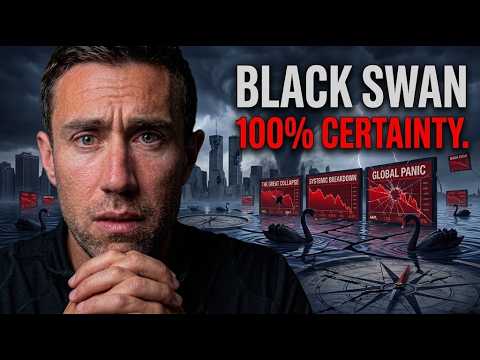
"Something ALWAYS Breaks" | Major Black Swan Risk.
Meet Kevin
4,651 views • 22 hours ago Save 14 min 4 min read
Video Summary
Skyrocketing 10-year treasury yields, reaching levels not seen since 2007, are sparking fears of a financial crisis, with historical data showing that rapid rate hikes often precede market breakdowns. Analysts warn that the current surge may be driven by forced selling and liquidations, a "pain trade" that could escalate.
The market's stability appears increasingly reliant on the artificial intelligence sector, with 75% of the S&P 500's earnings attributed to AI since late 2022. This concentration, guaranteed by AI pioneers like Sam Altman and Dario, faces significant risk from potential disruptions in financing markets, exacerbated by high treasury yields and a shift towards off-balance-sheet funding. A resolution to the conflict in Iran could offer a reprieve, but without it, the AI-driven economy faces collapse.
Short Highlights
- Rapid Treasury Yield Increases: Historically, significant spikes in treasury yields have consistently led to market disruptions, with "something always breaking."
- Forced Selling Suspected: The current rapid rise in yields may be driven by forced selling and liquidations, a "pain trade" that could continue.
- AI's Dominance: The S&P 500's earnings are heavily concentrated in AI, making the broader market highly dependent on this sector's continued growth.
- Financing Vulnerabilities: The AI sector's reliance on financing, particularly from entities like Anthropic and OpenAI, is a critical vulnerability, especially with rising yields and off-balance-sheet funding.
- Geopolitical Influence: A potential deal with Iran could stabilize bond markets and alleviate pressure, but its absence poses a significant risk.
- Market Indicators: The 2-10 spread on treasury yields is a key indicator to watch for potential economic distress.
Key Details
The "Something Always Breaks" Phenomenon [0:08]
- Concerns are mounting that skyrocketing 10-year treasury yields could trigger a "black swan" event, leading to a financial crisis.
- Historical data reveals a pattern where rapid interest rate increases are followed by market calamities, such as the 1987 crash, the 2008 financial crisis, and the 2023 regional bank collapse.
-
"Something always breaks."
Forced Selling and the "Pain Trade" [1:04]
- While rising yields typically mean bond values are falling, selling might not be voluntary; forced liquidations by investors or banks could be driving the current yield surge.
- This "pain trade" has the hallmarks of investors being forced out of positions at elevated levels, suggesting the trend could persist.
-
"The move has the hallmarks of a pain trade and forced selling by investors at these more elevated levels that could have further to run."
Oil Prices and Treasury Yield Correlation [2:10]
- Recent spikes in oil prices, influenced by attacks on Saudi pipelines and tanker strikes, have coincided with rising treasury yields.
- However, treasury yields have continued to climb even as oil prices have recently retreated from their peaks, suggesting other factors are at play.
-
"suggesting that we might be up against some kind of private credit liquidation, banking liquidation, somebody's going bankrupt, something's going broke."
The AI Foundation of the Economy [3:45]
- The S&P 500's earnings are heavily reliant on artificial intelligence, with AI contributing significantly to GDP growth.
- Contrary to popular belief, the S&P 500 is seen not as a diversifier but as a concentrator and enabler of AI.
-
"75% of the S&P 500's earnings have been artificial intelligence since late 22."
Guarantors of AI and Financing Risks [5:20]
- The AI sector's growth is underpinned by key players like Anthropic and OpenAI, whose financing is critical.
- A shift towards riskier off-balance-sheet financing for AI projects, coupled with rising treasury yields, creates significant vulnerabilities.
-
"The problem is, and this is where it sort of loops around. If there is a concern about these guys, and all of a sudden financing gets harder, because what's really happening is these guys are kind of secretly coming around over here and they're putting yet another pyramid under here."
Critical Market Indicators and Potential Triggers [7:30]
- The spread between the 10-year and 2-year treasury yields is a crucial indicator; a spread exceeding 0.5% signals potential distress.
- The absence of a deal with Iran is highlighted as a major risk that could exacerbate current market pressures and lead to a collapse.
-
"So if you want a single chart to watch the 2-10 spread, watch this. You get over 0.5 and you still don't have an Iran deal, you have a problem."