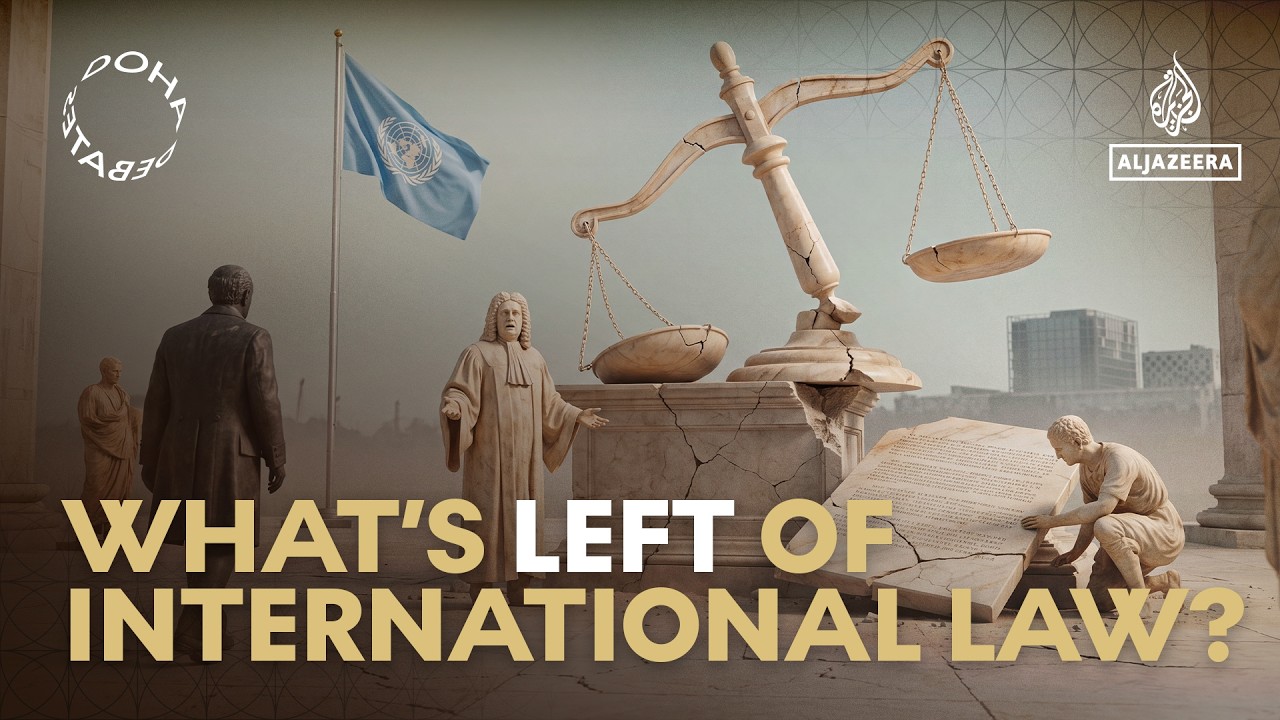
Does international law still matter? | Doha Debates
Al Jazeera English
196 views • 21 hours ago Save 40 min 9 min read
Video Summary
The very idea of international law is under siege, with powerful nations increasingly disregarding its tenets, leading to a "wilderness of self-contradicting myths." While some argue that the system, exemplified by treaties governing air travel and global communication, is the "most wondrous thing in human history" and prevents catastrophic conflicts like World War III, others contend that its effectiveness is undermined by selective enforcement and a persistent "double standard."
This tension is particularly evident in ongoing conflicts, where rulings go unenforced and institutions are unable or unwilling to act. The debate probes whether international law is merely a "rule of power, but not law," or if its continued existence, even when challenged, offers a path toward a more just and stable global order. The discussion highlights the historical evolution of international law, its colonial baggage, and the ongoing struggle to adapt it to contemporary challenges like climate change and artificial intelligence.
Short Highlights
- International law's existence and relevance are debated: Some argue it's the "water we swim in" and essential for global order, while others see it as a "rule of power, but not law."
- Enforcement is a critical issue: Rulings are often unenforced, and institutions struggle to act, leading to questions about the universality and effectiveness of international law.
- Historical evolution of international law: The shift from classical, natural law-based systems to modern positive law, including the UN Charter, is a key point of contention.
- Colonial baggage and double standards: Concerns are raised that international law carries colonial legacies and is applied inconsistently, favoring powerful nations.
- Preventing major conflicts: The UN Charter system is credited by some with preventing World War III, despite its imperfections.
- Contemporary challenges: Emerging issues like climate change, pandemics, and artificial intelligence necessitate an evolving international legal framework.
- The younger generation's inheritance: There is a call for the next generation to critically examine and continue building the system of international law.
Key Details
The Water We Swim In [00:01:18]
- International law is often unnoticed, like water to fish, yet it underpins global interactions, from air travel to diplomatic relations.
- Despite detractors, international law is presented as a foundational element enabling global events and cooperation.
"The truth is, we couldn't have even arrived here for this debate to have a conversation about whether international law matters if it weren't for international treaties."
Does International Law Still Matter? [00:02:11]
- The existence and relevance of international law are questioned in an era of great power geopolitics.
- Some argue that the disregard of international law by certain countries should reinforce the conviction to preserve it.
"The fact is just the opposite. it should reinforce the conviction of everyone in the world that we need to preserve international law and we need to buck the trend unleashed by certain countries to disregard or to disobey or to even try to destroy international law."
The Rule of Power, Not Law [00:03:07]
- When cardinal rules of international law are violated with little consequence, it becomes difficult to distinguish law from a rule of power.
- There's a debate on whether international law possesses universal consensus or is a body of rules argued over by various stakeholders.
"When many of those cardinal rules are violated and the rest of the world does very little about it, then it's hard to pretend that there is any such thing as a law because what basically exists is a rule of power, but not law."
Classical vs. Positive International Law [00:04:11]
- Over two centuries, international law has shifted from classical, natural law-based systems to positive law, primarily treaties.
- This transition has led to a reversal of concepts, such as the right to make war, which was fundamental in classical international law.
"Over the past two centuries, what we mean by international law has changed almost entirely, has been almost entirely reversed because what I usually call classical international law, which is the Westphalian international law, mainly due to the 17th and 18th centuries, is a system of natural law."
The UN Charter and Preventing World War III [00:07:51]
- The international order established around the UN in 1945, particularly the Security Council with its veto power, is seen as crucial for preventing a third world war.
- Despite its imperfections, this system is credited with moving the world forward and managing global affairs.
"The point I want to make is that the international order established around, rallying around the United Nations, may need to exist unless there will be a third world war, which will completely change every aspect of it."
Post-War International Order: Two Phases [00:09:06]
- The post-war era can be divided into two phases: 1945-late 1980s (Cold War) and post-Cold War.
- The first phase saw the consolidation of Pax Americana and the rise of the Soviet model, alongside efforts to use international law for the development of formerly colonized countries.
"The first phase is between 1945 to roughly the 1980s, late 80s until the end of the Cold War, when there was a post-war consensus of a kind about the new legal framework that had been put in place."
The Bandung Conference and Third World Perspectives [00:10:07]
- The 1955 Bandung Conference is a critical moment in framing international law from the perspective of formerly colonized nations.
- Many saw the 1945 framework as having colonial baggage and requiring urgent reform.
"That is widely regarded in international legal scholarship, for example, as a critical moment that founded the framing of international law as one that was lacking in the critical rules and institutions that really would help the formerly colonized countries."
The Binding Nature of Treaties [00:11:55]
- The Vienna Convention on the Law of Treaties states that treaties are binding because they are binding (pacta sunt servanda).
- This ultimately rests on a natural law rule, suggesting that countries should abide by treaties simply because they should.
"So ultimately, what this means is that what looks like a positivistic international law ultimately rests on a natural law rule which simply says countries should abide by treaties because, well, they should abide by treaties."
The UN Charter's "Enemy State" Clause [00:13:04]
- The UN Charter contains an "enemy state" clause, authorizing victor nations of WWII to take action against former enemy states if they pose a threat.
- This clause, never formally removed, provides a deterrent and demonstrates that international law has "teeth."
"Now, the UN Charter did not exist in a vacuum. It did not exist really on sands. It existed on these very crucial international treaties."
Evolution of International Humanitarian Law [00:15:39]
- Rules governing the use of force evolved from concerns about the frequency and humanitarian consequences of wars.
- The work of the International Committee of the Red Cross and the Kellogg-Briand Pact contributed to questioning the sovereign right to use force.
"The evolution of the International Committee of the Red Cross by the work of Henry Dunant, after he witnessed the savage nature of war in Solferino, the battle is too well recorded."
The "Board of Peace" and International Legitimacy [00:20:09]
- The "Board of Peace," proposed by a former US President, is criticized for lacking legitimacy and being primarily composed of Americans.
- Its establishment after being tasked by the Security Council highlights a disregard for formal processes by leading powers.
"And he can put together a panel of his friends if he wants, but that does not have the legitimacy that the UN Charter has."
Might Makes Right vs. Universal Rules [00:22:47]
- The Azeri-Armenian conflict is cited as an example where "might made right" and led to a swift resolution without prolonged conflict.
- This contrasts with protracted conflicts where international law's application is questioned.
"And because nobody in the world really cared that much, the war happened, it ended, territory changed hands, no vast century, you know, decades of terrorism, no, you know, revanchism, no, none of this, the war is over."
Double Standards in International Law [00:25:05]
- Powerful states often get away with more than weaker states, a structural condition of the international system.
- Institutions like the International Criminal Court (ICC) are attempting to address this by indicting major leaders, though enforcement remains a challenge.
"So more powerful states are always going to be able to get away with more than weaker states. That is not a problem with the law. That is a structural condition of the international system."
Gaza and the Deficiencies of International Law [00:27:26]
- The destruction in Gaza highlights both the double standard of power and the substantive deficiencies in international law, particularly regarding civilian objects like homes.
- International law is characterized by a "substantive double standard" stemming from outdated legal frameworks.
"The Geneva Convention just don't do a good job of protecting the things that really matter for people like keeping their own homes, for example, or schools or hospitals in place."
The Long Arm of Justice [00:30:55]
- Despite current power dynamics, justice eventually prevails, as seen in the downfall of Hitler and Japanese fascism.
- The principle of "do unto others what you don't want others to do unto you" is emphasized as a guiding moral and logical principle.
"So, if you see someone very powerful today, holy cow, holding the whole world at bay for example, don't believe he represents the truth. He may be crushed eventually."
International Law as an Unfinished Project [00:32:52]
- International law should be viewed not just as a threatened system but as an ongoing, unfinished project.
- The younger generation faces significant challenges in addressing emerging issues like climate change, inequality, and AI.
"When it comes to international law, look at international law not simply as a system or rules that are achieved against great odds and that are now threatened because of behavior of some rogue actors which it might look like given the behavior of especially some governments including the current U.S. administration but also to realize that international law is really an unfinished project."