Why 3 Private Companies Are Worth 45 Years of Public Tech — And You're Locked Out
Tom Bilyeu
3,711 views • 21 hours ago Save 36 min 10 min read
Video Summary
The U.S. is draining its emergency oil reserve at a rate unseen since 1982, depleting it to a 44-year low while producing more oil than any other nation. This action, coupled with a doubling of the U.S. Treasury's debt buybacks and a surge in private company valuations that dwarf public market listings, signals a potential economic shift.
These developments, occurring simultaneously, suggest a deliberate strategy to manage inflation and interest rates, potentially at the expense of ordinary savers. The speaker posits that this approach, reminiscent of past economic downturns where a select few profited while many lost, is a mechanism to obscure underlying economic fragility and maintain a facade of stability before a larger crisis unfolds. Understanding this mechanism is crucial for navigating the changing economic landscape and protecting one's assets.
Short Highlights
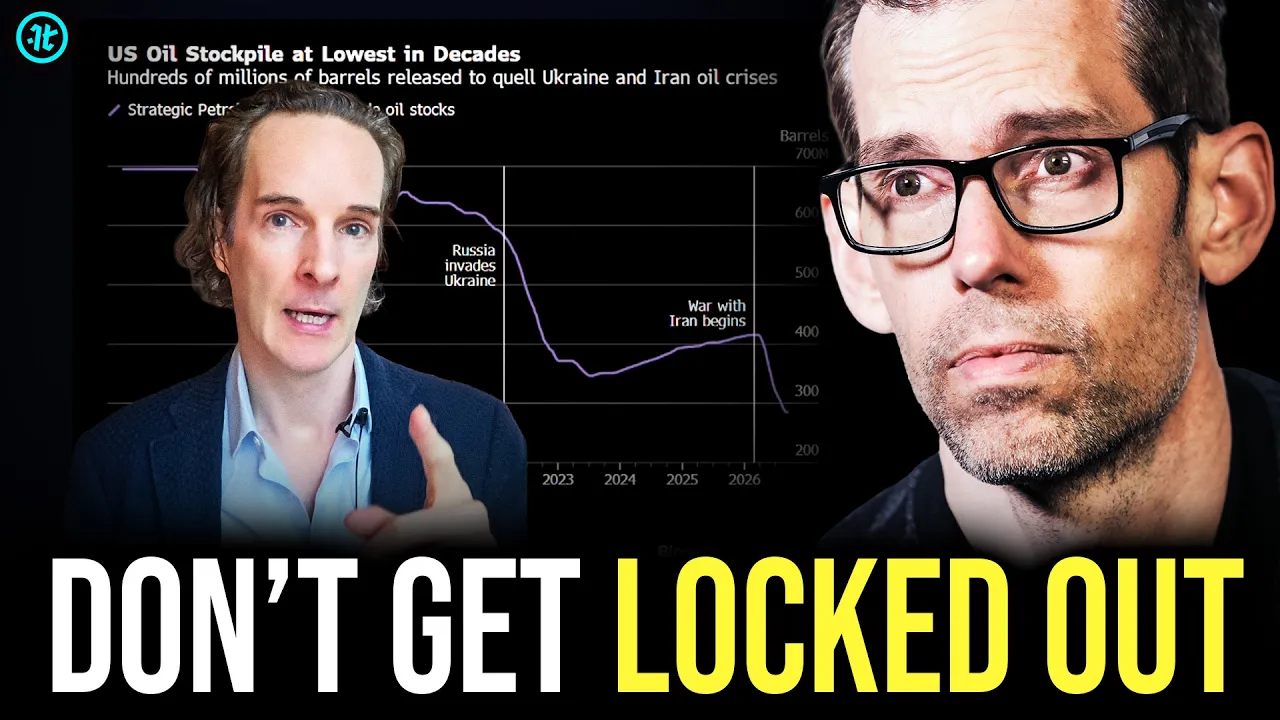
- The U.S. Strategic Petroleum Reserve is at its lowest level since 1982, with 26 consecutive weeks of declines.
- The U.S. Treasury is doubling its debt buybacks, a move described as "legalized counterfeit."
- Private companies like SpaceX, Anthropic, and OpenAI are now valued more than all U.S. public companies from the last 45 years combined.
- These actions are viewed as a strategy to artificially suppress oil prices and manage inflation, particularly before elections.
- The current economic environment is characterized as "late stage investing" and a potential "new regime" where traditional playbooks may not apply.
- Ordinary savers are at risk of losing their savings, while those who understand the market mechanisms can profit.
- Diversifying into assets that cannot be printed, such as precious metals and certain essential businesses, is recommended.
Key Details
The Draining of America's Oil Reserve [0:10]
- For 26 consecutive weeks, the U.S. government has been drawing down its emergency oil reserve.
- The reserve is now at its lowest level since 1982, marking a 44-year low.
- This is happening despite the U.S. being the world's largest oil producer and exporter.
"For 26 weeks in a row, the US government has been quietly draining America's emergency oil reserve literally every single week."
The "Wild West" of Investing [0:40]
- The current economic situation is described as the "Wild West," with the global order and investment strategies changing.
- These changes are leading to the "obliteration" of people's savings in real-time.
- The central question is whether traditional inflation-fighting strategies are still effective or if a new regime is in place.
"This is the Wild West. We are watching the entire world order change."
The Strategic Petroleum Reserve's Purpose [1:08]
- The Strategic Petroleum Reserve (SPR) is intended as a backup for supply disruptions, such as hurricanes or shipping lane blockages.
- The decision to empty the reserve week after week, while the country doesn't need it, is questioned.
- The speaker suggests there's a specific reason for this action, which, when combined with other recent events, is cause for concern.
"So why would anyone empty the emergency tank week after week at the exact moment the country doesn't need to?"
The Three Converging Events [1:25]
- The draining of the oil reserve lines up with two other significant events that occurred this month.
- The convergence of these three events is what worries the speaker, as it indicates a larger setup.
- Historically, similar setups have led to ordinary savers being "cleaned out" while a select few profited.
"And it's the three of them landing together at once that actually worries me."
The Urgency of High Interest Rates [3:10]
- The U.S. has been accumulating significant debt, which was manageable in a low-interest-rate environment.
- However, interest rates have risen significantly, with the 10-year Treasury yield above 5% and the 30-year even higher.
- This puts the government in a fiscal crisis, as the cost of servicing the debt becomes unsustainable.
"But now we're, as of recording this, we're north of 5% on the 10 year, way above that on the 30 year."
Potential Government Responses to Debt Crisis [4:00]
- When a government is trapped by debt and high interest rates, it has limited options.
- One option is to push interest rates back down, which often involves maintaining higher inflation.
- Other options include austerity (stopping deficit spending), significantly higher taxes (akin to socialism), or economic growth.
"When a government is trapped like this, there is only one way out. And that one way out doesn't involve paying for politicians, which is really what their motivation is."
The Japanese Stagnation Model [6:30]
- Japan has spent decades keeping interest rates near zero to manage its debt.
- This strategy has led to economic stagnation for nearly 30 years, with "zombie companies" surviving due to low borrowing costs.
- The quality of life for the average person in Japan has declined, with stagnant wages and rising costs.
"They have been stagnant for nearly 30 years. People working at one company their whole life, which might sound good, but that absolutely robs the dynamism from the corporate ecosystem."
The Strategic Petroleum Reserve's Decline [7:30]
- The SPR has been running down for some time, but the pace has accelerated rapidly in the last year.
- The reserve was nearly three times larger a decade ago.
- The president's announcement to refill with Venezuelan oil is questioned due to the type and availability of Venezuelan crude.
"And it's at the lowest level since 1982. And the president just released another 400,000 barrels last week, a 26th week in a row of it declining."
Venezuelan Oil and Geopolitical Strategy [8:15]
- Venezuelan oil is heavy and sulfur-rich, not meeting reserve specifications for U.S. crude.
- The Venezuelan oil industry has been in decline for 20 years.
- Despite these issues, a strategic relationship with Venezuela could be advantageous for the U.S. in the long term, creating a significant energy block.
"However, having a strategic relationship with Venezuela, I think, is going to be extremely advantageous to the US."
The Real Reason for Draining the Reserve [9:30]
- The primary reason for emptying the emergency oil tank is to hold down oil prices.
- A spike in oil prices would exacerbate inflation, making it unmanageable and preventing the government from printing more money.
- The reserve acts as a "shock absorber" to keep pump prices acceptable, especially before an election.
"Why do you empty your emergency tank when you produce more oil than anybody on Earth? Well, it's simple. They're using it to hold down the oil price."
The Treasury's Debt Buyback Doubling [14:00]
- The U.S. Treasury announced it is doubling the amount of debt it buys back, to $4 billion each time.
- This is termed "liquidity support" but is essentially the government buying its own debt because not enough buyers exist at affordable rates.
- This is likened to "legalized counterfeit" and is a sign of desperation.
"The US Treasury just announced it's doubling the amount of debt it buys back. $4 billion each time now."
The Death Spiral of Debt and Money Printing [15:30]
- The U.S. has a massive amount of debt, and interest rates are high, causing interest payments to become the largest budget item.
- This creates a "death spiral" where more money printing is required to manage the debt.
- This situation is compared to Japan's long period of stagnation due to near-zero interest rates, which is now breaking down.
"So we've got so much debt. It's compounding every year and interest rates are ridiculously high. And so now the interest is eating you alive."
The Mechanism of Wealth Transfer [17:00]
- The wealthy benefit from rising asset prices, selling assets in "post-inflation dollars" to preserve wealth.
- This allows them to accumulate more wealth compared to those whose savings are eroded by inflation.
- Assets that cannot be printed, like precious metals, become attractive during times of turmoil.
"The reason is that when you invest in assets, which I know you guys already understand, but the part that I think people often miss is as your assets go up in value, you then sell some of those assets."
Private Company Valuations vs. Public Markets [19:30]
- Three private companies (SpaceX, Anthropic, OpenAI) are now worth more than all U.S. public companies from the last 45 years combined.
- Companies are being held private for much longer, allowing private investors to capture most of the value before IPO.
- This creates a wealth disparity, locking out ordinary investors from early-stage growth.
"This month it was reported that SpaceX, Anthropic and OpenAI, three private companies, are worth more than every single US company that went public in the last 45 years combined."
Concentration in Public Markets [21:00]
- American households have unprecedented exposure to the stock market, with about a quarter of net worth tied up in stocks.
- However, the market is highly concentrated, with the top 10% owning 93% of assets.
- The five largest companies in the S&P 500 now constitute 30% of the index, making index funds heavily reliant on a few names.
"But even with that, 10% own 93% of the assets. That's the bad news."
The Bubble in Tech Valuations [22:00]
- The CAPE ratio (cyclically adjusted price-to-earnings) is over 40, far above its historical average of 16.
- This suggests a significant bubble in the market, particularly in tech.
- The narrative driving these valuations is a key factor, as fundamentals have been disregarded.
"We're now over 40. And every time that we've crossed over 40, there has been catastrophe."
Skilled Money vs. Ordinary Investors [24:00]
- "Skilled money," exemplified by Donald Trump's trades, is moving into essential, "boring" businesses like waste management and home improvement.
- These businesses are cash-generating and benefit from inflation.
- Conversely, ordinary investors are chasing crowded tech stocks, which are seen as overvalued and prone to bursting.
"On the way in, boring toll booths that love inflation, and on the way out, all the crowded tech stuff."
The "Toll Booth" Business Model [27:30]
- Businesses that act as "toll booths," like credit card networks, are attractive because they take a percentage of transactions.
- As inflation increases prices, their revenue naturally grows.
- These cash-light, essential businesses are seen as more resilient in an inflationary environment.
"What you're looking at is something where as inflation goes up and everything just gets more expensive, the credit card companies are just taking a percentage off the top."
The Risk of AI Investments [29:00]
- While AI has immense potential for productivity gains, current valuations are extremely high.
- Debt accumulation in AI companies is still outpacing revenue growth, making them risky.
- Over-indexing on AI without diversification is cautioned against, despite its transformative potential.
"But you can say that right now, the debt accumulation is still outstripping the revenue accumulation. And that is a problem."
Thriving in the New Economic Regime [30:30]
- Inflation is expected to persist or increase, making it essential to be invested in assets.
- The focus should be on companies likely to thrive in an inflationary environment, such as those with "toll booth" models or essential services.
- Understanding the economic reorientation and adapting investment strategies is crucial for long-term success.
"So with me or somebody else, this really isn't a plug for you watching my content. This is me being absolutely terrified that people are going to get devastated as the economy reorients itself to something new."