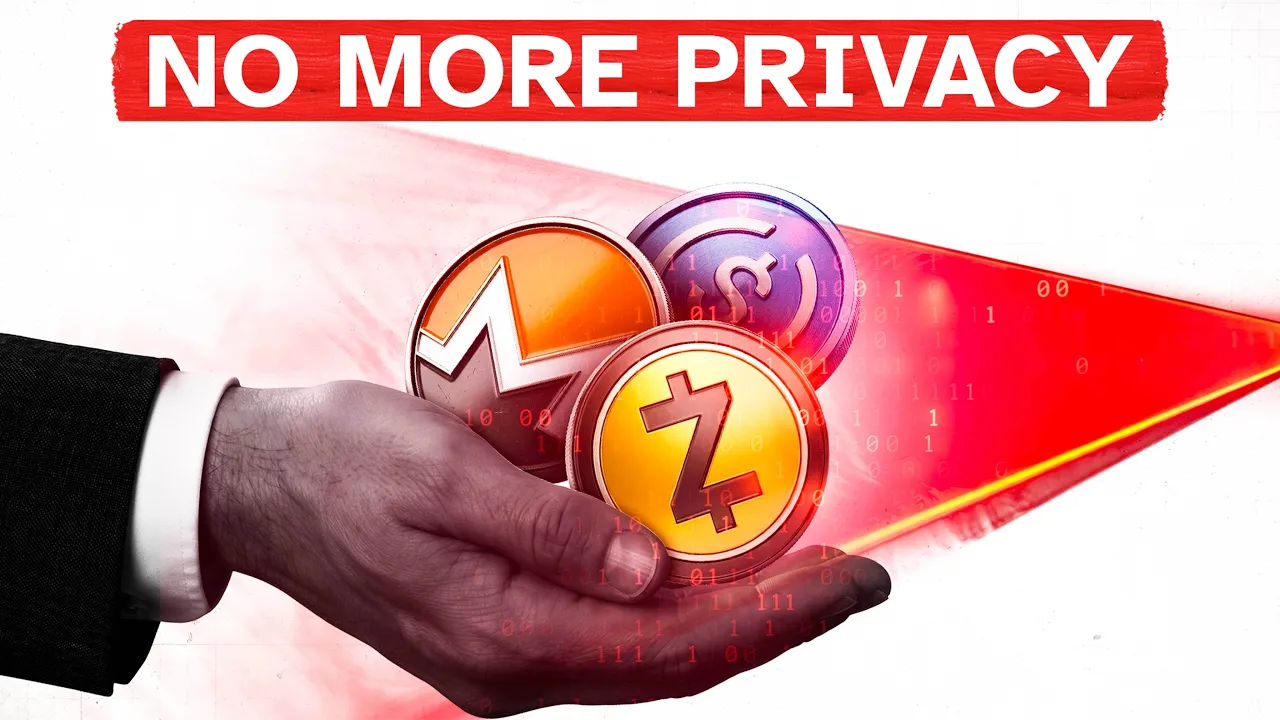
The Crypto Privacy WAR Is Here.
Coin Bureau
697 views • yesterday Save 7 min 4 min read
Video Summary
Crypto's initial promise of financial privacy has been challenged by the industry's embrace of transparency, which has enabled unprecedented transaction tracking. This shift has led to a legal battle where developers of privacy tools face prosecution, while regulators and institutions grapple with the implications.
While governments and analytics firms benefit from this transparency, many in the crypto space are pushing for a return to privacy through advanced technologies like zero-knowledge proofs. This evolving landscape pits those who want to keep the ledger open against those who seek to shield their financial activities, creating a complex debate over who controls access to financial data.
Short Highlights
- The original vision for crypto was financial privacy, aiming for transactions that couldn't be monitored.
- Bitcoin's design prioritized pseudonymity, not true privacy, allowing transactions to be traced.
- Privacy-focused coins like Monero and Zcash have faced delisting from major exchanges.
- Governments have targeted privacy tools, leading to the prosecution of developers behind mixers like Tornado Cash.
- Advanced technologies like zero-knowledge proofs are enabling new forms of privacy on blockchains.
- Institutions are now demanding privacy for competitive and operational reasons.
- The debate centers on whether financial privacy should be the default or an opt-in feature.
Key Details
The Transparent Ledger [0:19]
- A freelance designer received $2,000 in USDC and discovered they could view the sender's entire transaction history by pasting their wallet address into a block explorer.
- This revealed the client's full balance, payment history, and recipients, demonstrating that blockchain transparency allows for extensive data access without hacking.
"No hacking required. All he had to do was check the chain."
The Original Privacy Promise [1:29]
- Early concepts in cryptography, like David Chaum's DigiCash in the 1980s, aimed for electronic money that even issuing banks couldn't trace.
- The 1993 Cypherpunks manifesto argued for privacy as essential in the electronic age, with the goal of creating money nobody could watch.
- Satoshi Nakamoto's 2008 white paper for Bitcoin carried this idea forward, though it focused on pseudonymity rather than true privacy.
"Privacy wasn't an afterthought in crypto. It was, at least originally, the whole point."
The Rise of Transparency and Its Consequences [2:49]
- Firms like Chainalysis and Elliptic built businesses around linking blockchain addresses to real individuals, leveraging transparency.
- The tracing of coins from the Silk Road takedown and the 2016 Bitfinex hack demonstrated how transactions touching regulated exchanges could lead back to individuals.
- Exchanges and regulators viewed this transparent ledger as a feature, not a flaw, leading to the delisting of privacy coins like Monero and Zcash by platforms such as Bittrex, OKEx, Binance, and Kraken.
"So, for exchanges and regulators, the glass ledger became a feature rather than a flaw."
Government Crackdown on Privacy Tools [4:12]
- In August 2022, the US Treasury's OFAC sanctioned Tornado Cash, a smart contract mixer, marking the first time software itself was sanctioned.
- This led to the arrest and subsequent conviction of Tornado Cash developer Alexei Pertsev in the Netherlands for money laundering, sentenced to 64 months, though he was released pending appeal.
- Co-founder Roman Storm was indicted in the US and convicted of operating an unlicensed money-transmitting business, with a retrial on more serious charges set for April 2027.
"And this was the first time a government had sanctioned software itself rather than a person."
The Evolution Towards Selective Disclosure [10:00]
- The development of zero-knowledge proofs (ZK proofs) allows for verification of information without revealing the underlying data, enhancing privacy.
- Ethereum's roadmap now includes privacy as a core pillar, with initiatives like the rebranding of its research team to "privacy stewards" and the development of frameworks like Kohaku for private wallets.
- Institutions, including JPMorgan, are building confidential infrastructure for financial transactions, recognizing the need for privacy from competitors while remaining compliant.
"The new people demanding privacy are actually the suits."
- The concept of selective disclosure is emerging, allowing users to reveal only necessary information, such as with Zcash's viewing keys or ZK compliance proofs, to balance privacy needs with regulatory requirements.