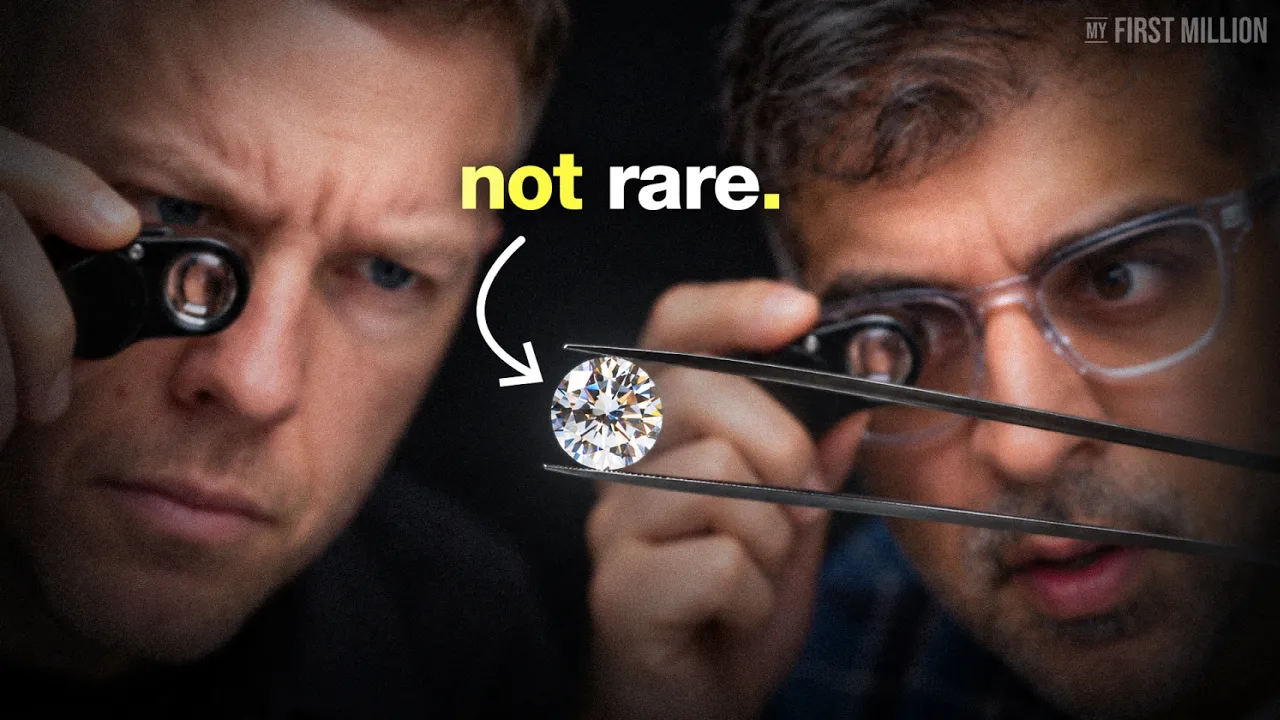
we went down the diamond rabbit hole (and it’s unhinged)
My First Million
24,593 views • 13 days ago Save 25 min 7 min read
Video Summary
The diamond industry's value is a carefully constructed illusion, built on decades of masterful marketing rather than inherent rarity. Originally symbols of royalty, diamonds became plentiful after a South African discovery in the late 1800s. To combat this devaluation, De Beers consolidated supply, creating a near-monopoly. Facing the Great Depression, they hired an agency to reposition diamonds from a luxury item to a symbol of eternal love, famously coining "A Diamond is Forever." This campaign, coupled with tactics like educating young girls and influencing Hollywood, cemented diamonds as an expected part of engagement, driving demand and price.
Today, lab-grown diamonds, chemically indistinguishable and significantly cheaper, now dominate the market at over 60% share. De Beers initially tried to discredit them but eventually launched their own lab-grown line, intentionally undercutting the market to create a wider perceived gap. Despite wholesale price drops, retail jewelers maintain high markups, highlighting the enduring power of marketing and perception over intrinsic value. The success of this strategy offers lessons for industries like data centers and cryptocurrency, demonstrating how changing mass perception can create immense value.
Short Highlights
- Diamond prices have plummeted, with two-carat lab-grown diamonds costing as little as $148.
- De Beers created a near-monopoly by consolidating diamond supply after a major South African discovery.
- The "A Diamond is Forever" campaign repositioned diamonds as symbols of eternal love during the Great Depression.
- Hollywood influence and targeted education campaigns cemented diamonds as an engagement ring expectation.
- Lab-grown diamonds, indistinguishable and cheaper, now hold over 60% of the market.
- Retail jewelers maintain high prices despite falling wholesale costs, capturing increased margins.
- The diamond industry's success highlights the power of marketing to shape perception and create perceived value.
Key Details
The Diamond Price Collapse [0:00]
- Diamond prices have crashed dramatically, down 70% from their peak and 50% since COVID-19.
- A two-carat lab-grown diamond, once imagined to cost $20,000, now retails for a mere $148.
-
"it's the price of dinner you can have a diamond ring or dinner is the trade right now"
The Marketing Masterclass [0:42]
- The diamond industry's success is attributed to masterful marketing, not inherent rarity.
- De Beers strategically managed supply and perception to maintain high prices.
-
"this whole thing is a marketing master class lab grown versus natural uh you know versus blood diamonds versus you know there's so many different ways they position these things it's crazy"
Historical Rarity and Discovery [2:10]
- Diamonds were historically rare, associated with royalty, power, and wealth.
- A massive diamond discovery in South Africa in the late 1800s shifted them from rare to plentiful.
-
"diamonds went from extremely rare to plentiful you could just go down there get a scoop like it's baskin robbins and come out with with diamonds"
De Beers' Monopoly and Supply Control [2:55]
- Cecil Rhodes and others consolidated supply, forming De Beers and controlling the market.
- They acquired mines to control the flow of diamonds, creating a near-monopoly.
-
"they formed the de beers companies have you ever heard of de beers diamonds that's kind of the the merger of these two guys who were consolidating the industry trying to trying to lock up supply"
Repositioning Diamonds: From Wealth to Love [4:40]
- During the Great Depression, De Beers hired an agency to reposition diamonds.
- The focus shifted from wealth and royalty to emotions, specifically love and commitment.
-
"we're going to relink diamonds instead of to royalty and wealth because people don't have there's not enough people who feel wealthy right now we're going to relink it to love"
"A Diamond is Forever" and Emotional Anchoring [5:16]
- The famous slogan "A Diamond is Forever" was created to symbolize eternal love.
- This marketing strategy aimed to make diamonds a necessity for engagement.
-
"that's where the the idea came of a diamond is forever you know this famous copywriter who came up with this diamond is forever line"
The Four Cs and Pricing Discrimination [8:30]
- De Beers invented the "Four Cs" (Cut, Color, Clarity, Carat) to create language for pricing discrimination.
- This system allowed for a wide gradient of pricing, similar to the wine industry.
-
"the four c's gave them language to use for pricing discrimination and this is very common this happens with wine as well"
Hollywood and PR Machine [7:15]
- De Beers bribed Hollywood directors and actors to feature diamonds prominently in films.
- A coordinated PR machine disseminated celebrity engagement news to media outlets.
-
"they made diamonds into news so the insight was they realized it is much easier to get somebody who's buying a six thousand dollar diamond to go up to 12 than to get somebody who's not buying a diamond to spend six grand on a rock"
The Rise of Lab-Grown Diamonds [11:45]
- Lab-grown diamonds, chemically identical and much cheaper, now constitute over 60% of the market.
- De Beers initially tried to discredit them but later launched their own lab-grown products.
-
"lab has become 60 plus percent of the market wow it has grown like crazy and so just it's growing it's a freight train it's a majority it's already the majority it'll be the super majority soon"
De Beers' Second Attack on Lab Diamonds [12:40]
- De Beers intentionally undercut the lab-grown market to create a stark price difference.
- This tactic aimed to distinguish "real" natural diamonds from "fake" lab-grown ones.
-
"they then launched their own lab product and intentionally undercut the lab market by a lot to almost even further create a big spread between natural and lab"
Retail Markups Persist [14:25]
- Despite falling wholesale prices, retail jewelers maintain high markups.
- Jewelers are hesitant to lower prices, as most consumers cannot access wholesale diamonds.
-
"even though the wholesale prices have dropped off like that chart if you go to the jewelry store they're still roughly the same price so down like 15 20 the jewelers the retail stores are just keeping the markup"
Lessons for Other Industries [15:15]
- The diamond industry's success demonstrates the power of changing mass perception.
- This strategy can be applied to industries like data centers and cryptocurrency (e.g., Bitcoin's reframing as "digital gold").
-
"i think the data or the data center industry can take note from a lot of this stuff well yeah i think that's uh supplements for sure it it fits there i would say also i think bitcoin"
The Power of Narrative and Belonging [16:40]
- Bitcoin's narrative shifted from currency to "digital gold," and terms like "diamond hands" foster belonging.
- Creating narratives and a sense of community can drive adoption and value, similar to diamonds.
-
"and then they called it you know instead of being the loser who held it at uh you know 100 grand and now it's at 20 grand and you're just sitting on it like a like a a punk and they were like no you have diamond hands"
The Illusion of "Greatest Generation" [18:50]
- The concept of a "Greatest Generation" is largely a narrative construct, not historical fact.
- Words and phrases used to describe past generations are often more about perception than reality.
-
"it was just this idea that like when you and i were 21 millennials were shit on now gen z soon it'll be i don't know what the next name is but this idea of like these words and phrases that we use to look back they're just mostly nonsense"
Pro-Noia: The Opposite of Paranoia [19:45]
- Believing the universe conspires in your favor ("pro-noia") can lead to self-fulfilling prophecies.
- This mindset encourages looking for evidence that supports positive beliefs, changing behavior and outcomes.
-
"paranoia is feeling like everything is working against you and pro noia is feeling like the universe is kind of conspiring in your favor"
A Random Life Simulation [20:30]
- A simulation shows how incredibly lucky modern humans are to be born in the current era.
- Life in 1200 CE, even for a boy in present-day Yemen, involved a short lifespan and high child mortality.
-
"life expectancy was only 29 years half your kids would die before the age of five"
Extreme Luck of Modern Birth [21:50]
- Out of 100 billion humans who have ever lived, being born today is statistically extraordinary.
- The simulation highlights the vast improvements in life expectancy, health, and opportunity.
-
"how incredibly lucky you are out of the 100 billion people that have ever lived of humans that have ever lived in the history of time"