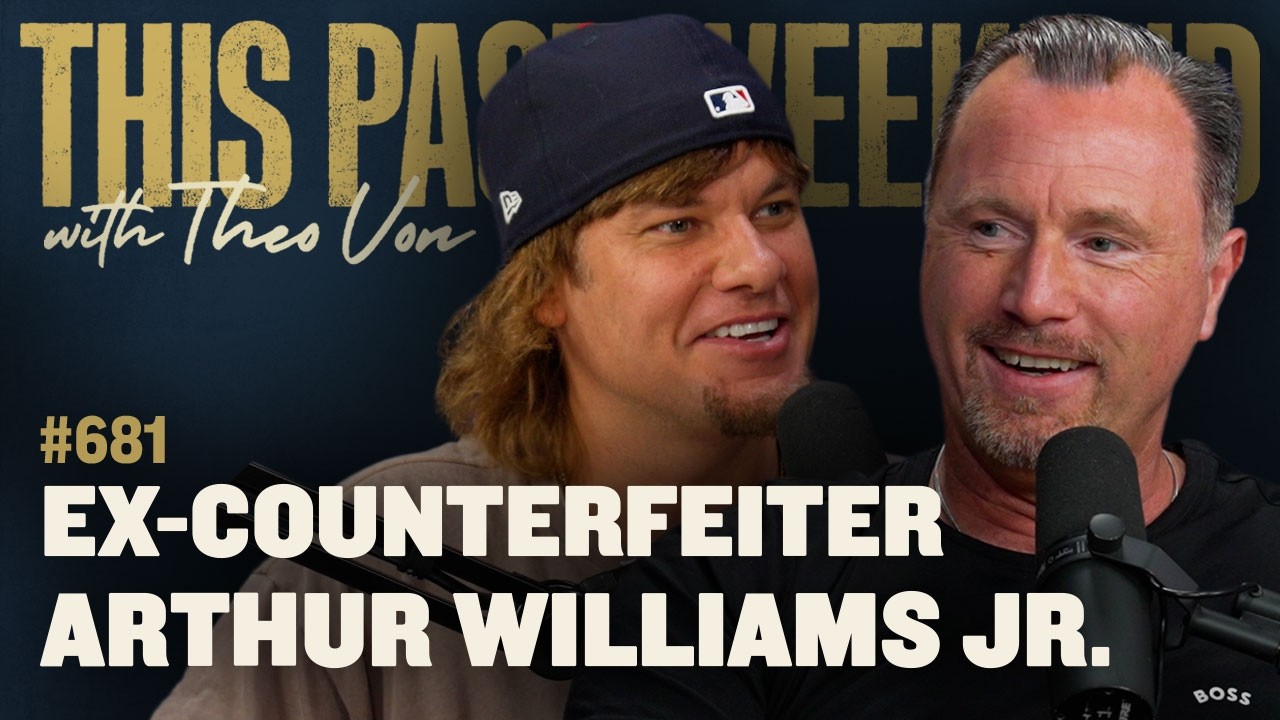
Ex-Counterfeiter Arthur Williams Jr. | This Past Weekend w/ Theo Von #681
Theo Von
305,992 views • 1 month ago Save 134 min 5 min read
Video Summary
Art Williams, once one of America's most prolific counterfeiters, reveals how he turned the government's own security measures against them to print millions in fake currency. Driven by a childhood of poverty and a natural talent for solving complex puzzles, Williams operated as a "ghost," eventually creating a high-tech hybrid method that bypassed advanced security features like watermarks and security strips. His operation, which he describes as a form of art, was so effective that the federal government was forced to redesign the $100 bill to thwart his efforts.
Despite his criminal success, Williams' life was defined by the high-stakes tension of the underground world, leading to multiple prison sentences and a bizarre, tragic intersection with his own family history. Today, Williams has pivoted from crime to professional art, using his skills to create pieces on canvas that incorporate his former craft. He warns that the shift toward programmable digital currency represents a new, dangerous era of state control, far more invasive than the physical counterfeiting he once mastered.
Short Highlights
- Williams printed over $10 million in fake currency using a hybrid of old-school offset printing and modern digital technology.
- He successfully replicated security features including watermarks, security threads, and color-shifting ink by studying patent schematics.
- The U.S. government redesigned the $100 bill in 1996 and again in 2013, with Williams claiming his work was a primary catalyst for these changes.
- His operation was highly secretive, relying on "ghost" tactics and avoiding corporate or small-business targets to delay detection.
- Williams and his son were both imprisoned for counterfeiting, eventually serving time in the same federal facility.
- He views the transition to a programmable U.S. digital dollar as a dangerous tool for government surveillance and financial control.
- Williams is now a professional artist, incorporating his printing expertise into canvas works that serve as historical commentary on currency.
Related Video Summary
Key Details
Early Life and Crime [00:04:15]
- Williams grew up in poverty on Chicago's South Side, where his first "crime" involved breaking into parking meters to feed his family.
- He developed a lifelong obsession with dissecting puzzles and mechanics, which he later applied to his criminal enterprises.
- His introduction to organized crime began through local gangs, which he describes as an escalation from breakdancing crews to violent street factions.
Apprenticeship with Pete [00:15:30]
- An older mentor, nicknamed "Pete da Vinci," introduced Williams to the quiet, organized world of counterfeiting.
- Williams learned the fundamentals of offset printing, ink mixing, and plate making while working as Pete's assistant.
- Pete taught him the essential philosophy of the trade: to be a "ghost" and remain completely invisible to law enforcement.
The 1996 Currency Challenge [00:27:00]
- When the new $100 bill was released, the government claimed it was impossible to replicate due to new security features.
- Williams took this as a personal challenge, studying the bill's micro-printing, color-shifting ink, and watermarks to find ways to defeat them.
- He discovered that the "moray" pattern, which caused wavy lines on scanners, was a key security feature he had to navigate.
Developing the Hybrid Method [00:42:15]
- Williams combined traditional offset printing for the bill's background with digital technology for serial numbers and seals.
- He discovered that standard phone book paper was the perfect weight and acidity to pass the "marker test" used by retailers.
- He recruited unsuspecting senior citizens to help assemble the paper, unaware they were assisting in a massive counterfeiting operation.
High-Stakes Spending [00:58:10]
- Williams and his partner Natalie traveled across the country, spending fake bills at malls to stay ahead of the authorities.
- He often used the proceeds to help struggling families and donate to the Salvation Army, which he describes as a source of genuine fulfillment.
- Despite his success, he maintained a "top secret" lifestyle, burying millions in PVC pipes throughout the country.
The House of Blues Bust [01:15:45]
- Williams was arrested at the House of Blues in Chicago after a bartender overheard him talking about a "party" and alerted authorities.
- He successfully beat the case in court when his lawyer proved the police falsified their probable cause regarding the presence of drugs.
- The Secret Service was unable to charge him for counterfeiting at that time because they lacked the necessary evidence.
Reunion in Alaska [01:30:20]
- Seeking his estranged father, Williams traveled to rural Alaska, where they bonded over their shared history in crime.
- The reunion turned volatile when his father's wife contacted the Secret Service, leading to a massive law enforcement operation.
- Williams and his father were both eventually sentenced to federal prison, where his father died of a heart attack on the day Williams was released.
Father and Son in Prison [01:50:10]
- Williams' son began printing fake $20 bills, leading to his own arrest by the Secret Service upon turning 18.
- The two were reunited in a federal prison in Arkansas, where they spent years together as cellmates.
- During this time, they focused on their respective crafts: Williams on painting and his son on music.
Transition to Professional Art [02:05:30]
- After his final release, Williams was mentored by a prominent Chicago businessman who helped him transition into the professional art world.
- He now operates galleries and creates art that incorporates his past, often printing on actual currency as a commentary on history.
- He remains a vocal critic of the proposed U.S. digital dollar, warning of the dangers of programmable money and government surveillance.