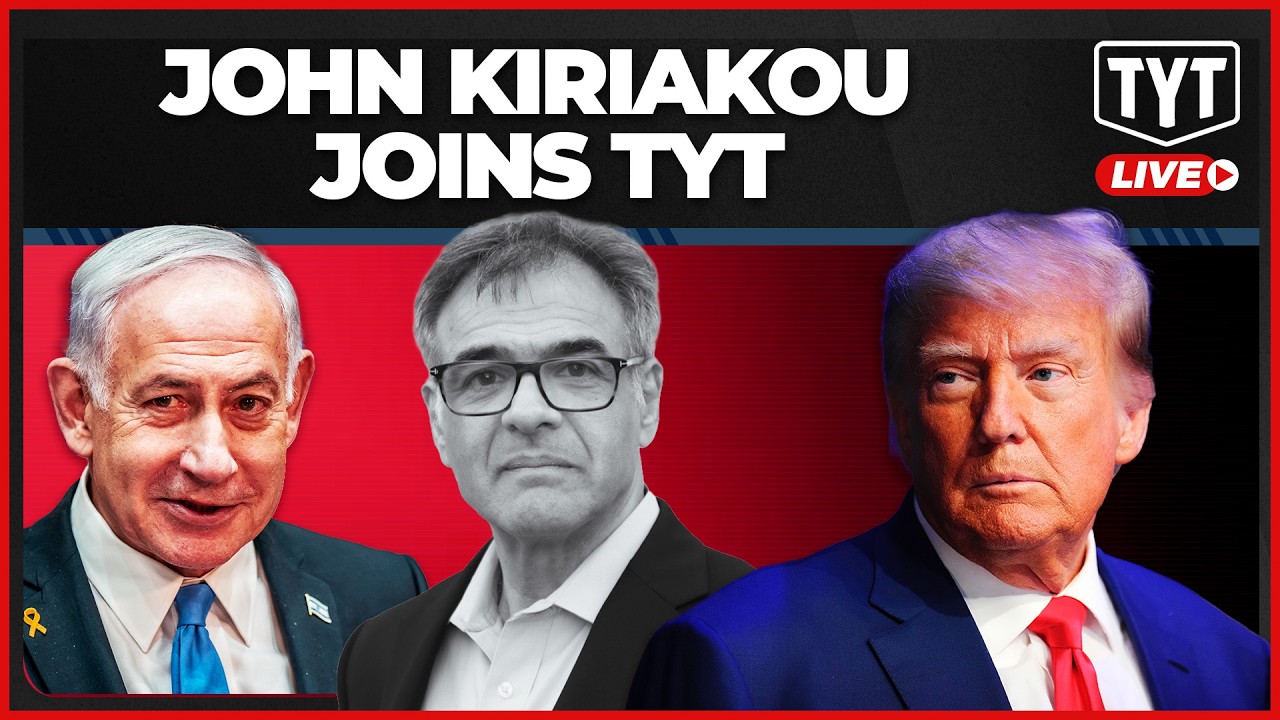
John Kiriakou Discusses BOGUS Israeli Intel & Civilian Slaughter COVERUP
The Young Turks
102,897 views • 1 month ago Save 127 min 22 min read
Video Summary
The United States is increasingly mirroring Israel's aggressive military tactics, leading to a surge in civilian casualties, particularly in Yemen. This shift, driven by a deepening political and military entanglement with Israel, has raised concerns about war crimes and the erosion of American values. The transcript highlights how this strategy, characterized by attacking civilian infrastructure and a disregard for civilian lives, is not only a violation of international law but also counterproductive, potentially fueling further conflict and extremism.
Furthermore, the discussion delves into the pervasive influence of money in American politics, particularly concerning the Israel lobby's sway over Congress. This influence, coupled with a media landscape often perceived as complicit or uncritical, allows for policies that benefit defense contractors and foreign interests at the expense of American taxpayers and democratic principles. The piece concludes by emphasizing the need for greater accountability and a fundamental shift away from endless wars and unchecked corporate power.
Short Highlights
- Civilian Casualties in Yemen: US strikes have killed at least 150 civilians, with potentially more casualties yet to be accounted for.
- Loosened Rules of Engagement: The US has reportedly loosened rules, contributing to increased civilian deaths.
- War Crimes Allegations: Attacking civilian infrastructure is described as a "black and white war crime."
- Media's Role: Mainstream media is criticized for not reporting on the realities of the wars and for promoting pro-war narratives.
- Influence of Money in Politics: The Israel lobby's financial influence on Congress is highlighted as a key driver of US foreign policy.
- Defense Contractor Exploitation: Defense contractors are accused of profiting from taxpayer money with little accountability.
- Endless War: The persistent cycle of conflict is seen as a failure that bankrupts the nation.
Key Details
Civilian Casualties in Yemen [00:01:08]
- The US has killed at least 150 civilians in Yemen, with initial reports underestimating the toll.
- This comes after Pete Hegseth reportedly gutted civilian protection measures.
- The executive director of Air Wars noted that the US hit 1,000 targets in Yemen over 50 days, a pace far slower than in Iran.
"And now we realize that there's 150 civilians at a minimum that we killed in strikes in Yemen."
Loosened Rules of Engagement [00:01:42]
- John Kiriakou believes the US has significantly loosened its rules of engagement, leading to more civilian deaths.
- He states that attacking civilian infrastructure is a clear war crime.
- Kiriakou argues that such actions by the US encourage similar behavior from allies like Israel and Saudi Arabia.
"Attacking civilian infrastructure is a black and white war crime. You can't do that. And we do it anyway."
US Strikes in Yemen [00:02:36]
- US forces attacked at least 1,000 targets in Yemen over approximately 50 days.
- The goal was to diminish the Houthis' arsenal and restore freedom of navigation.
- The Houthis were striking ships in the Red Sea to protect Palestinians and impose costs on Israel and its allies.
"US forces attacked at least 1,000 targets in that time. And it was a span of about 50 days, according to Pentagon figures."
Pentagon Review of Strikes [00:03:24]
- US forces acknowledged killing 153 civilians and wounding nearly 250 others in Yemen.
- One attack on April 28, 2025, killed 68 civilians.
- The Pentagon has reviewed three attacks but has yet to analyze 15 more.
"And that's what we know so far. Now one attack on April 28th, 2025 alone killed 68 civilians in northwestern Yemen, according to the Pentagon's review."
Pete Hegseth's Mentality [00:04:25]
- Pete Hegseth advocated for "Operation Epic Fury" with "maximum authorities" and "bold, precise" rules of engagement.
- He stated, "This was never meant to be a fair fight and it is not a fair fight."
- Hegseth's approach involved taking out 90% of the staff of a group meant to look at civilian casualties.
"America is winning decisively, devastatingly and without mercy."
Consequences of Aggressive Tactics [00:05:09]
- Kiriakou explains that aggressive tactics drive disparate factions together, as the US is often seen as an attacker, not a liberator.
- Attacking civilian infrastructure like schools and hospitals does not help win wars but rather unites people against the US.
- Such actions can lead to increased anger and a greater likelihood of fighting back.
"And you've got a million different factions in Yemen, whether it's in northern Yemen or southern Yemen, used to be two different countries."
Lessons from Past Wars [00:07:14]
- Kiriakou draws parallels to Fallujah, Crete, and the bombing of Dresden, questioning if lessons have been learned about civilian casualties.
- He notes that bombing civilian targets like a girls' school in Iran did not cause the government to fall but instead united Iranians against the US.
- Kiriakou suggests diplomacy as a more effective approach.
"Have we learned nothing over the last 80 years relative to civilian casualties?"
The Vietnam Analogy [00:08:20]
- The speaker compares the current situation to the Vietnam War, where bombing failed to break the will to resist.
- Vietnam was eventually won through economic engagement (McDonald's, Levi's) rather than military force.
- Kiriakou shares his experience visiting the Cu Chi Tunnels in Vietnam, reinforcing the idea that military might doesn't always equate to victory.
"We bombed them and murdered their people mercilessly from 1959 to 1975 and we lost."
The Israelification of US Policy [00:10:00]
- The speaker suggests the US is adopting Israel's methods, including a willingness to harm civilians.
- This is seen as a departure from previous US policy, which, while aggressive, generally aimed to avoid civilian casualties.
- Kiriakou links this shift to the increasingly close political and military relationship with Israel.
"So the Israelis wantonly slaughter innocents, we now are slaughtering innocents."
Israeli Espionage and Political Influence [00:11:31]
- Kiriakou recounts that during his time at the CIA, Israelis were kept at a distance due to spying.
- He notes that the Director of the Defense Intelligence Agency recently warned employees about increased Israeli espionage.
- Intense pressure from AIPAC on Congress is cited as a reason for the strengthening US-Israel relationship, bleeding into policy.
"Well, as recently as three weeks ago, the director of the Defense Intelligence Agency released an all hands email to all Defense Intelligence Agency employees telling them to be especially careful right now because the Israelis have ramped up their espionage activities against DOD and specifically DIA."
Training Local Police [00:12:57]
- Israeli IDF and police are training local police departments in the US, such as in Atlanta, Georgia.
- This is questioned as unnecessary, given the US's own role in training other countries.
- The deep and troubling relationship with Israel is highlighted.
"Why do we need the Israelis to train our local police?"
Media's Misrepresentation [00:13:49]
- A clip of Joe Scarborough from 14 years ago is shown, where he attributes Middle East conflict to religion, culture, and "peer pressure."
- Scarborough's explanation is dismissed as simplistic and lacking understanding of the region's politics, history, and culture.
- The speaker contrasts this with the reality that US actions, like bombing, are likely drivers of conflict.
"They hate us because of their religion. They hate us because of their culture and they hate us because of peer pressure."
Trump Administration and Netanyahu [00:16:49]
- Politico reports that Donald Trump is allowing Benjamin Netanyahu to publicly humiliate him.
- Israel rejected a peace deal with Hamas that included disarmament, despite the administration's initial disappointment.
- A US official stated the administration was "pleased that it has since eased its assault" on Gaza, though reports indicate continued killings.
"The administration was initially, quote, disappointed that Israel responded to the 15-point peace proposal by ramping up attacks in Gaza, but is pleased that it has since eased its assault."
Netanyahu's Actions and US Control [00:18:54]
- Kiriakou believes this situation is an admission by Trump that he has no control over Netanyahu.
- Netanyahu prioritizes his own interests, not Trump's diplomatic image.
- The support for Netanyahu's re-election campaign is seen as a violation of the US policy of not interfering in foreign elections.
"No, of course not. And in fact, I think it's the opposite."
Israeli Duplicity and Fake Intelligence [00:21:14]
- Netanyahu's statement about bringing the campaign "to the assistance of the United States" is highlighted.
- He is accused of lying for 40 years about Iran's nuclear program.
- Reports suggest Israel provided the CIA with a "low confidence" assassination threat against Trump, which was not viewed as compelling.
"My friend, the President of the United States, Donald Trump, and the US military. This combination of forces allows us to do what I have longed to do for 40 years, to strike the terrorist regime hip and thigh."
Bribery and Blackmail [00:23:49]
- The influence of legalized bribery through political donations is discussed.
- The possibility of Israeli blackmail operations, potentially involving Jeffrey Epstein, is raised.
- Trump's refusal to release the Epstein files is seen as suspicious.
"So the money that has infected our political system has gotten us to the point where we're just about at the point of no return."
Netanyahu's Longstanding Push for War [00:25:34]
- Kiriakou states that Netanyahu, as Israeli ambassador, repeatedly asked US presidents to bomb Iran.
- Every president until the current one refused.
- Netanyahu's claims of Iranian terrorist squads in the US are dismissed as fabrications.
"Benjamin Netanyahu as the Israeli ambassador to the United Nations and then Israeli ambassador to the United States went to Reagan and George HW Bush and Bill Clinton and George W Bush and Barack Obama asked them, please bomb Iran, please bomb Iran, please bomb Iran."
Threat Matrix and Israeli Intelligence [00:27:08]
- Kiriakou explains the CIA's "threat matrix" used to report all raw intelligence, even from unreliable sources.
- He argues that Israeli intelligence is often presented as a threat, even when unsubstantiated, influencing US policy.
- American policy is being made in response to Israeli claims, which Kiriakou deems wrong.
"Well, that's what we're seeing today. Every utterance from the mouth of Benjamin Netanyahu, every memo coming from the Mossad or the IDF goes directly to the White House."
Israeli Lies and Media Complicity [00:28:35]
- The speaker notes that Israeli intelligence regarding the Strait of Hormuz proved false.
- Mainstream media is criticized for not questioning Israeli claims and for labeling criticism as anti-Semitic.
- The media's role in covering up potential Israeli actions is questioned.
"The only people in this country who haven't figured it out are the reporters."
Intelligence Agencies and Blackmail [00:29:20]
- Kiriakou confirms that intelligence agencies, including Israel's Mossad, use blackmail and honeypot operations.
- These tactics are effective for the Israelis, even if they didn't work for the CIA in the 1970s.
- The Mossad's goal is to obtain information, regardless of the target's feelings.
"So sure, of course they use them. They use them because for their purposes, they do work."
Media's Role in Covering Up [00:31:05]
- The speaker criticizes journalists for not entertaining the possibility of blackmail by Israeli intelligence.
- The media's labeling of such discussions as "conspiratorial" is seen as a cover-up.
- The lack of accountability for powerful individuals involved with Epstein is highlighted.
"And our press says, yes, all of that is true. But if you report things that are true, we're just gonna call you an anti-Semite."
Fox News and the Strait of Hormuz [00:33:55]
- Fox News is noted for questioning Trump's claim of "total control" over the Strait of Hormuz.
- Anchor Liz Klayman reported that oil exports through the Strait are significantly lower than Trump claimed.
- Bret Baier highlighted that vessel traffic had slowed to a trickle, contradicting Trump's assertion.
"Despite President Trump claiming total control over the Strait, traffic has slowed really to a trickle."
Trump vs. Fox News on Iran [00:35:07]
- Kiriakou states that Fox News is correct in its assessment of the Strait of Hormuz situation.
- He points out a contradiction in Trump's statements, as CENTCOM confirmed the Strait was open shortly after Trump claimed it was closed.
- Kiriakou explains that the Strait is effectively closed for large tankers due to shallow waters, forcing them through the Iranian channel.
"It's definitely Fox News. It's funny to me that just what a week or 10 days ago, Trump said that the Strait of Hormuz was closed and that the Iranians were gonna have to pay a price for closing the straight."
Oil Market Discrepancies [00:36:40]
- The speaker finds the oil market's response illogical, with lower supply but stable prices.
- The use of the Strategic Petroleum Reserve is mentioned as a factor.
- A potential reset of the international economy towards electric vehicles and public transportation is speculated.
"So what's going on with the markets? I know it's mainly a financial question, and you and I are not experts on it, but it is weird."
Iran's Oil Revenue and Inflation [00:37:54]
- Brett Erickson reports that Iran's oil revenues are ahead of schedule despite blockades.
- Iran exported 80 million more barrels of oil during a specific period, increasing its normal export rate by 175%.
- Iran's inflation rate has not been significantly impacted by the blockade.
"So while eventually the blockade will bite, we're not seeing that in the real. The real has held better than it did prior to the war, to the US dollar."
Reaction to Trump's Statements [00:39:40]
- Kiriakou notes that other countries' journalists and professors ignore Trump's statements due to their frequent falsehoods.
- They are counting down to the 2028 election, hoping for a change.
- Trump's attempt to link a nuclear deal with Saudi Arabia to the Abraham Accords is seen as a destabilizing tactic.
"And they were unanimous in their position that they just ignore Donald Trump now."
Scarborough's Stance on War [00:43:30]
- Joe Scarborough is criticized for his pro-war stance, described as a "lifelong neocon."
- His argument that sanctions are effective is dismissed, as Iran can easily bypass them through trade with China, Russia, and India.
- Kiriakou's Iranian-American partner's daily life in Iran is presented as evidence that Iranians lack for nothing.
"Joe Scarborough is a lifelong neocon. Whether he's still a Republican or not, I think is irrelevant."
Media's Pro-War Consensus [00:45:50]
- The speaker notes that nearly all cable news stations (MSNBC, Fox News, CNN, Newsmax, NewsNation) seem to favor war.
- Scarborough's insistence on staying in the war and his downplaying of oil price increases are highlighted.
- The narrative presented by the media is that war is necessary and beneficial, even if the reasons are unclear.
"And that's the part that people are going to feel about this war of Donald Trump's choice."
The Cost of Endless War [00:48:41]
- Kiriakou argues that war bankrupts the nation economically, citing the poor state of US infrastructure.
- He questions why Israelis receive free education and healthcare paid for by American taxpayers.
- The policy of never-ending war, supported by both Republicans and Democrats, is deemed a failure.
"Why do we not have the best airports? Why are our airports second rate?"
The "Global War on Terror" [00:50:10]
- The speaker suggests the "global war on terror" primarily targeted Israel's neighbors and opponents.
- The $8 trillion cost of this war is mentioned.
- The media's uniform support for these wars, often at Israel's behest, is criticized.
"So that's really exactly what we did."
Taxpayer-Funded Artillery Failure [00:51:59]
- A ProPublica report reveals that American taxpayers funded an artillery factory with over $533 million, producing nothing.
- The factory, run by General Dynamics, had malfunctioning machinery and used Chinese steel.
- The subcontractor, Repcon, was never properly vetted.
"But according to a report from our own Department of Defense back in July, the factory was only using two out of three production lines by August 2025 because the machinery kept catching on fire."
Lack of Accountability [00:53:16]
- No individuals or companies were held accountable for the wasted taxpayer money.
- General Dynamics received more contracts despite the failure.
- The Army's response was tepid, with recommendations for future reviews rather than immediate recoupment.
"There is a lack of consequences and all it does is it helps to empower these defense contractors to just take more of our money and ask for more money."
No-Bid Contracts and Corporatism [00:55:44]
- The practice of awarding no-bid contracts, especially during wartime, is criticized.
- This system is seen as killing free markets and benefiting corporations.
- The media is accused of not reporting on this issue, contributing to corporatist rule.
"By the way, we also can't negotiate drug prices. They killed capitalism, and the press never told you."
Israel's Wars and Defense Spending [00:57:05]
- The speaker argues that Israel demands endless wars, costing trillions of dollars.
- Defense contractors profit immensely from this, even when producing useless or non-existent products.
- The current defense budget is $1.15 trillion, with proposals to increase it further.
"And you're never allowed to get out of them, and you're gonna spend trillions of dollars fighting Israel's wars?"
Useless Military Hardware [00:58:18]
- Trillions spent on military hardware are deemed nearly useless due to inexpensive drones.
- The focus on expensive, large-scale projects is seen as a way for defense contractors to make more money.
- The lack of accountability means contractors enrich themselves while the public pays for wasted resources.
"We have the greatest military in the world, because we waste billions of dollars on things that don't get built."
The Political Revolution [00:59:30]
- The speaker calls for a "political revolution" to address corruption and money in politics.
- The current political system is described as a "great American robbery" where politicians are bribed by corporations and foreign governments.
- Getting money out of politics is presented as the solution to regain democracy and serve voters.
"The whole exercise of politics today is not about democracy. It's about the great American robbery."
Israeli Settlements and Violence in West Bank [01:03:34]
- The UN reports an "unprecedented level of violence" in the occupied West Bank, with over 1,430 incidents of settler violence this year.
- 75 Palestinians, including children, have been killed in the West Bank this year, and 3,800 displaced.
- Israeli forces often participate in or protect settler actions, including home demolitions and evictions.
"And according to the UN, there have been more than 1,430 incidents of Israeli settler violence, affecting about 260 Palestinian communities this year alone."
"Biblical Rights" Argument [01:06:52]
- Israel's UN ambassador, Danny Dannon, insists on Israel's "biblical rights" to Judea and Samaria (West Bank).
- He claims Jews are not settlers but have a historical connection to the land.
- This argument is dismissed as a historical and factual misrepresentation, with Jews owning only 6% of the land in 1948.
"Madam President, I could lecture for hours about our biblical rights, our historical rights, our legal rights to Judea and Samaria."
Israeli Right-Wing Radicalization [01:10:45]
- A significant majority of young Jewish Israeli voters identify as right-wing, a trend that is accelerating.
- This shift is attributed to a media environment that fosters a sense of victimhood and justifies aggressive actions.
- The speaker argues that the Israeli right-wing ideology is akin to Nazism, with a belief in a superior race and a desire to eliminate enemies.
"So if you're calling yourself right wing in Israel, that is extraordinarily right wing."
Media's Role in Propaganda [01:14:32]
- The speaker criticizes American media for acting as a "loyal servant of Israel," failing to accurately report on the situation.
- Criticism of Israel is often labeled as anti-Semitic, silencing dissent.
- The media is accused of promoting a narrative that justifies Israeli actions and demonizes Palestinians.
"And our media says, no, they're wonderful innocent victims."
The "Chosen People" Complex [01:17:15]
- The speaker contrasts the belief in being a "chosen people" and a superior race in Israel with its rarity among Jewish Americans.
- This ideology is seen as fueling the conflict and justifying the displacement and murder of Palestinians.
- The belief that God has granted them the land is used to legitimize their actions.
"But I think that they have lost touch with the people back in Israel. Cuz the people back in Israel, an enormous percentage of them think that they are the chosen people and a superior race."
Consequences and Lack Thereof [01:21:57]
- Despite international condemnation and an arrest warrant for Netanyahu, Israel faces no real consequences for its actions.
- The US continues to supply weapons and munitions, enabling the ongoing conflict.
- The speaker suggests that only defeat or significant consequences might bring Israel back to sanity.
"Except that's all anyone has done is ask them very nicely to stop doing what you're doing over there."
The Israeli Narrative of Victimhood [01:23:50]
- The Israeli culture is described as constantly emphasizing a victimhood complex, believing they are under existential threat.
- This narrative justifies their aggression as self-defense against supposed annihilation.
- Young Israelis are indoctrinated into this worldview through media and education.
"The entitlement, the way that they feel that they are always right, the way that they feel that they are more special and more important than everyone else."
Media's Denial of Reality [01:26:00]
- The speaker expresses frustration with the media's refusal to acknowledge the reality of Israeli actions and the influence of money in politics.
- Journalists are accused of being complicit in a cover-up, unwilling to challenge powerful interests.
- The media's framing of political issues is seen as a tool to gaslight the public.
"And our media goes, shut up, you don't have any rights to God. Only the Israelis have the rights to God and their God says that you should be murdered and that they should steal your land."
The "Abusive Relationship" with Israel [01:28:10]
- The relationship between the US and Israel is described as abusive, with Israel constantly "beating" the US.
- American politicians and media are accused of accepting this abuse, even defending it.
- The speaker calls for an end to this dynamic and for the US to assert its own interests.
"Yeah, they're an abusive husband or wife or whatever. And they just keep beating us and beating us."
Hijacking Religion as a Shield [01:29:24]
- Israel is accused of hijacking Judaism to shield itself from criticism.
- The use of religion to justify actions and silence dissent is condemned.
- Anyone who labels criticism of Israel as anti-Semitism is called immoral and a supporter of fascism.
"They have to stop hiding behind their religion. It's disgusting the way they have hijacked Judaism and used it as a shield."
The Cost of War and Infrastructure [01:31:30]
- The speaker reiterates that endless wars, funded by American taxpayers, lead to neglected domestic infrastructure.
- The focus on military spending diverts resources from essential services like healthcare and education.
- The comparison is made between Israeli citizens receiving free services paid for by US taxpayers and the deteriorating state of American infrastructure.
"Why do we not have state of the art hospitals?"
The "Revolution" and Political Apathy [01:34:00]
- The speaker expresses frustration with the public's and media's focus on trivial matters like the Kennedy Center renovations.
- This distracts from more critical issues like endless wars and political corruption.
- The speaker calls for a "revolution" to address these systemic problems.
"But really, none of this stuff affects us at all."
Money in Politics and Bribes [01:35:30]
- The speaker asserts that politicians are controlled by millions of dollars in donations.
- Journalists are criticized for being naive or complicit in ignoring this reality.
- Ted Cruz is used as an example of a politician whose actions are dictated by his donors.
"You give people millions of dollars, they do what you want."
Democrats and Inaction on Corruption [01:38:00]
- Democratic politicians are accused of paying lip service to campaign finance reform without taking meaningful action.
- Their inaction is seen as a betrayal of voters' trust.
- The speaker contrasts the rhetoric with the lack of concrete policy changes.
"And it's a lot of empty words, a lot of bullshit, none of them mean it at all."
Incumbents and Voter Apathy [01:40:00]
- The speaker encourages voters to hold incumbents accountable, especially in primaries.
- The defeat of several incumbents is seen as a small step towards change.
- Voters are urged to stop voting for corrupt politicians, even if it means choosing a random person.
"Stop voting for the robbers."
Fox News's Shift on the War [01:42:00]
- The speaker notes a surprising shift in Fox News's coverage, with the network beginning to question the war.
- This change is attributed to potential market bets or a deliberate manipulation of information.
- The speaker remains skeptical but will monitor the situation.
"So now Fox News is questioning the war. That's three times just today alone."
USS Abraham Lincoln Issues [01:43:00]
- Reports indicate mold, mildew, depression, and suicide ideation among crew members on the USS Abraham Lincoln.
- Food is described as rotten and served anyway.
- The ship's deployment has been extended, leading to crew burnout.
"And there's more reports from the USS Abraham Lincoln that there's mold and mildew everywhere."
The Great American Robbery [01:45:00]
- The speaker concludes that the current political and economic system is a "great American robbery."
- Corporations and foreign governments bribe politicians to steal taxpayer money.
- The media's complicity in this system is highlighted.
"It's about the great American robbery. How much can corporations and foreign governments bribe our politicians to steal our money?"