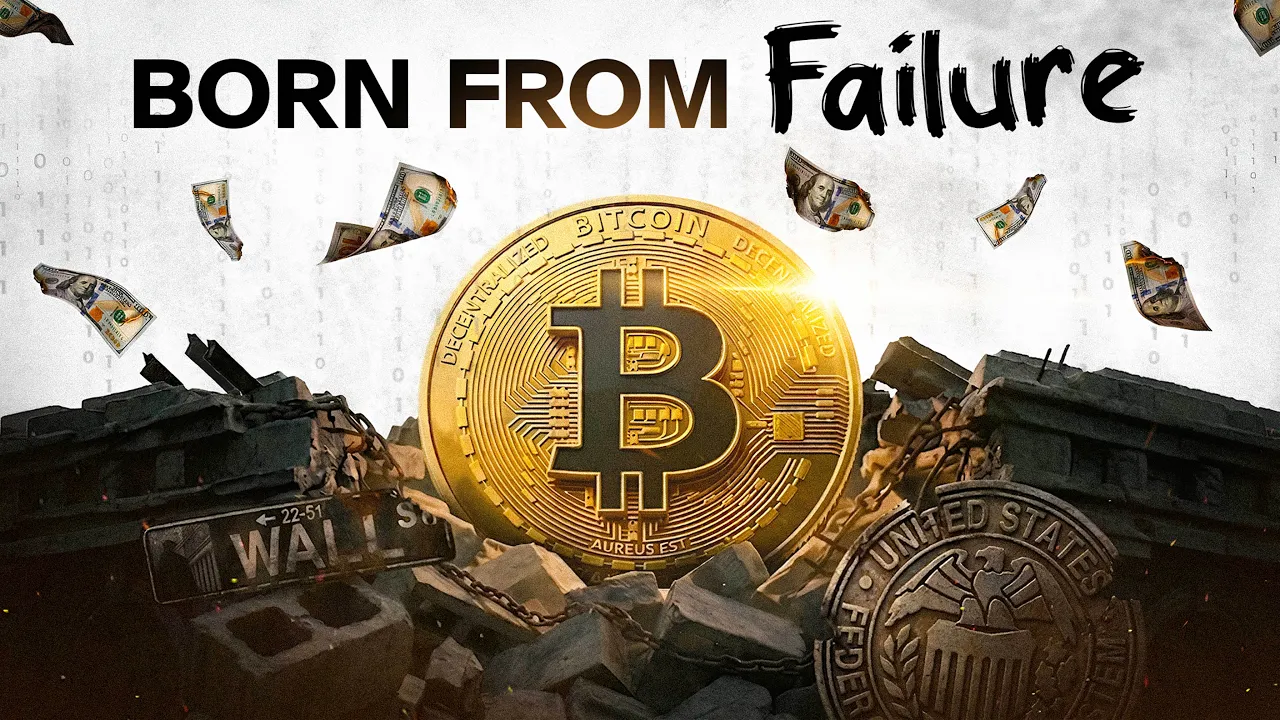
Bitcoin Was Born From a BROKEN System
Coin Bureau
46,515 views • 1 month ago Save 20 min 5 min read
Video Summary
The 2008 financial crisis, triggered by the collapse of the U.S. housing market and fueled by risky subprime mortgages and complex financial instruments, revealed deep flaws in the traditional financial system. As institutions deemed "too big to fail" received massive government bailouts, public trust eroded, leading to a search for a decentralized alternative. Bitcoin emerged from this chaos, offering a peer-to-peer electronic cash system designed to operate without intermediaries.
Created by the pseudonymous Satoshi Nakamoto, Bitcoin built upon decades of cypherpunk research into digital cash and cryptography. Its innovative blockchain technology, combined with a proof-of-work system, solved the long-standing double-spend problem without relying on a central authority. The first block, or "genesis block," embedded a headline about a bank bailout, serving as a stark reminder of the system's fragility and Bitcoin's radical departure from it.
Short Highlights
- Bitcoin was born out of the 2008 financial crisis, which exposed the fragility and perceived unfairness of the traditional financial system.
- The crisis stemmed from a housing bubble, subprime mortgages, and complex financial products like MBS and CDOs, leading to widespread institutional failures and government bailouts.
- Bitcoin's white paper, published in October 2008 by Satoshi Nakamoto, proposed a peer-to-peer electronic cash system to circumvent financial intermediaries.
- Key technological foundations for Bitcoin were developed by cypherpunks over decades, including concepts like blind signatures and proof-of-work.
- Bitcoin solved the double-spend problem without a central authority through its blockchain and proof-of-work consensus mechanism.
- The genesis block of Bitcoin contains a timestamped headline about a bank bailout, symbolizing its challenge to the existing financial order.
- Despite its radical potential, Bitcoin initially garnered little attention and was considered a niche experiment by programmers and enthusiasts.
Key Details
The Seeds of Crisis: Loose Lending and Financial Innovation [0:00]
- The 2008 financial crisis was preceded by years of economic slowdown and a Federal Reserve decision to drastically cut interest rates.
- Government policies aimed at expanding homeownership, coupled with relaxed lending standards, led to a surge in demand for housing.
- This environment fostered the rise of subprime mortgages, including "ninja loans" given to borrowers with no income, job, or assets.
"what could possibly go wrong"
The Shadow Banking System and the MBS/CDO Machine [0:00]
- Mortgage companies and investment banks increasingly took on bank-like roles, forming the "shadow banking system."
- Mortgages were bundled into Mortgage-Backed Securities (MBS) and further repackaged into Collateralized Debt Obligations (CDOs) sold to investors.
- This system created an incentive for lenders to offload risk, leading to progressively lower lending standards.
"lenders could sell mortgages further up the chain they had no reason to care anymore if a borrower defaulted"
A House of Cards: Ratings, Leverage, and Collapse [0:00]
- Credit rating agencies assigned high ratings (e.g., AAA) to MBS and CDOs, creating a false sense of security.
- High leverage, or borrowed money, amplified bets on the housing market, making institutions vulnerable.
- As subprime borrowers began to default and house prices fell, MBS and CDO values plummeted, triggering widespread losses.
"prices collapsed further and banks insurers pension funds and other institutions holding billions of dollars of mortgage related securities suffered enormous losses"
Systemic Failure and Government Intervention [0:00]
- Major financial institutions like New Century, Bear Stearns, Lehman Brothers, and AIG faced collapse or bankruptcy.
- The U.S. government and Federal Reserve intervened with massive bailouts, including the Troubled Asset Relief Program (TARP) and quantitative easing.
- These interventions, while preventing a deeper collapse, fueled public anger over the disparity between institutional rescues and individual hardship.
"the institutions responsible for the worst financial crisis since the great depression were being saved millions of ordinary americans were losing their jobs"
The Cypherpunk Dream: Precursors to Bitcoin [0:00]
- The crisis highlighted the perceived flaws in a system built on trust in intermediaries.
- Cypherpunks had long advocated for privacy and censorship resistance, exploring digital cash systems since the 1990s.
- Pioneers like David Chaum (e-cash), Adam Back (Hashcash), and Wei Dai (b-money) developed foundational concepts, but none fully solved the double-spend problem without a central authority.
"nobody had managed to build a digital currency that could agree on who owned what or prevent double spending without putting a trusted company bank or other authority in charge"
Satoshi Nakamoto's Breakthrough: The Bitcoin White Paper and Genesis Block [0:00]
- In October 2008, a pseudonymous individual or group named Satoshi Nakamoto published the Bitcoin white paper, proposing a peer-to-peer electronic cash system.
- Bitcoin's solution involved a public ledger (blockchain) maintained by a network of computers using a proof-of-work system to prevent double-spending.
- The genesis block, created on January 3, 2009, contained a headline from The Times newspaper referencing a bank bailout, a likely commentary on the failing financial system.
"the times 3rd of january 2009 chancellor on brink of second bailout for banks"
Bitcoin's Quiet Launch and Early Days [0:00]
- Bitcoin's launch in January 2009 went largely unnoticed, with no established exchanges or market value.
- Early adopters, like cypherpunk Hal Finney, experimented with the software, with Satoshi sending Finney the first known Bitcoin transaction.
- For much of 2009, Bitcoin remained a niche experiment for programmers and enthusiasts, its future utility uncertain.
"basically the only people experimenting with it were nerds and cypherpunks who believed in its potential"