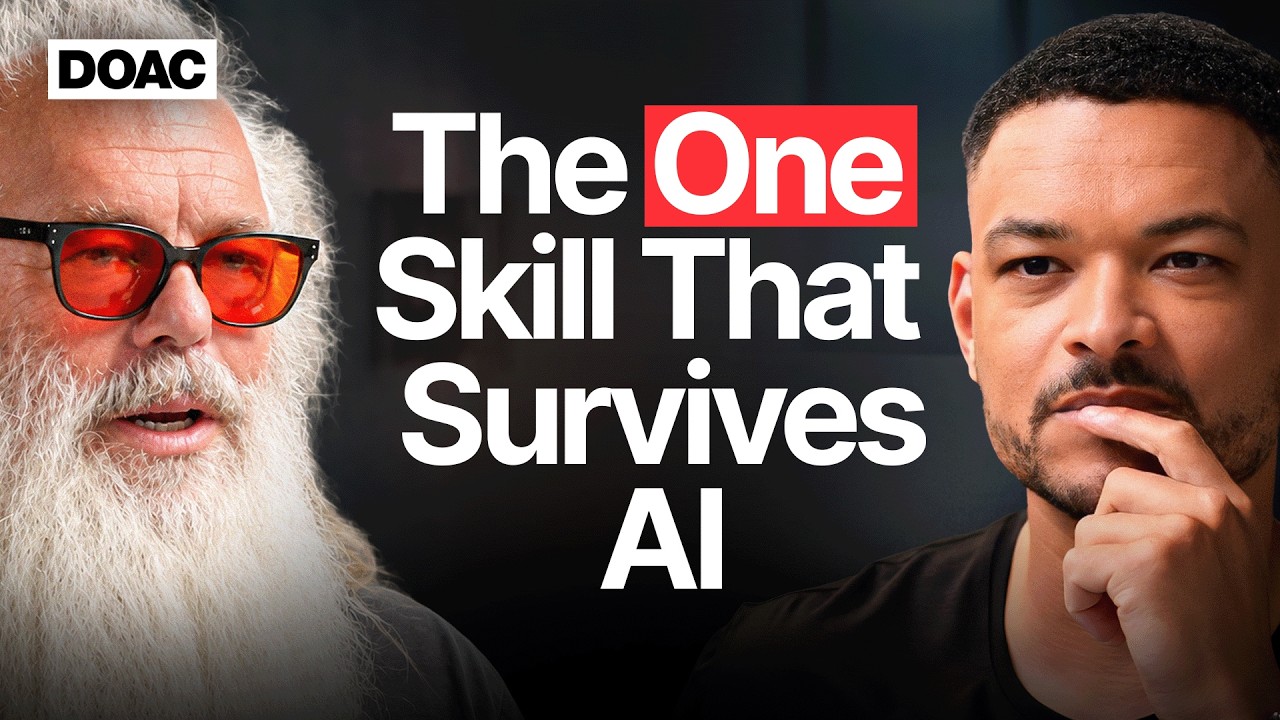
Rick Rubin: The Only Skill That Matters Now Is The One Thing AI Can Never Steal!
The Diary Of A CEO
355,195 views • 17 hours ago Save 159 min 7 min read
Video Summary
Rick Rubin, the legendary music producer, argues that true creativity flourishes only when we abandon the paralyzing need for external validation and near-term incentives. By treating art as a personal diary entry rather than a commercial product, creators can tap into a deeper, indefensible intuition that defies conventional market logic. Rubin suggests that the most revolutionary works often appear alien or 'insane' upon first contact, yet they possess the power to shift culture precisely because they refuse to conform to existing patterns.
Ultimately, Rubin posits that creativity is a fundamental human state that is frequently suppressed by institutional schooling and rigid societal labels. He advocates for a life of radical self-expression, where individuals treat their existence as an ongoing experiment. By embracing uncertainty and viewing life's challenges as opportunities to 'hit the reset button,' one can transcend the limitations of their own identity and align with a broader, creative force.
Short Highlights
- Creativity is not an inherent talent but a natural state often suppressed by societal rules and schooling.
- The most revolutionary art is often 'indefensible'—it defies reason and lacks context when first introduced.
- Near-term incentives and market metrics are the enemies of long-term artistic greatness.
- Meditation serves as a vital tool for grounding and accessing deeper levels of creative intuition.
- All creative work is a personal diary entry; if it resonates with the creator, it has fulfilled its purpose.
- Labels and identities are limitations; we are beyond labels and free to start over at any moment.
- Greatness is not about competition; it is about being the most honest version of oneself.
Key Details
The Creative Process [00:00]
- Jay-Z’s unique process involved humming and mumbling in the back of the room until he had the entire verse memorized before recording.
- Rubin views his role as a collaborator or coach, helping artists remove roadblocks to their own self-expression.
"Jay-Z wrote in a way that no one else wrote. All the other rappers that I worked with spent a lot of time writing lyrics, and I never saw Jay write lyrics."
Creativity vs. Schooling [01:10]
- Creativity is often beaten out of us by institutions that prioritize following rules over independent thought.
- The goal is to break free from these constraints and express ourselves without fear of judgment.
"We're not taught to be free, creative thinkers. So I'm suggesting we break free and express ourselves freely."
The Power of Indefensible Art [03:45]
- Rubin defines 'indefensible' as art that exists beyond reason, which he argues is a necessary quality for true innovation.
- He shares his experience with 'vibe coding,' where he followed a mysterious energy to create a project despite having no logical reason to do so.
"I'm in that camp of reason is a tiny sliver of how decisions get made. And I, I would be much more in the camp of intuition."
Rejecting Near-Term Incentives [07:20]
- Working on Kanye West's 'Yeezus' was an intentional effort to create an 'anti-hip hop' album that defied market expectations.
- Rubin emphasizes that he never considers commercial success or record label pressure during the creative phase.
"We never consider near-term incentive ever at any point in time. Never once. Never a consideration. It doesn't exist."
The Risk of Reinvention [09:30]
- Linkin Park chose to evolve their sound rather than repeat their previous success, alienating some fans but securing a longer creative future.
- Rubin notes that revolutionary work often requires the audience to catch up to the artist's new paradigm.
"All of the best things involve risk. Because I'm sure you've also got examples where someone followed that thesis of listening to what they wanted to make."
The 99 Problems Story [11:15]
- The iconic track was born from a suggestion to shift the focus from the original Ice-T narrative to a broader set of problems.
- Despite label executives claiming it would never be a single, its unique sound eventually led to massive impact.
"The president of the label that I founded was saying, this could never be a single because it doesn't sound like everything else on the radio."
Transcendental Meditation [13:30]
- Rubin has practiced TM since age 14, describing it as a fundamental deposit in his mental bank that allows him to see beyond the surface.
- He has frequently meditated with artists like Tom Petty and Johnny Cash before recording sessions.
"Every time you meditate, it's like making a deposit in the bank. So it builds up."
The Myth of 'Creative' People [18:00]
- Rubin rejects the binary classification of people as 'creative' or 'not creative,' arguing that everyone has the potential to cultivate their own expression.
- Comparison is a trap; artists like Michael Jackson and Prince are incomparable because they are simply the best at being themselves.
"Any label that you put on yourself or that's put on you makes you smaller. No label supply. We are beyond labels."
The Phases of Creativity [21:30]
- Rubin outlines four phases: seed, experimentation, crafting, and finishing/editorial.
- Timelines are impossible to set in the early phases because the work itself dictates how long it takes to gestate.
"In the seed phase, you have to try a lot of things and it's going to take as long as it takes."
Dealing with Failure [23:00]
- People often conform to avoid the risk of losing money or social standing, but Rubin argues that true freedom requires accepting those risks.
- He notes that one can pursue a dream while maintaining a day job, separating the art from the pressure of survival.
"The idea that it all has to be one thing. I have to do my dream thing and it has to be my profit. It doesn't have to be."
The 'Reset Button' [30:00]
- When people feel trapped, they often mistake the need for a lifestyle change for a need to end their life.
- Rubin recounts helping a friend realize they could simply walk away from their obligations and start anew.
"You're in the sweet spot. And I remember saying that and he looked at me and he looked at me like I was insane. But it was the first time anyone the first thing he reacted to was that."
The Depressive Episode [34:00]
- At age 33, after a professional setback, Rubin experienced a severe depressive episode that he describes as feeling like being shot with a 'poison arrow.'
- This experience permanently changed his perspective, grounding him in reality and deepening his empathy for struggling artists.
"I felt like the rug had been pulled out from under me. I started having panic attacks and couldn't sleep."
Artificial Intelligence [42:00]
- Rubin views AI as a powerful tool that could democratize creativity, but notes it lacks the human 'point of view' that defines great art.
- He compares the AI prompt to the storyboard of a film, suggesting the creativity lies in the human ideation, not the execution.
"Everything we've talked about today, about what creativity is, has to do with point of view. And AI doesn't have a point of view."
Miracles in the Studio [46:00]
- Rubin shares how the Avett Brothers' 'No Hard Feelings' and Johnny Cash's early recordings became magical through processes that were unplanned.
- He asserts that the best work is often discovered through the process rather than forced by a rigid initial vision.
"I remember thinking there's this feeling it's scary because it's really good. We don't know how or why."
Art as an Offering [49:00]
- Rubin realized later in his career that he views his work as an offering to a higher power, which renders commercial metrics insignificant.
- He believes we are here to self-express, and that art is the mechanism through which consciousness explores itself.
"We're making it as an offering to God. And if we're making it as an offering to God, things like the numbers, that's much, that's insignificant."
The Jay-Z Documentary [52:00]
- The documentary aims to shift the public perception of Jay-Z from 'billionaire businessman' to 'poet and lyricist.'
- Rubin highlights the importance of the intimate, unscripted nature of the conversations he had with Jay-Z.
"I thought, shedding light on the poet, the lyricist, the artistry of Jay-Z was a really interesting thing."