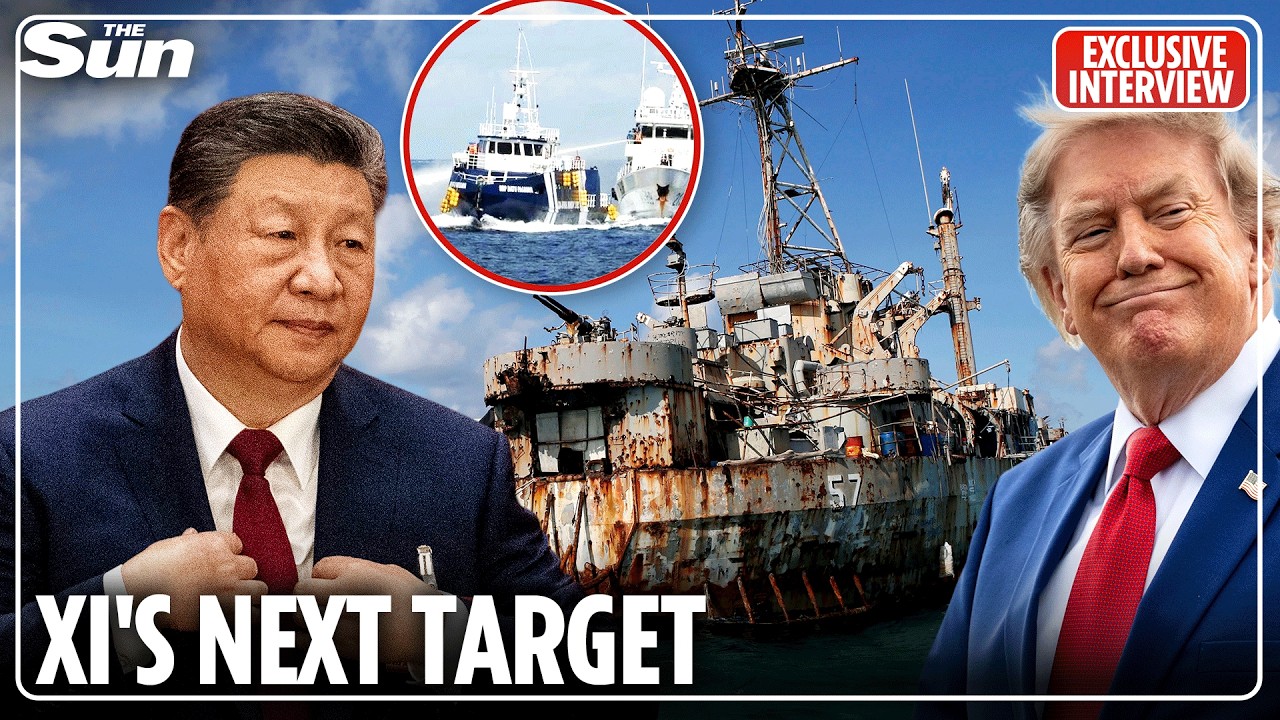
China's new invasion target revealed as Xi Jinping builds island fortresses risking war with Trump
The Sun
39,362 views • 1 month ago Save 18 min 6 min read
Video Summary
China's assertive actions in the South China Sea, particularly against the Philippines, are creating a dangerous flashpoint with global implications.
Beijing aims to control the region, pushing back American influence and securing vital trade routes. This expansionist policy includes the militarization of the South China Sea and the strategic goal of controlling Taiwan. The Philippines has become a key testing ground for China's "grey zone" tactics, including intimidation and physical altercations, as it attempts to assert its claims over disputed territories like the Second Thomas Shoal. Despite a 2016 international ruling against its claims, China continues to ignore it, employing a strategy of "assertive transparency" by filming and publicizing its actions, often involving dangerous confrontations with Philippine vessels.
Short Highlights
- China seeks to control the South China Sea and push back American influence.
- The Philippines is a key target of China's "grey zone" tactics and territorial claims.
- Taiwan's status is central to China's regional ambitions and a potential flashpoint.
- The US-Philippines mutual defense treaty is crucial for deterring Chinese aggression.
- China's actions in the South China Sea impact global trade and regional stability.
Related Video Summary
Key Details
China's Regional Ambitions [0:00]
- Xi Jinping's foreign policy prioritizes controlling the region around China, especially the South China Sea.
- The goal is to push back American influence and make the area China-centric.
- From a Chinese perspective, control of the South China Sea and East China Sea is essential for security.
"And that certainly in the medium to longer term, that becomes a China-focused area with America, the other side of the Pacific, you know, the Pacific's big enough for both of them, but we could kindly keep out of our region."
The Taiwan Problem [2:07]
- Securing Taiwan is a prerequisite for China's regional control ambitions.
- Taking Taiwan would destabilize regional alliances and broader stability.
- Japan and the Philippines view Taiwan's security as linked to their own.
"I think that if China was able to take Taiwan, it would be devastating for regional alliances, and it would be devastating for the broader stability in the area, not just economic because of the importance of the South China Sea, but in terms of the involvement of Japan."
China's Tactics Against Taiwan [3:20]
- China prefers to take Taiwan without a fight due to the potential consequences of a failed invasion.
- The war in Ukraine demonstrates how a weaker power can inflict significant damage on a stronger adversary.
- Taiwan views its defense capabilities as a deterrent, comparing the Taiwan Strait to the "road to Kyiv."
"He said, now look at the Taiwan Strait, that's equivalent to our to their road to Kyiv. We can make them pay pay dearly."
"Grey Zone" Warfare [4:28]
- China employs tactics short of full-scale attack, including "grey warfare," military intimidation, and cyber attacks.
- Rehearsals for blockading Taiwan have been observed.
- Taiwan's recent military exercises appear to mimic American tactics, fueling speculation about US involvement.
"So what did they do? They're trying to do all things at the moment, short of a full on attack, grey warfare, military intimidation, cyber attacks, information warfare, sabotaging internet cables, all manner of things that have been going on."
South China Sea as Imperialism [6:12]
- China views the South China Sea as part of its "near abroad," akin to Russia's control over Eastern Europe.
- Control of the waterway is vital for China's trade and allows leverage over allies like Japan and Korea.
- Militarizing the sea contradicts China's past promises to President Obama.
"So I mean, I think it's just naked imperialism. It's taking control of an international waterway upon which one third of global trade to Asia, the most fastest growing part of the global economy, occurs."
The Philippines Stands Against China [8:19]
- The Philippines is a problem for China because it has actively challenged Beijing's claims.
- China's claims extend far beyond its own territory, encroaching on areas near the Philippines.
- The Philippines uses "assertive transparency," filming and publicizing China's aggressive actions.
"But China wants to ensure that it has the whole of what it considers to be its historical birthright. And the Philippines has been the one country that has actually challenged that even though it's a lot smaller."
The Second Thomas Shoal Confrontation [11:11]
- China uses lawfare, "grey zone" tactics, and a large Coast Guard and maritime militia against the Philippines.
- The Philippines deliberately beached a rusting naval vessel, the Sierra Madre, on the Second Thomas Shoal as a symbol of sovereignty.
- China's actions, including ramming and using water cannons, aim to disrupt resupply missions to the Sierra Madre.
"And the problem with the Sierra Madre is that it is a hulk that's rusting and will not be there forever."
US-Philippines Alliance and Deterrence [13:49]
- The US-Philippines mutual defense treaty is critical for deterring China.
- The US has clarified that attacks on Philippine vessels or aircraft would trigger the treaty.
- China's actions are seen as a test case for how it will behave in the region and a "laboratory" for tactics against Taiwan.
"And the big question in, in Xi Jinping's mind will be will, will they honor that agreement?"
Ambiguity and Red Lines [17:43]
- The US has historically been ambiguous about what triggers its defense commitment to the Philippines.
- China is adept at pushing limits without crossing clear "red lines."
- The US is cautious, seeking to avoid direct conflict while not allowing China to gain unchecked advantage.
"And the question is, what does that mean? Where is the line? Where is the red line? How far does China have to go? How many people have to die? What has to be destroyed before it's regarded as an incident that would trigger the mutual defense treaty with the Philippines, especially when the US is so preoccupied with the Iranian war?"
Strengthening Support for Taiwan [19:36]
- There's a call for increased clarity and support for Taiwan, treating it as an independent country.
- Facing down Chinese threats requires unity among democratic nations.
- The US behavior and treatment of allied countries are crucial for building regional solidarity.
"We should be making it much more clear that we do support Taiwan. We should be thickening up our relations with Taiwan."