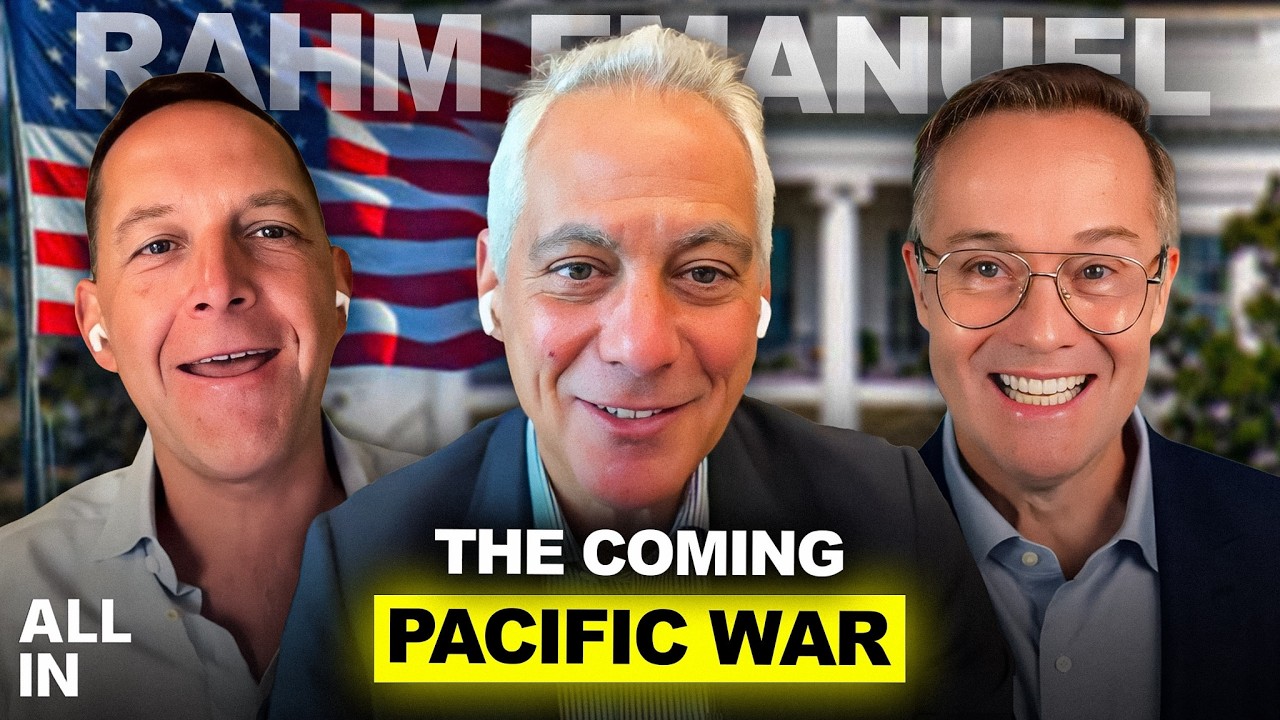
Rahm Emanuel: Trump's Foreign Policy, China, Europe's Decline, Immigration & DSA vs Democrats
All-In Podcast
123,568 views • 1 month ago Save 63 min 8 min read
Video Summary
Former White House advisor Rahm Emanuel argues that the U.S. must pivot from its post-WWII approach of exporting democracy and culture to a more pragmatic strategy of building economic blocks to counter China's global economic dysfunction. He criticizes both China's and the U.S.'s current leadership for exporting their domestic problems, leading to global instability.
Emanuel advocates for a unified economic front with allies like Australia, Japan, South Korea, and the EU to isolate China. He also stresses the need for America to reinvest in its own scientific research, innovation, and critical industries, warning against unilateral disarmament and the atrophy of its manufacturing and technological base. The discussion also touches on immigration reform, the need for a balanced approach to government spending and market forces, and the importance of education and workforce development to maintain American competitiveness.
Short Highlights
- Countering China: The U.S. must form economic blocks with allies to isolate China, which exports economic dysfunction.
- Rebuilding Alliances: Strengthen ties with Japan, South Korea, Australia, and the EU to create a unified front against global challenges.
- Investing in Innovation: Prioritize research and development in life sciences, technology, and manufacturing to maintain U.S. leadership.
- Immigration Reform: Support the Dignity Act, balancing border control with the nation's identity as a nation of immigrants.
- Education and Workforce: Reform high school to ensure all students have a post-graduation plan, focusing on vocational training and college credit.
- Fiscal Responsibility: Address the national debt by controlling spending and reforming the tax code to incentivize wealth creation, not just preservation.
- Economic Policy: Balance public and private sector roles, with targeted government intervention to address market failures and incentivize growth.
Related Video Summary
Key Details
Lessons from Clinton and Obama [00:01:09]
- Both presidents had an affirmative view of government and its role in progressive policy.
- Clinton excelled at integrating policy, politics, and press, redefining the presidency for the 21st century.
- Obama navigated a pivotal moment, saving the U.S. from a depression and repositioning America globally.
"You can't have progressive policies if people think that the government can't run and organize a one-car parade."
The Summit of Disruption: Xi and Trump [00:07:13]
- China's primary export is domestic economic dysfunction, impacting global manufacturing.
- The U.S. is exporting its own political and cultural dysfunction, exacerbating global tensions.
- Both superpowers are using their domestic problems to hold the world hostage.
"We are exporting our domestic political and cultural dysfunction. That is the two superpowers are holding the world hostage, one through economic dysfunction and domestic."
Exporting American Culture vs. Economic Statecraft [00:12:01]
- The U.S. has four tools: military power, political persuasion, economic statecraft, and cultural attraction.
- America's brand, economic statecraft, and institutions are key national security assets.
- The current administration has damaged the American brand, impacting its global influence.
"I actually think this president has hurt the American brand, our economic statecraft, our market, our technology, our universities and research, uh, uh, national labs."
China's Economic Strategy and AI [00:17:19]
- China's strategy is to make other economies dependent on them while remaining independent.
- They leverage their market size to manipulate and control other nations' sovereignty.
- AI and open-sourcing AI could further dampen global manufacturing and knowledge service competition.
"China wants everybody dependent on China and them independent of you. That is their theory of the case."
Lessons from COVID and Life Sciences Investment [00:22:47]
- The U.S. developed vaccines rapidly, while China lagged, and leaders secretly used Western vaccines.
- China has massively invested in life sciences, becoming a major competitor to the U.S.
- Cuts to NIH funding undermine American leadership in critical research areas.
"Xi makes a decision that will never happen again, massively invests in the life sciences. And within five years, China is not just nipping at our heels, the peripersu with the United States in life sciences."
Rebuilding American Dominance: Software and Manufacturing [00:27:11]
- The U.S. must focus on both software and manufacturing, not choose between them.
- Commercialization of national security interests and offshoring of supply chains have made the U.S. vulnerable.
- Forming an economic block with allies is crucial to confront China's dominance.
"We allowed one to atrophy. Everybody, we allowed a commercialization of our national security."
The Middle East's Shifting Alliances [00:31:41]
- Key Middle Eastern nations are hedging their bets due to perceived U.S. leadership gaps.
- The India-Middle East-Europe economic corridor aims to strengthen economic and political ties with the U.S.
- Iran's proxy strategy is weakening, with groups like Hamas degraded and Hezbollah cornered.
"Saudi Arabia, Egypt, and Jordan in that first list. Saudi Arabia, Egypt, Pakistan, Turkey, and Qatar look like they're hedging."
Confronting China in the South China Sea and Taiwan [00:37:35]
- China's aggression has increased in the Indo-Pacific, particularly in the South China Sea.
- The U.S. must reinforce its commitment to treaty allies like the Philippines.
- Preparedness for multiple Chinese strategies regarding Taiwan, including blockade and invasion, is essential.
"The damage by this administration moving, not only resources there are attention political. The one thing I know you guys didn't ask, but it's not that you didn't ask, but when there's a war, the White House becomes a one ball juggler."
Japan's Remilitarization and Strategic Importance [00:46:29]
- Japan is a critical U.S. ally in the Indo-Pacific, central to alliances like the Quad.
- Japan's public acknowledgment of Taiwan as a national security threat is significant.
- Increased military training and presence are needed to counter Russian and Chinese exercises.
"Japan is the long pole of America's Indo-Pacific policy."
Europe's Policy Decisions and Immigration [00:51:11]
- Immigration and economic stagnation have contributed to political reactions in Europe.
- Policy decisions, such as Germany's energy policy and immigration approach, have had significant consequences.
- A strong, competitive Europe is in the U.S. interest.
"I think immigration played a role in the same way that I think economic stagnation played a role."
Immigration Reform: A Nation of Laws and Immigrants [01:02:17]
- The U.S. must uphold its identity as both a nation of laws and a nation of immigrants.
- The Dignity Act is a bipartisan compromise that addresses border security and legal immigration.
- Attracting the "best and brightest" is crucial for economic growth and innovation.
"We're a nation of laws and a nation of immigrants. And whatever we do on legal and illegal has to be true to both."
Lessons from Canada and Denmark on Immigration [01:07:38]
- Canada and Denmark offer valuable models for points-based immigration systems.
- These systems attract talent and encourage assimilation.
- The U.S. has underinvested in its university system, a key draw for international talent.
"I think the best lesson for the United States, if I could, but there's lessons."
The Role of Government Spending and Market Forces [01:12:49]
- Government initiatives like the GI Bill spurred economic growth and homeownership.
- Excessive government spending and restrictive local regulations can drive up costs in areas like housing.
- A balance between public and private sectors is needed, with targeted government intervention.
"The GI Bill was a government initiative. Massive increase in housing and home ownership in America."
Fixing the Broken Education System [01:22:17]
- Reforms in Chicago improved graduation rates and academic scores significantly.
- Key elements include full-day pre-K, universal accountability, and revamped teacher training.
- High school reform should focus on college credit, vocational training, and ensuring every student has a post-graduation plan.
"We drove our graduation rates from 56 to 83%."
Addressing Higher Education Costs [01:31:29]
- Allowing more foreign students at full tuition could subsidize American students and reduce costs.
- A three-year Bachelor's degree could save families significant tuition expenses.
- Free college for incomes below $200,000 and capped increases for higher incomes are proposed.
"If your income is below 200,000, you're going to go to college for free."
Reconciling Fiscal Conditions and Economic Growth [01:37:53]
- The U.S. faces a significant deficit and debt, requiring both spending cuts and revenue increases.
- The tax code needs reform to incentivize wealth creation over wealth preservation.
- Raising the minimum wage, coupled with a robust earned income tax credit, can make work pay.
"We have to figure out a way to reconcile the fiscal condition of the federal government to have a future for our kids."
The Political Divide and the Democratic Socialists of America [01:47:05]
- Emanuel criticizes the DSA as a separate party, distinct from Democrats.
- He emphasizes a strategic and policy difference, advocating for unity against Republicans.
- He believes Donald Trump poses an existential crisis, unlike mainstream Democrats.
"You are a separate party. You're the Democratic Socialists of America. I'll see you in November on the ballot."