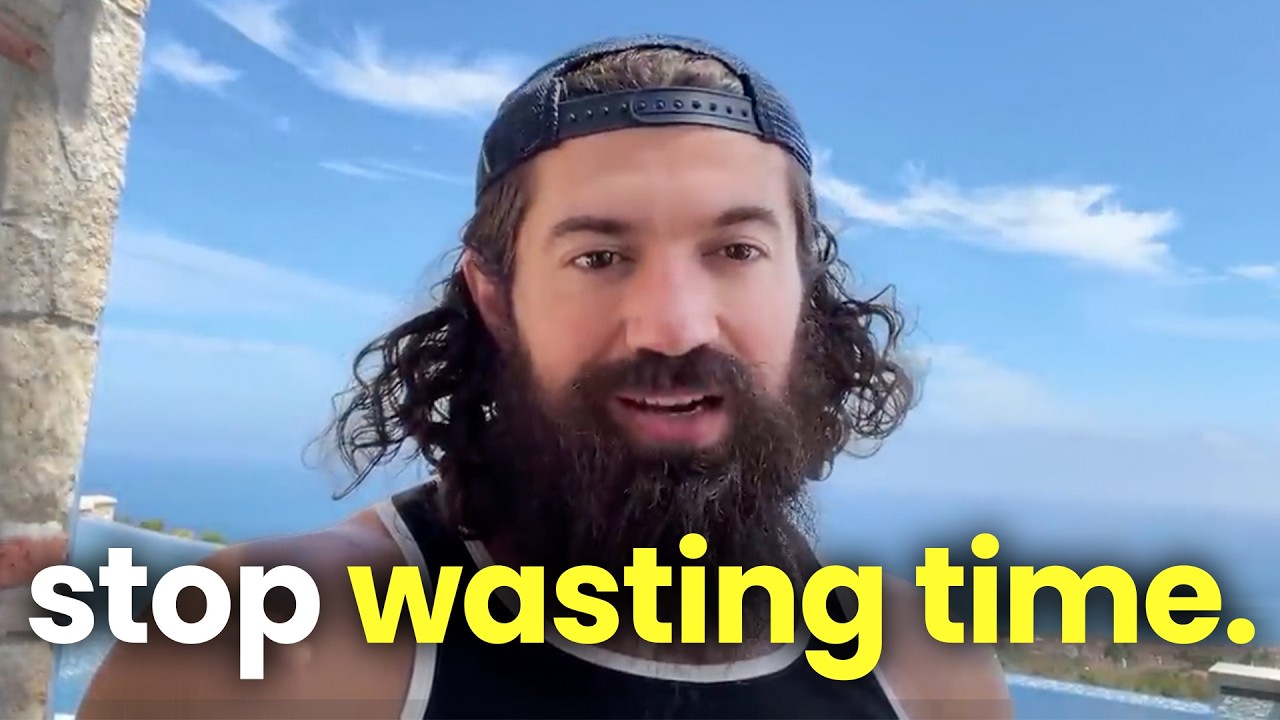
My Actual Social Media Strategy For 2027 - The Algorithm
Alex Hormozi
101,657 views • 1 month ago Save 12 min 4 min read
Video Summary
In a "show me" era demanding demonstrable expertise, the path to commercial success lies in "educational content that drives commerce." This involves creating clear, believable instructions that solve customer problems, leading to influence and authority. The speaker outlines a five-step "algorithm" for content creation, inspired by Elon Musk's manufacturing approach, emphasizing efficiency and effectiveness.
The core of the strategy is to question requirements, delete unnecessary elements, simplify processes, accelerate timelines, and finally, automate. The speaker warns against premature automation, stating that elimination is more efficient than automating tasks that shouldn't be done. He stresses that truth, including one's failures, is the most compelling marketing tool, building trust and driving conversions. A free 10-stage roadmap to scaling a business is offered as a resource.
Short Highlights
- Content creation is a digital manufacturing process.
- The "Algorithm" for content creation has five steps: ** Question the requirements ** Delete unnecessary elements ** Simplify and optimize ** Accelerate timelines ** Automate
- Automation should be the last step, after elimination and optimization.
- Truth, including failures, is the most effective marketing tool.
- Educational content that solves problems drives commerce and builds influence.
- A free 10-stage roadmap to scaling a business is available.
Key Details
The "Qualium" Concept: Quality Volume [0:00]
- The speaker introduces the challenge of balancing "making good shit" with "making lots of shit."
- The ideal middle ground is termed "qualium," focusing on achieving "quality volume."
- This concept is linked to Elon Musk's manufacturing approach, detailed in "The Algorithm."
"And so we've referred internally as this middle spot as qualium, which is how do we create quality volume?"
Step 1: Question the Requirements [1:08]
- The first step involves questioning the necessity and order of existing requirements.
- The goal is to identify and eliminate "waste" – time spent on tasks outside the core work.
- An example is given of color grading in video production, questioning its actual impact on quality.
"And so the idea when we question the requirements is like, why must these things happen in this order?"
Step 2: Delete Unnecessary Elements [3:36]
- After questioning requirements, the next step is to delete elements that don't add significant value.
- The principle is to delete so much that some items might need to be added back later.
- This approach encourages overcoming the fear of deletion by recognizing that most steps are reversible.
"And so when I question the requirements, I answer asked those two questions, what does that mean?"
Step 3: Simplify and Optimize [5:40]
- This stage focuses on optimizing processes to get the most output for the least input.
- It involves evaluating whether the return on investment for certain tasks, like color grading, justifies the time and cost.
- The speaker advocates for producing more content at slightly lower quality (e.g., 95%) over less content at maximum quality if the effort is disproportionate.
"What do we get the most for the least?"
Step 4: Accelerate Timelines [7:25]
- This step is about speeding up processes by pulling timelines forward.
- The speaker uses a "who, what, when" framework to manage tasks and accountability.
- Increasing communication cycles (e.g., daily updates instead of weekly) can significantly speed up team performance.
"And so if you ever want to speed up the movement of a team, increase communication cycles."
Step 5: Automate Wisely [9:31]
- Automation is the final step, leveraging machines to perform tasks.
- The speaker cautions against automating tasks that should be eliminated entirely.
- A key test for AI usage is whether it leads to increased views, leads, or money; otherwise, it may be a waste of resources.
"And so the easiest limit test for many of you people, uh, you people, for many of you is though I am using AI, are we getting more views though?"
The Trust Economy and Educational Content [12:37]
- The current era is the "trust economy," requiring demonstrable expertise ("show me" times).
- Educational content that solves specific customer problems is key to driving commerce and building influence.
- The speaker distinguishes between content for entertainment (selling eyeballs) and content for sales (selling products/services).
"That is content from an education perspective that drives commerce. That is content that drives commerce."
Truth as the Ultimate Marketing Tool [15:44]
- The most compelling marketing element is the truth, including one's failures and shortcomings.
- Imposter syndrome arises from misrepresenting the truth; acknowledging weaknesses builds credibility.
- The speaker shares an example of a man who overcame imposter syndrome by honestly stating his past agency failures and focusing on his strength in client acquisition.
"The truth sells the most. I will say this again. The truth sells the most."