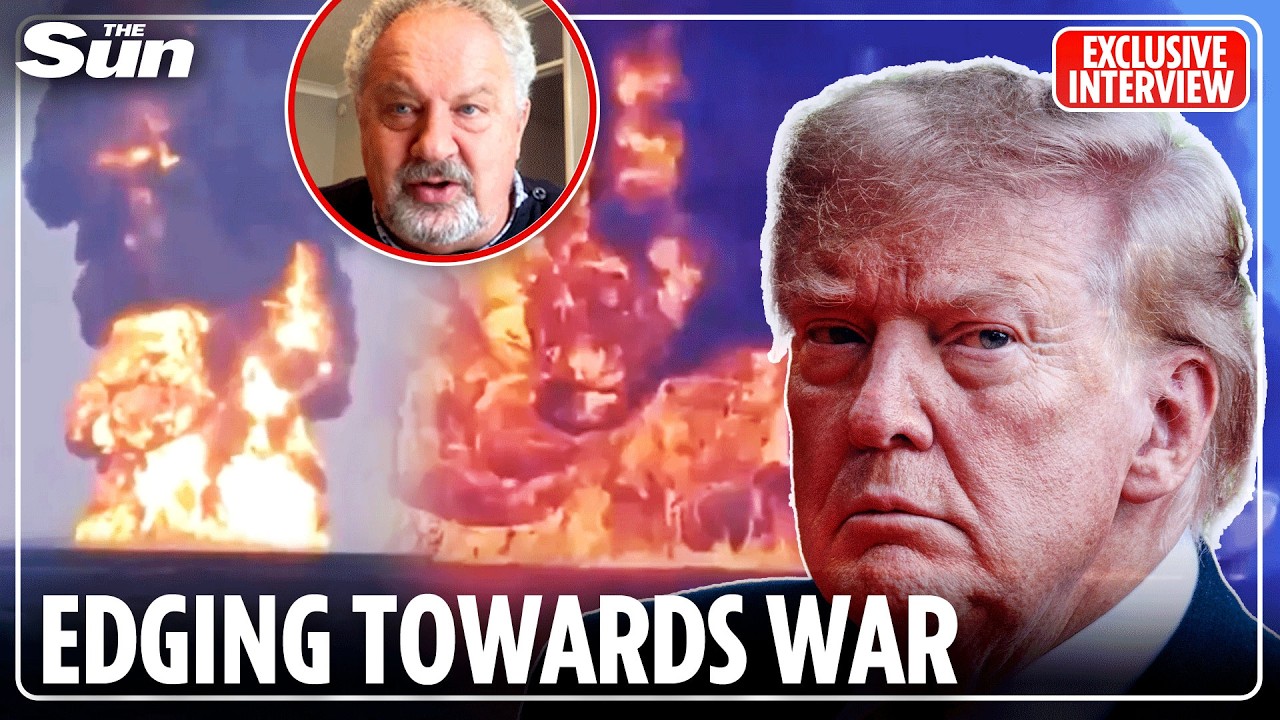
Iran blows up tanker as US bombs Qeshm Island: Is Trump facing inevitable escalation in Hormuz?
The Sun
42,567 views • yesterday Save 11 min 4 min read
Video Summary
Escalating tensions in the Strait of Hormuz have seen a tanker struck twice, potentially by mines or missiles, igniting fears of a wider conflict. While President Trump has declared the "mercury element" over, the U.S. has deployed three carrier battle groups to the region, signaling a readiness for overwhelming force. Iran, in response to attacks on its territory, has targeted U.S. allies, widening the conflict's political and military scope. The core disputes—Iran's nuclear ambitions and freedom of navigation—remain intractable, with intelligence suggesting Iran may be planning a "dirty bomb" attack in Washington D.C., further complicating any peaceful resolution. The situation is poised for either a de-escalation into a "frozen conflict" or a significant escalation, particularly during the current window of heightened U.S. military presence.
Short Highlights
- A tanker was hit twice in the Strait of Hormuz, potentially by mines or missiles, escalating regional tensions.
- The U.S. has deployed significant military assets, including three carrier battle groups, to the region.
- Iran has retaliated against U.S. allies following attacks on its territory, broadening the conflict.
- Fundamental disputes over Iran's nuclear program and maritime passage remain unresolved.
- Intelligence suggests Iran may be planning a "dirty bomb" attack in Washington D.C.
- The situation could lead to a "frozen conflict" or a significant military escalation.
Key Details
Double Blockade and Tanker Attack [0:00]
- The U.S. maintains a blockade of Iranian ports, while Iran claims to blockade the Strait of Hormuz.
- A tanker was struck twice, possibly by a mine or missile, with dramatic images of fire emerging from the second impact.
"This particular tanker appears to have been hit twice."
Strategic Island and Tit-for-Tat [1:09]
- An island near the Strait of Hormuz, used as a base for naval operations, has been a target of recent attacks.
- The U.S. has a significant military presence in the region, leading to a cycle of "tit-for-tat" events between the U.S. and Iran.
"And in the past, it's been used as a base for the ILGC's naval or maritime element for laying of mines and doing direct attacks on vessels as well."
Escalation and Mixed Signals [2:23]
- President Trump has indicated an end to certain tensions, yet the U.S. has deployed three carrier battle groups to the region.
- Iran has responded to attacks by targeting U.S. allied bases in Kuwait and Bahrain, a tactic to widen the conflict and pressure the U.S.
"On the one hand, you've got President Trump talking about the fact that, and this is his word, these are his words, I'm not paraphrasing, that the mercury element is now effectively over."
Military and Political Aims [3:45]
- Iran's attacks on softer targets, like radar sites, serve both military purposes by degrading enemy planning capabilities and political aims by highlighting the cost of conflict for the U.S. and its allies.
- Neither side appears willing to compromise on key demands, particularly regarding Iran's nuclear ambitions and freedom of navigation.
"Militarily, they're the kind of right targets to go for because they're often softer targets."
Nuclear Ambitions and "Dirty Bomb" Threat [5:10]
- The U.S. demands Iran abandon its pursuit of nuclear weapons, a non-negotiable point for the U.S.
- Intelligence suggests Iran may be planning a "dirty bomb" attack in Washington D.C., a scenario described as potentially disastrous and mass casualty-inducing.
"And also, the straightforward moves are opened up to traffic."
Omani Position and Future Scenarios [7:51]
- Oman, a Western ally, seeks to maintain dialogue with Iran despite regional tensions, leveraging its strategic location and patience.
- The current situation could lead to a de-escalation into a "frozen conflict" or a significant escalation, with a limited window of opportunity for the U.S. to act decisively due to the presence of carrier battle groups.
"They've always worked to try and find a way to talk to the Iranian regime, even when at their most obstreperous and most difficult, and have done a very good job in the past of, firstly, showing some strategic patience in terms of absorbing some of the attacks that the Iranians have thrown at them, but still be leaving the door open to talk to them from there."