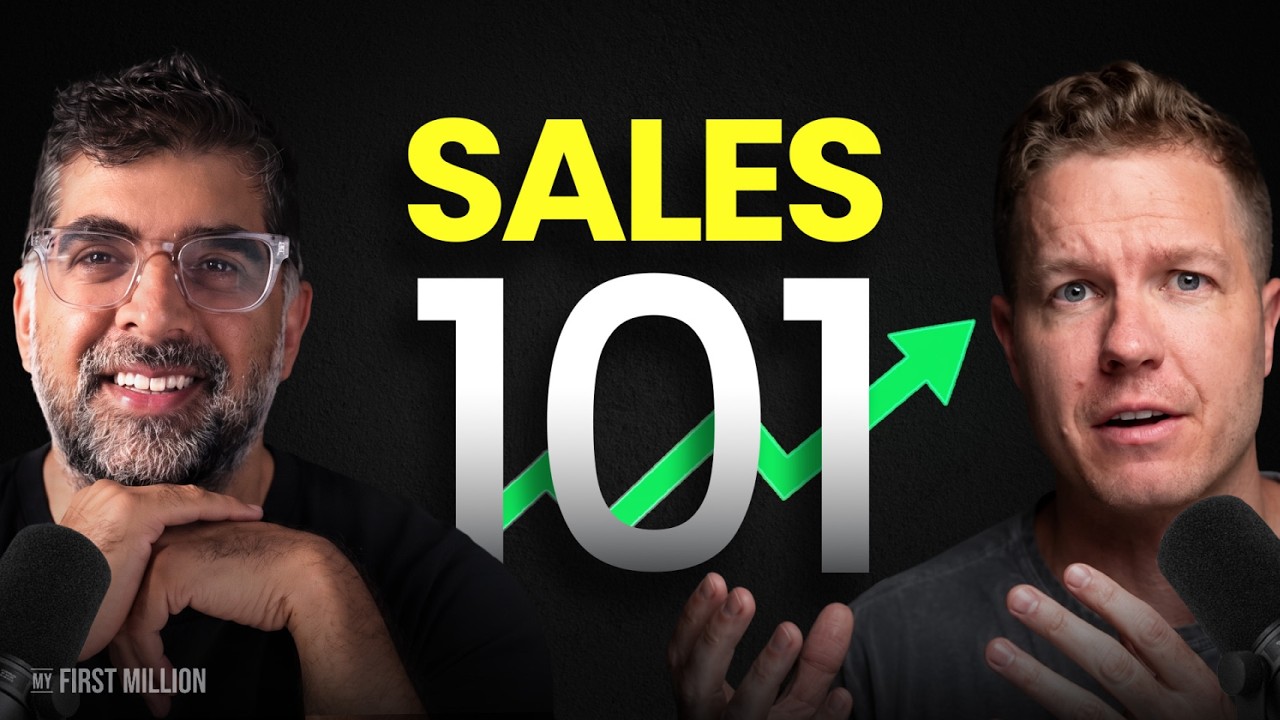
7 simple rules to become a sales machine
My First Million
14,203 views • 1 month ago Save 39 min 9 min read
Video Summary
A viral Hacker News comment offers seven counterintuitive sales tips, emphasizing simplicity, human connection, and problem-solving over technical jargon. The speaker also shares personal anecdotes illustrating the "rule of reciprocity," including a humorous failure where an offer of Diet Coke backfired during a tense meeting. The conversation then pivots to the inspiring story of United Hatzalah, an Israeli volunteer emergency medical service that drastically reduces response times, and the remarkable business model of "Magic: The Gathering," which has achieved sustained, massive growth through innovative game design and a focus on player collection.
Further discussions explore the art of public relations through Bernard Arnault's "Merci" letter, highlighting humor and likability in crisis management. The episode concludes with an examination of singular entrepreneurial vision, using examples like the founders of the UFC, Airbnb, and the creator of Minecraft, and delves into Brian Johnson's ambitious longevity project, driven by a desire for historical impact rather than mere wealth.
Short Highlights
- Seven Sales Tips:
- Keep it simple, like golf.
- Focus on people and problem-solving.
- Sell time, money, sex, or approval/peace of mind.
- Sell "aspirin," not "vitamins."
- Make friends; people buy from friends.
- Be valuable and useful without expecting return.
- Focus on the customer's problem, not your business needs.
- Rule of Reciprocity: Offering a small favor, like a Diet Coke, can create an obligation for the recipient to reciprocate, though this can backfire.
- United Hatzalah: An Israeli non-profit with 18,000 volunteers providing emergency medical services, aiming for 90-second response times to save lives.
- Magic: The Gathering: A collectible card game that has achieved $2 billion in annual revenue for Hasbro through its innovative business model based on player collections and ongoing engagement.
- Bernard Arnault's PR Takedown: The LVMH CEO used humor and a "thank you" to deflect a critical exposé, turning it into a PR win.
- Entrepreneurial Vision: Stories of UFC, Airbnb, and Minecraft creators highlight the necessity of singular vision and perseverance.
- Brian Johnson's Longevity Project: A wealthy entrepreneur's self-funded quest for longevity, driven by a desire for historical impact.
Key Details
The Hacker News Sales Bible [0:00]
- A highly-rated Hacker News comment offers seven points on sales, emphasizing simplicity and human connection.
- The core advice is to "walk up and hit the ball," avoiding overcomplication.
"Sales is a lot like golf. You can make it so complicated that it's almost impossible, or you can simply walk up and hit the ball."
People Buy Problems, Not Products [0:00]
- Sales is fundamentally about people and solving their problems, not about the technical details of a product.
- Customers are motivated by four core desires: time, money, sex, and approval/peace of mind.
"People buy four things and four things only ever. Those four things are time, money, sex, and approval or peace of mind."
Aspirin vs. Vitamins in Sales [0:00]
- The "aspirin" strategy, addressing immediate pain points, is more reliable than the "vitamin" approach, which offers general wellness but is less predictable.
- Building genuine relationships is crucial; "all things being equal, people will buy from their friends."
"People buy aspirin always. They'll buy vitamins sometimes, but it will be unpredictable. Sell aspirin."
The Power of Giving Value [0:00]
- Consistently being valuable and useful to others—through helpful content, introductions, or support—builds trust and leads to business opportunities.
- The key is to offer help without immediate expectation of return, fostering authentic connections.
"Being valuable and useful is all you'll ever need to sell things. Help people out. Send them interesting posts. Write birthday cards."
Customer Focus is Key [0:00]
- Customers are not interested in a seller's internal business metrics like quotas or burn rates.
- The sole focus should be on the specific problem the customer needs solved.
"No one cares about your quota, your payroll, your OPEX, your burn rate. No one. They care about the problem you're solving for them."
The Rule of Reciprocity in Action [3:10]
- Robert Cialdini's "rule of reciprocity" suggests people feel compelled to return favors.
- An anecdote illustrates this: offering a Coke during a negotiation for a motorcycle led to a price reduction.
"The next day, if you come to me and say, hey, can I borrow your car for the day? Even though those two ask aren't even remotely equal, I, because of the rule of reciprocity, am very likely to lend you my car."
Reciprocity Gone Wrong [5:30]
- A humorous story details a failed attempt to use the rule of reciprocity by offering two Diet Cokes before a meeting with school administrators.
- The administrators declined the offer, leaving the speaker to drink both Cokes while his program was shut down.
"And I go, you want a Diet Coke? And then he's like. And he just goes, no, thanks. And now I have two Diet Cokes. I go, I have two. I go, I have two."
HubSpot's Best Practices [8:00]
- A plug for HubSpot's free resource offering best practices for CEOs on delegation, difficult conversations, and hiring.
- The resource is presented as a way to save years of "headache and heartache."
"So the team at HubSpot, they actually went and put together a bunch of best practices that Sean and I use in our own companies."
The Genesis of United Hatzalah [9:15]
- Mark, a successful entrepreneur, co-founded United Hatzalah, a volunteer emergency medical service in Israel.
- The inspiration came from a tragic incident where a child died because an ambulance was too slow to arrive, despite a doctor being nearby.
"The ambulance didn't make it there in time and the kid died. And he was like, it really sat with him. He was really bothered by that."
United Hatzalah's Mission and Scale [9:15]
- The organization aims to respond to medical emergencies within 90 seconds, significantly faster than traditional ambulances.
- It has grown to 18,000 volunteers across Israel, handling approximately 2,000 calls daily.
"Our goal is to get there in 90 seconds in anywhere in Israel. And right now, I think they do it in like two minutes."
The Power of Community and Altruism [9:15]
- United Hatzalah brings together diverse groups in Israel, fostering unity through shared volunteer work.
- The model relies on donations and operates strictly as a non-profit to leverage Good Samaritan laws.
"We have super Orthodox Jews who are doing it. We have non-secular Jews who are doing it. We have Arabs, we have Muslims, we have Christians."
Bernard Arnault's "Merci" Masterclass [15:10]
- Bernard Arnault, CEO of LVMH, responded to a critical French investigative series with a public letter titled "Merci."
- Instead of defensiveness, he used humor and wit to address the exposé, effectively turning negative press into a positive PR moment.
"Instead of being defensive, he just starts with thank you. He goes, it seems I am the head of, quote, the last royal family of France."
PR Through Humor and Likability [15:10]
- Arnault's approach demonstrated the power of likability and humor, drawing parallels to Cialdini's principles.
- His response made him more relatable and garnered positive attention, even from those who might have been critical.
"He basically, like, paints them as absolute overkill for what they were trying to do. And this deserves a word. And that word shall be thank you."
The Business of Magic: The Gathering [22:50]
- Magic: The Gathering, a 20+ year-old collectible card game, is Hasbro's cash cow, generating $2 billion in annual revenue.
- Its success stems from an innovative model inspired by the game of marbles: players bring their own collections, creating infinite possibilities and fostering a collector's market.
"Most games like chess or checkers at the time were all like fixed games, meaning you open the box and the pieces are all what they are."
From Marbles to Millions [22:50]
- The game's creator, Richard Garfield, drew inspiration from his childhood experience playing marbles, where each player brought their own set and could trade or win others.
- This "tinkering" approach, focusing on player-owned collections and infinite variability, is the core of Magic's enduring appeal.
"Oh, I could take five magics, but I could change it. And he has this really good insight, which is most games like chess or checkers at the time were all like fixed games."
Strategic Launch and Business Model [22:50]
- Garfield meticulously play-tested the game and targeted influencers at conventions to build initial momentum.
- The model encourages players to spend an average of $1,000 over years, treating card acquisition as an investment rather than just spending.
"He would find the guys who owned the shops. He would get the guys who write the magazine articles. He would get the guys who were the pro players of other games."
Acquiring Dungeons & Dragons [22:50]
- Garfield strategically purchased Dungeons & Dragons to diversify his company's portfolio before an IPO, making it more defensible.
- He paid off D&D's significant debt, turning a struggling brand into a valuable asset.
"And it had like 40 million in revenue, but it had like 30 million in debt. And it was doing really, they stopped printing cards because they just had too much debt."
Singular Vision in Entrepreneurship [33:00]
- Many successful ventures, like the UFC, Airbnb, and Minecraft, were built by individuals with a unique, unwavering vision and relentless drive.
- These entrepreneurs often faced immense obstacles but persisted because the idea might not have existed without them.
"And I think that there are actually many businesses that were only going to be built by one person. It was either going to be built by that person or it wasn't going to exist."
Brian Johnson's Longevity Quest [37:30]
- Brian Johnson, founder of "The Longevity" movement, pursued radical self-experimentation driven by a desire for historical impact, not just wealth.
- His approach, combining personal wealth, scientific rigor, and a unique social media presence, brought unprecedented attention to longevity.
"None of them does it relate around money. And so that's when I realized that going after just business and making more money was not the answer to my question of how do I be somebody that other people remember in 500 years?"
The Freedom of Being Forgotten [37:30]
- The pursuit of legacy can be a powerful motivator, but the realization that most people are forgotten offers a sense of freedom.
- This understanding allows individuals to live more authentically on their own terms.
"And yet all they're going to get from me and millions of other people is a, oh, okay. Yeah. And like, and some hand, I'm always like, that's a bummer."