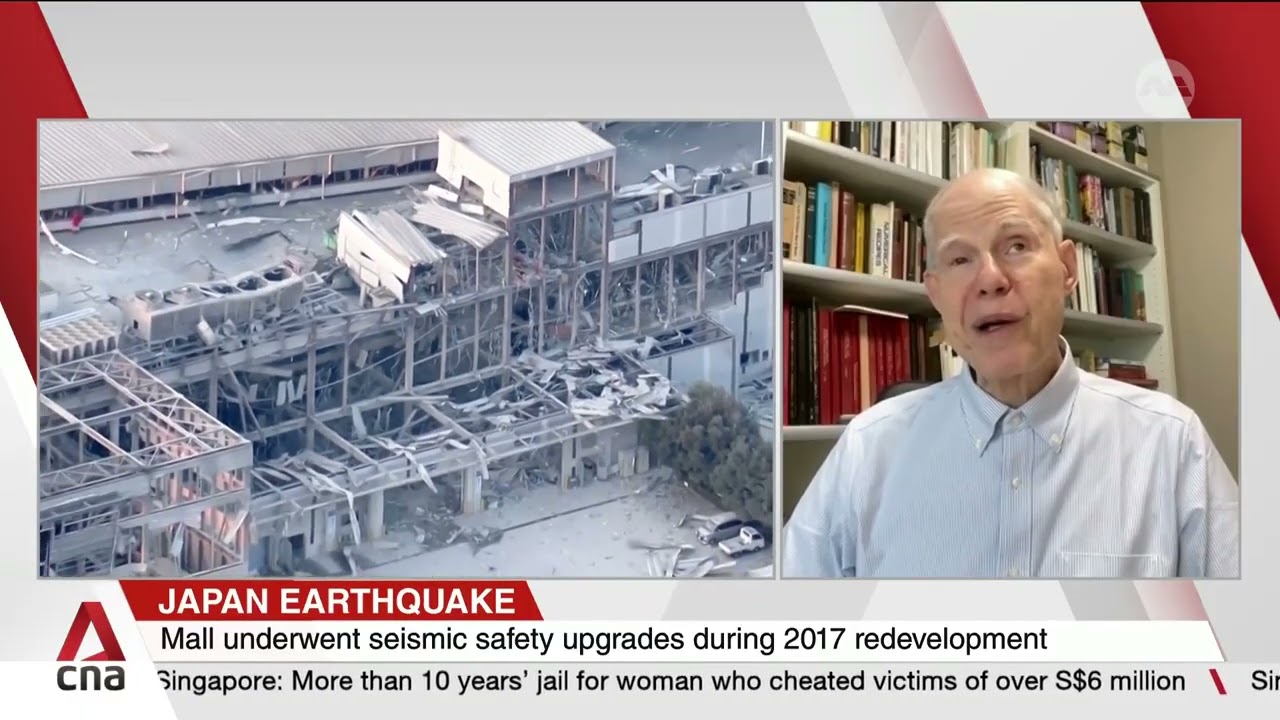
Japan quake: Reopened Aeon mall likely withstood shaking, says seismologist
CNA
291 views • 3 months ago Save 3 min 4 min read
Video Summary
A recently reopened mall in Kumamoto, Japan, designed with earthquake-resistant features, sustained significant damage after a 7.1 magnitude earthquake. While the building's overall structure reportedly withstood the tremor, a potential gas leak and explosion, not accounted for in the design, exacerbated the damage. This highlights that while earthquake preparedness can reduce risks, unexpected events and internal factors like unsecured gas lines can still lead to severe consequences. Experts suggest that while buildings can be made safer, achieving zero risk is impossible, and preparedness must extend beyond structural integrity to include internal systems and furnishings.
Short Highlights
- A newly reopened mall in Kumamoto, damaged by a previous earthquake, suffered significant damage from a 7.1 magnitude tremor.
- Experts suggest the damage was exacerbated by a gas leak and explosion, which the building's earthquake-resistant design did not account for.
- While structural integrity can be improved, complete earthquake-proofing is impossible, and internal factors like gas lines pose risks.
- Aftershocks pose a risk to already damaged buildings, and early warning systems provide only seconds of notice.
Key Details
Mall Reopens After Earthquake Damage [0:00]
- The Aeon Mall in Kumamoto had recently reopened after 10 years and extensive refurbishment following damage from a previous earthquake.
- The mall had highlighted its earthquake-ready features, including seismically reinforced ceilings.
"so it was meant to be a fresh start it had to close for months after the 7.3 magnitude earthquake back in 2016 and the refurbishment plan took years to finish"
Expert Assessment of Damage [0:30]
- Professor Emeritus of Seismology, Robert Geller, assessed the damage to the newly rebuilt mall.
- He noted that while the mall withstood the earthquake itself reasonably well, a gas leak and subsequent explosion, which the building was not designed for, likely caused significant additional damage.
"but then um if there was a gas leak and a gas explosion as apparently is the case that then that was not designed for it could not be designed for"
Structural Integrity vs. Internal Systems [1:15]
- Professor Geller clarified that the building's overall structure was likely sound, but issues with internal systems, such as restaurants with cooking facilities, contributed to the problem.
- He emphasized that if gas lines were not properly secured, this constituted a design failure, as the building was designed for earthquakes, not explosions.
"but the problem was not not the overall structure of the building but if you have restaurants with cooking facilities inside the building that if they didn't properly secure the gas mines then then this was a design failure"
Limits of Earthquake Proofing [2:10]
- Geller stated that while earthquake risk can be significantly reduced through proper design, it's impossible to achieve zero risk.
- He acknowledged that unexpected events will always occur, but noted that the earthquake resistance provisions in Kumamoto seemed to have worked reasonably well, though not perfectly, considering the magnitude and populous area.
"you can you can reduce the risk very largely through proper design but um i don't think it's ever possible to reach exactly 0.000"
Risks of Aftershocks [3:00]
- More than 60 aftershocks had been recorded, posing a risk to already damaged buildings.
- Geller advised people to stay out of damaged buildings and warned that rain could cause landslides in weakened hillsides.
- He also cautioned that a future aftershock could potentially be larger than the main earthquake.
"they should expect more aftershocks for sure and the risks they pose are to already damage buildings that um one one little i took them over the edge now"
Earthquake Early Warning Systems [4:00]
- Japan's early warning systems provide only seconds of notice before tremors strike, indicating a reactive rather than predictive response.
- Geller explained that these warnings are generated by detecting seismic waves near the source and alerting people farther away.
- He confirmed that there is no way to predict earthquakes before they happen.
"what we can do is um after an earthquake happens if we have sensors right near the source we can give warnings of one a few seconds to people farther away"
Predicting Future Earthquakes [5:00]
- Geller expressed skepticism about researchers' claims of reliable earthquake prediction or forecasting.
- He suggested that some researchers might be overly optimistic in their eagerness for funding, basing forecasts on potentially incorrect models, such as the idea of earthquake periodicity.
"from my my own experience in um seismic research is that there there are no prospects for reliable and accurate predictions or forecasts"
Conclusion on Research and Mitigation [5:45]
- Geller advised that research findings on earthquake prediction should be considered as research, not as tools for immediate disaster mitigation.
- He thanked the interviewer for their time.
"so i i think those things should be considered as research and and not things that can be applied for um disaster mitigation at the moment"