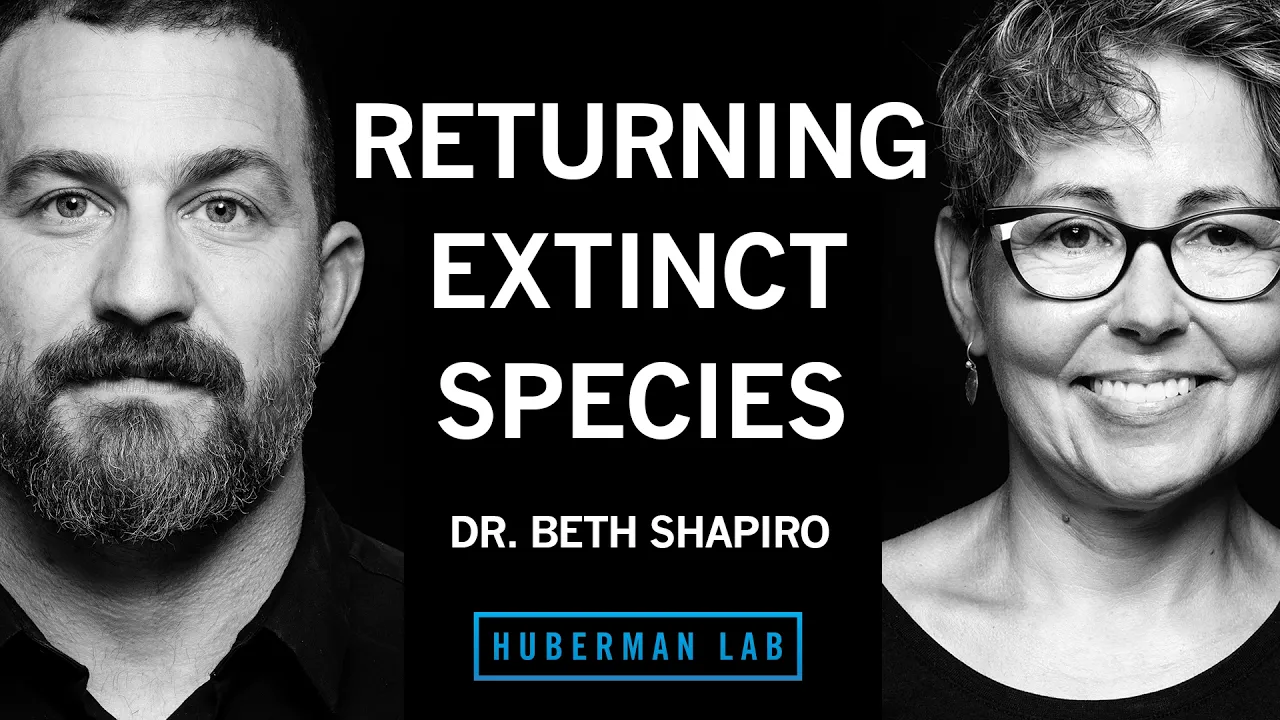
Bringing Extinct Species Back to Life | Dr. Beth Shapiro
Andrew Huberman
2,526 views • 22 hours ago Save 125 min 10 min read
Video Summary
Dr. Beth Shapiro, Chief Scientific Officer at Colossal Biosciences, is pioneering the de-extinction of species using advanced genetic engineering. Her work involves sequencing ancient DNA to understand the genetic traits of extinct animals like the woolly mammoth and dire wolf, then engineering those changes into the genomes of living relatives, such as elephants and gray wolves, to recreate them. This cutting-edge technology, while exciting, also serves a broader purpose: developing tools and fostering engagement that can be applied to species preservation and combating extinction in living species.
Shapiro addresses common questions about the ethics and practicality of de-extinction, emphasizing that the technology developed for bringing back extinct species is directly applicable to saving endangered ones. She highlights the importance of public engagement, using awe-inspiring projects like mammoths and dodos to generate enthusiasm and investment in conservation efforts. Her work also delves into the complexities of species definition, human evolution through interbreeding with Neanderthals, and the potential of genetic engineering for both ecological restoration and human health advancements.
Short Highlights
- De-extinction Technology: Genetic changes from fossil genomes are engineered into living relatives to recreate extinct species.
- Dire Wolf Creation: 20 specific genetic edits from fossil dire wolves were engineered into a gray wolf genome.
- Broader Applications: De-extinction technology is crucial for developing tools to prevent living species from going extinct.
- Species Concepts: Species are human constructs; DNA sequencing has revised our understanding of evolutionary relationships.
- Human Evolution: Humans interbred with Neanderthals, with 2-5% of modern human DNA originating from this admixture.
- Ecological Restoration: Bringing back extinct species can help restore destabilized ecosystems and increase biodiversity.
- Conservation Tools: Genetic engineering and synthetic biology offer solutions for endangered species, like making northern quolls resistant to toxic cane toads.
Key Details
The Dire Wolf Project [00:00:00]
- The process of de-extinction involves sequencing genomes from fossil dire wolves to identify genetic changes contributing to traits like size, robustness, and coat color.
- These identified genetic changes are then engineered into the genome of a living relative, the gray wolf, to recreate the dire wolf.
"So our direwolves, they have 20 edits that we picked and we sequenced genomes from fossil direwolves."
The Dual Purpose of De-Extinction [00:01:15]
- De-extinction efforts are often questioned, with a common query being why focus on extinct species instead of living ones.
- The answer is that the same tools and technologies used for de-extinction are directly applicable to species preservation and preventing extinctions.
"And when we excite people with the idea of mammoths and dodos and thylacines, we get more engagement and enthusiasm and investment in developing the technology that we can use to stop living species from becoming extinct."
Defining a Species [00:06:10]
- The concept of a 'species' is a human construct, not a biological imperative.
- Different species concepts exist, including the biological species concept (ability to interbreed and produce fertile offspring) and the genetic species concept (based on sequence similarity).
"Species is a human concept. We have this incredible proclivity to want to put things into boxes so that we can talk about them, so that we can have conversations or share stories or share memories."
Taxonomy and Nomenclature [00:07:45]
- Carl Linnaeus developed a system of taxonomy to classify organisms.
- The naming of the American bison as 'buffalo' by Europeans illustrates how common names can be misleading and unrelated to actual genetic relationships.
"But bison is the taxonomic name that was given to American buffalo by Carl Linnaeus."
Neanderthals and Human Ancestry [00:13:00]
- Ancient DNA studies, including the Neanderthal genome, reveal interbreeding between Homo sapiens and Neanderthals.
- Most people today carry 2-5% Neanderthal DNA, indicating successful hybridization events.
"So if they were a different species, they were violating the biological species concept at this point."
Evolutionary Divergence and Hybridization [00:17:30]
- The ability of different species to interbreed and produce viable offspring depends on the evolutionary time since their divergence.
- Brown bears and polar bears, which diverged about half a million years ago, can interbreed, though hybrid offspring often survive better as one species over the other.
"Brown bears and polar bears diverged about half a million years ago, and we know that they can readily interbreed and do whenever they overlap in habitat."
The Role of Ancient DNA in Science [00:25:00]
- Ancient DNA provides a direct link to past organisms, allowing for precise identification and lineage tracing, unlike fragmented fossil records.
- This technology helps understand evolutionary history, including admixture events between different human lineages.
"But that is one of the coolest things about being able to sequence one of these bones because now you know what it is and now you can line it up against all the DNA from all of the people that are alive today and discover things like we all have ancestry because there was breeding between these lineages because they could and because I think that if they can, they do."
Recreating Extinct Species: The Mammoth Example [00:37:30]
- The goal is not to create an exact genetic replica of an individual, but to engineer key traits that define a species.
- For mammoths, this involves changing about 99% of the Asian elephant genome to incorporate mammoth-specific traits.
"So our mammoths, our dire wolves are not created by that process. That's not what anyone doing synthetic biology is thinking about when they're designing or engineering things to solve problems, engineering animals or engineering plants to solve problems that we have in the future."
Technical Challenges in De-Extinction [00:41:00]
- Recovering viable DNA from extinct species is challenging due to degradation processes like UV light, freeze-thaw cycles, and microbial decay.
- DNA preservation is best in cold, dry environments, making Arctic samples more promising than those from warmer climates.
"As soon as an organism dies, the DNA in its cells starts getting chopped up into smaller and smaller and smaller fragments until eventually there's nothing left."
Ecological Considerations for De-Extinction [00:43:00]
- De-extinction projects must consider the ecological role of the species and the availability of its niche.
- Restoring keystone species can help stabilize and revitalize ecosystems, as seen with mammoths in the Pleistocene Park.
"And so they are essentially recreating their ecosystem just by being there."
The Dodo and Bird De-Extinction [00:46:00]
- Birds present unique challenges for de-extinction due to their reproductive biology, specifically the absence of easily accessible egg cells for cloning.
- The dodo was chosen partly for its cultural recognition and the opportunity to develop technologies applicable to other endangered birds.
"But birds are among the most endangered species on the planet, and it is not possible to clone birds using somatic cell nuclear transfer, the process that most famously brought us Dolly the sheep, because we don't have access to the egg cells at the right stage."
Reproductive Mechanisms in Nature [00:51:00]
- Sexual reproduction has evolved in diverse ways across species, including temperature-dependent sex determination in reptiles and different sex chromosome systems in birds.
- Parthenogenesis, where an egg develops without fertilization, can occur in some species, like the California condor.
"So when normally, in normal reproduction, an egg that has one copy of the set of chromosomes and a sperm that has one copy of the set of chromosomes come together, they're fertilized."
Genetic Diversity and Conservation [01:04:00]
- Low genetic diversity, often due to small founder populations, can lead to inbreeding depression and health issues in endangered species.
- Cloning and genetic rescue are strategies to reintroduce lost genetic diversity, as seen with the black-footed ferret.
"So a few years ago, this collaboration of organizations got together and said, there's a solution to this."
The Role of Plague in Black-Footed Ferret Decline [01:08:30]
- Bubonic plague is a major threat to wild black-footed ferret populations.
- Genetic engineering could potentially make these ferrets resistant to the disease, complementing cloning efforts.
"But there's another problem, and that is that the thing that's actually killing the black-footed ferrets in the wild is plague."
Public Perception and Scientific Progress [01:14:00]
- Public fear of new technologies, like gene editing, is often based on a lack of understanding and a default to caution.
- Education and open dialogue are crucial for public acceptance of scientific advancements, whether for de-extinction or human health.
"And so for people that are experts in the area can be a little bit grading at times. But the public, I think is open, right?"
Reintroducing Species and Ecosystem Health [01:18:00]
- Reintroducing species, like gray wolves to Yellowstone, can have cascading positive effects on ecosystems.
- The goal is to enhance ecosystem resilience and biodiversity, not to return to a pristine past.
"The gray wolves that were reintroduced into Yellowstone, the population of animals that they ate had become too large and they had eaten away at all of the shrubbery."
Gene Drives and Invasive Species [01:24:00]
- Gene drives offer a potential tool for controlling or eradicating invasive species that disrupt ecosystems, such as cheatgrass.
- Careful development and regulation are necessary to ensure these powerful technologies are used safely and effectively.
"This is a situation where I would say, let's think about how we might safely deploy something like a gene drive that can remove something or at least tamp something down to allow that ecosystem to become again, once again, more robust and resilient."
Genetic Engineering in Humans [01:30:00]
- Technologies like IVF and gene editing are already enabling genetic selection in humans, raising ethical discussions.
- The line between therapeutic gene editing and enhancement is a complex area with significant societal implications.
"And so some of these companies are geared towards ruling out disease. Others are geared towards trying to optimize for best possible outcome."
The Ethics of Intervention [01:38:00]
- Humans have always intervened in natural systems, from domestication to conservation.
- The debate centers on who decides and how to navigate the risks and rewards of technological interventions for ecological and human benefit.
"But the world today is a human world. And the species that live today and thrive today are those that have figured out how best to do that in the niches that we have created for it."
Public Education and Engagement [01:42:00]
- Open communication and public education are vital for building trust and understanding around advanced scientific endeavors.
- Engaging the public with awe-inspiring projects can foster enthusiasm for science and conservation.
"And they were talking about it as if they had some agency in the world that they were inheriting."
The Pioneer Spirit in Science [01:48:00]
- Pushing the boundaries of science requires individuals deeply passionate and driven by their research questions.
- This pioneering spirit, while sometimes controversial, is essential for innovation and progress.
"And so I think that like we have to accept this about people and the people who move things forward, like Howard Hughes, the very Howard Hughes, he liked his aircraft, right?"
The Future of Genetic Technologies [01:55:00]
- Advancements in synthetic biology, artificial wombs, and gene editing hold immense potential for both de-extinction and human health.
- These technologies, while potentially transformative, require careful consideration of ethical implications and public engagement.
"I have a friend who was diagnosed with breast cancer during her pregnancy and she had to make a decision about not starting the therapy until she gave birth or taking a giant risk with the baby."