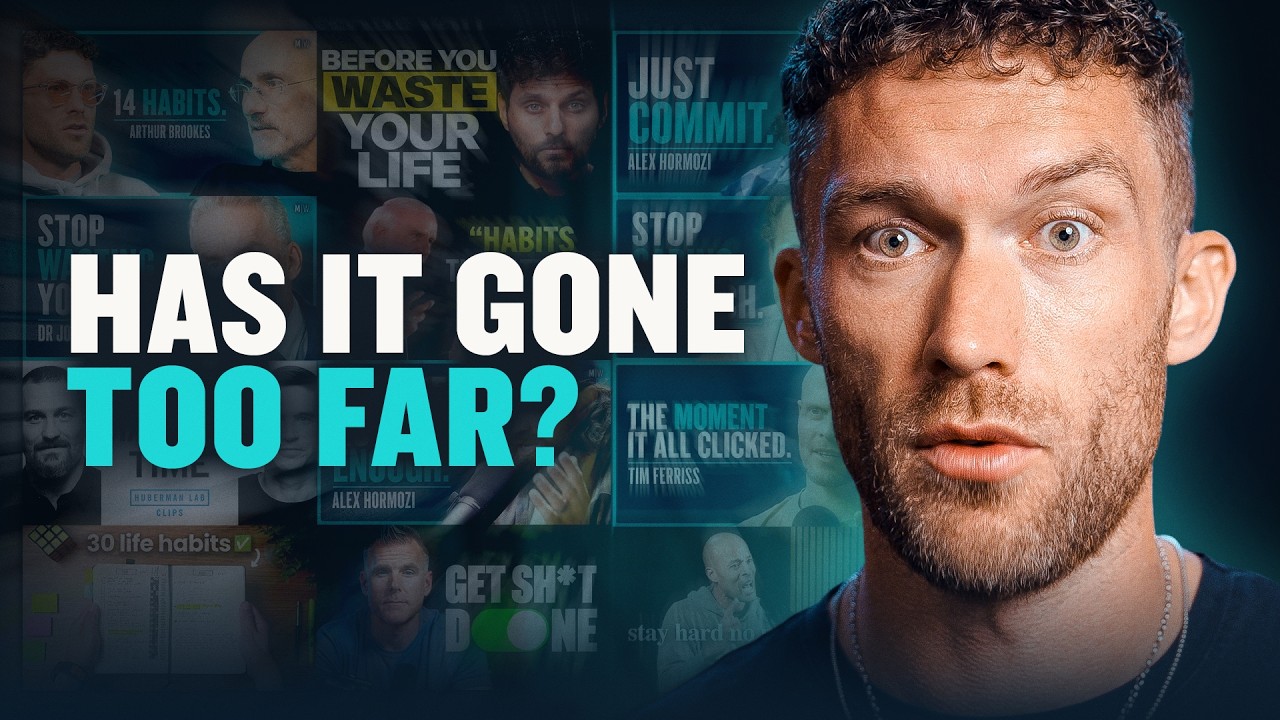
My Reaction To The Anti-Optimisation Trend
Chris Williamson
1,319 views • 1 month ago Save 4 min 4 min read
Video Summary
Hyper-optimization has become a "disease," according to one speaker, transforming personal development from healthy habits into an exhausting, all-consuming pursuit. Once a private endeavor, self-improvement now dominates online discourse with trends like "grindslop" and "anti-personal development," where the extreme focus on optimization is criticized for ruining happiness and becoming "nonsense."
The speaker, who has experienced both extreme partying and intense self-optimization, argues that while over-optimization can be detrimental, a period of focused self-improvement is necessary for many to escape negative patterns. He likens this intense phase to a "Navy SEAL hell week" and emphasizes that the "edgiest" thing he did was go to bed early, which drew more criticism than his reality TV appearances. Ultimately, he advises individuals to be mindful of their own needs, rather than blindly following advice, and to be gentle with themselves during their personal growth journeys.
Short Highlights
- Hyper-optimization has become a "disease," turning personal development into an exhausting pursuit.
- The trend of "grindslop" criticizes the extreme focus on optimization.
- The speaker advocates for a necessary, albeit intense, period of self-improvement.
- Blindly following advice can be harmful; focus on what works for you.
- Be gentle with yourself during the personal growth journey.
Key Details
The "Disease" of Hyper-Optimization [0:00]
- The internet twists good ideas like personal development into something "ridiculous."
- Hyper-optimization has become a "disease," stealing lives and turning self-improvement into an exhausting, second full-time job.
- This trend has led to "anti-personal development" content and the concept of "grindslop."
"Hyper optimization has become a disease."
From Degenerate to Optimizer [1:35]
- The speaker describes a past as a "professional party boy, DJ, model" with "red flags."
- He needed to "grow up" and decided to undergo an intense period of self-improvement, comparing it to a "Navy SEAL hell week."
- This intense optimization phase, lasting about five years, transformed him from someone he wasn't proud of into someone he was.
"And I had to pay my dues, right?"
The Necessity of Intense Self-Improvement [3:33]
- A period of intense self-focus and isolation is often necessary to move from a person you don't like to someone you do.
- This intense phase can appear "fragile" or like a "weird ritual" to outsiders.
- Criticism of morning routines is contrasted with the speaker's past of "trying to explain to the taxi driver that that stain on the seat was already there."
"And unfortunately, that's going to require some isolation and some restriction."
The Perils of Unbalanced Advice [6:31]
- The speaker has experienced both extremes: excessive partying and obsessive optimization.
- He acknowledges the burnout and misery that can come from years of self-optimization.
- Anti-optimizers' messages can inadvertently tell anxious, disciplined people to "stop trying" and that "trying is pointless."
"The type of person who consumes this sort of content most often isn't the lazy guy on the couch. It's the person who's already anxious."
Finding What Works for You [8:53]
- Advice lands unevenly: "Fuck your feelings, just work harder" helps the lazy but harms the overworker.
- "Be kinder to yourself" helps the perfectionist but enables the slacker.
- The crucial question is not "what works?" but "what works for me right now?"
- The "landscape" of self-improvement advice can be a "minefield."
"And the one thing I want to get across is that it's not helpful to ask, what works?"
Obsession: Gift and Curse [10:17]
- Obsession is inherent and cannot be easily dialed down; an obsessive mind will fixate on something.
- Without direction, an obsessive mind chooses the "path of least resistance" (drinking, scrolling, etc.).
- The goal of "Modern Wisdom" is to offer a more positive target for this intensity.
"If you're an obsessive person, and I am deeply, it's wide into me, then I can't actually help you with that."
A Library, Not a Rulebook [11:20]
- Content should be viewed as a "library" to explore, not a set of strict instructions.
- Absorb new ideas, keep what resonates, and discard the rest.
- Be gentle with the part of you that is still trying; searching takes courage.
"You don't walk into a library with the mission of following every protocol from every book."