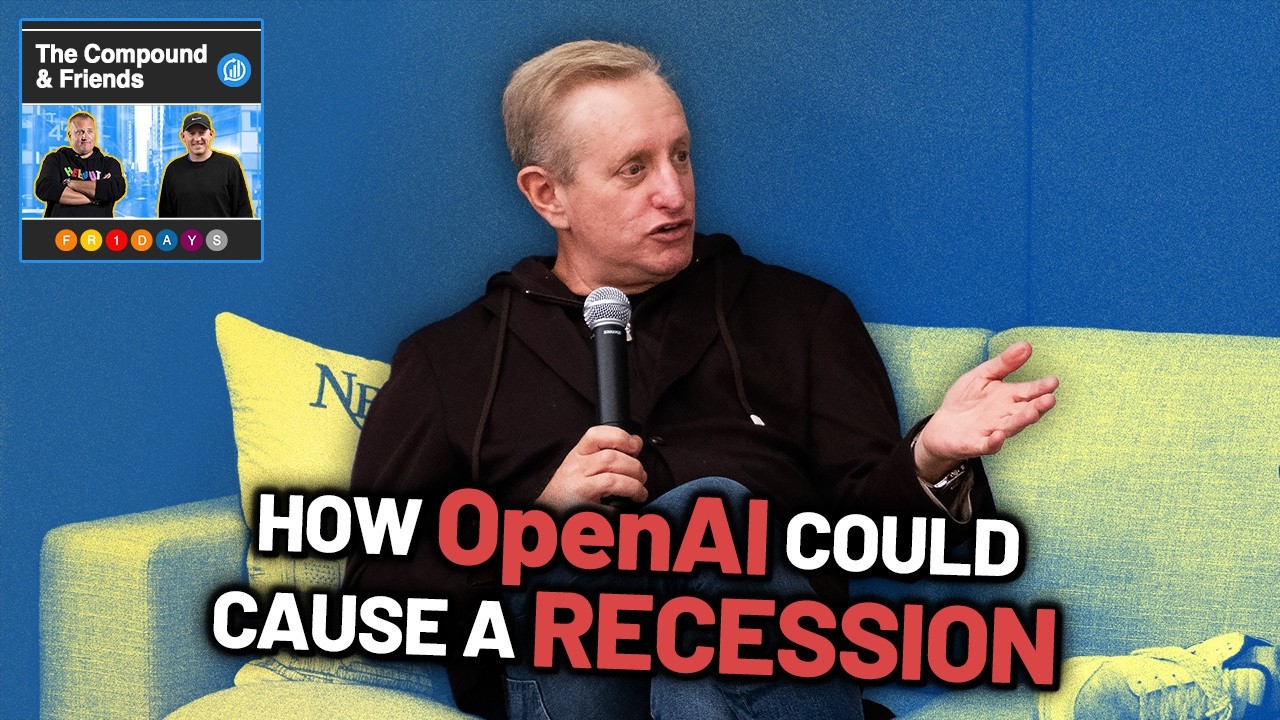
How OpenAI Could Cause a US Recession | TCAF 264
The Compound
13,667 views • 16 hours ago Save 39 min 9 min read
Video Summary
The AI industry faces a potential "token maxing" crisis as the cost of AI models forces a price war, threatening the dominance of major players like OpenAI and Anthropic. Investor Steve Eisman argues that the founders of these AI labs are calling for regulation not to prevent existential risks, but to stifle competition from cheaper, open-weight models and maintain a duopoly. He highlights the extreme concentration of revenue among a few AI companies, making the entire AI ecosystem vulnerable to a collapse in demand or pricing.
Eisman likens the potential fallout from an AI company failure to the bankruptcy of General Motors rather than the systemic collapse of a major bank during the 2008 crisis. However, he believes the failure of a company like OpenAI could trigger an immediate recession due to its systemic importance. The market's fixation on AI is so intense that even negative inflation data is overshadowed, with bond yields plummeting when any weakness appears in the AI narrative. Eisman remains skeptical about the long-term sustainability of current AI funding models and predicts a significant price correction.
Short Highlights
- AI Founders' Motives for Regulation: Major AI companies are pushing for regulation as a strategy to eliminate competition from cheaper open-weight models and maintain market control, rather than genuine concern for existential risks.
- Token Maxing Ending: The era of companies being forced to spend heavily on AI 24/7, known as "token maxing," is over due to high costs and the availability of cheaper alternatives, leading to a potential price war.
- Concentration Risk: The AI industry is highly concentrated, with a few companies like OpenAI and Anthropic accounting for a significant portion of revenue, making the entire ecosystem vulnerable to their financial health.
- Systemic Importance of AI: The failure of a major AI company like OpenAI could trigger an immediate U.S. recession due to its deep integration into various sectors.
- Market Narrative: The stock market is currently driven almost entirely by the AI narrative, overshadowing other economic indicators like inflation data.
- Housing Market Woes: Despite the AI boom, the housing market faces severe affordability issues due to high rates, insurance, utilities, and taxes, potentially leading to price declines.
Key Details
The "Token Maxing" Crisis and AI Founders' Strategy [00:00:00]
- Large Language Models (LLMs) are described as sophisticated retrieval systems, not sentient entities.
- The thesis is that founders of major AI companies are pushing for regulation to combat "token maxing" ending and losing market share to cheaper open-weight models.
- Companies like Uber exhausted their AI budgets rapidly due to the "token maxing" mandate.
"So token maxing is done. You've got open weight models that are a tenth the price."
The Absence of "Moats" in AI [00:01:00]
- AI companies lack durable competitive advantages or "moats," unlike established tech giants like Google.
- Users easily switch between AI models (Claude, Gemini, ChatGPT) based on preference or cost.
- Despite massive investment, the ease of switching highlights the lack of customer lock-in.
"There are no moats. None. Absolutely none."
Enterprise LLMs as a "Sneaky Moat" [00:02:00]
- Standardizing on enterprise LLMs like Claude can be a way to build a moat by accustoming workers to a specific platform.
- However, this moat is threatened if cheaper open-weight models offer comparable performance.
- The expectation is that enterprise LLMs will need to cut prices to remain competitive.
"I sort of think the enterprise LLM is a sneaky way to build a moat because you get all the workers of the fortune 500 accustomed to using it."
The "Regulation" Playbook [00:03:00]
- AI lab founders are publicly calling for regulation, a move seen as a strategic attempt to manipulate the regulatory landscape.
- The goal is to prevent open-weight models from gaining too much market share and to establish a duopoly.
- The claim that LLMs will "destroy planet earth" is dismissed as a lie used to justify this strategy.
"They created this, the world's going to end unless you regulate us because they think if they get regulated, they can manipulate the regulation."
AI's Funding Mechanism and Market Parallels [00:04:00]
- The core question is whether the funding mechanism for AI products will break.
- The case of CoreWeave, a data center provider with rapidly increasing debt yields and stock price drops, is presented as an example.
- Eisman contrasts the potential failure of an AI company with the 2008 financial crisis, stating an AI collapse would be more akin to a major corporation like General Motors failing, not a systemic bank failure.
"This is more like the General Motors story. Okay. I mean, it's a very big story."
Systemic Importance of OpenAI [00:05:00]
- Despite being a private company, OpenAI's potential bankruptcy is seen as capable of plunging the U.S. economy into a recession.
- This systemic importance stems from extensive commitments made to clients, making their failure highly disruptive.
- The concentration of power among a few AI providers is a key vulnerability.
"If you can't, it's the end. Yeah."
Concentration Risk in the AI Supply Chain [00:06:00]
- NVIDIA's revenue is heavily concentrated, with 70% coming from just five customers, highlighting a significant risk.
- Similarly, hyperscalers like Microsoft, Google, and Amazon derive a large portion of their AI revenue from OpenAI and Anthropic.
- Oracle's backlog is heavily reliant on OpenAI, illustrating the precariousness of this concentration.
"70% of NVIDIA's accounts receivable, which is a proxy for revenue, is from five customers."
Signs of Strain: Revenue Declines and Price Wars [00:07:00]
- OpenAI's reported annualized revenue dropped from $70 billion to $50 billion in a month, raising questions about its accuracy and sustainability.
- Anthropic's growth rate has significantly decelerated from 140% to 43% quarter-over-quarter.
- These figures suggest the end of "token maxing" is impacting revenue and potentially initiating a price war.
"The point is, I think the end of token maxing is starting to have an impact."
Data Center Financing and Supply Constraints [00:08:00]
- Rising interest rates make financing for new data centers more difficult and harder to justify.
- Despite potential shifts with open-weight models, supply constraints for compute capacity persist.
- Pushback against data center construction could further limit supply, creating an interesting market dynamic.
"So if the supply gets limited and the demand continues to increase, that could make for an interesting dynamic marketplace."
The Unchanging Demand for AI [00:09:00]
- Demand for AI at the enterprise and consumer levels is unlikely to decrease, with companies increasing AI budgets and consumers integrating AI into daily life.
- The issue is not demand, but the price of AI and who can affordably supply the necessary compute capacity.
- The difficulty in securing debt financing for data centers may strengthen the position of hyperscalers.
"I don't think the demand changes for AI. I think like this group in front of us, they've just spent a couple of days. I agree. It's the price. It's the price of the AI that matters."
The AI Narrative Dominates the Market [00:10:00]
- Despite hot inflation prints, bond yields have fallen, indicating the market's overwhelming focus on the AI narrative.
- The market's reaction to any perceived weakness in the AI trade, such as CoreWeave's debt issues, is immediate and significant.
- The AI narrative is currently the sole driver of market performance, influencing even unrelated sectors.
"The market is pure narrative. It is pure narrative. And the, and there is only one narrative that, that matters right now. And that's AI."
Housing Market Crisis Unnoticed [00:11:00]
- The housing market is experiencing its worst environment since the 2008 financial crisis, yet it receives little attention.
- High mortgage rates, insurance costs, utilities, taxes, and down payments have made housing extremely unaffordable.
- Eisman predicts housing prices will fall due to increased supply from aging boomers and rising foreclosures, despite persistent demand.
"This has been the worst housing environment since the GFC. No question."
The Futility of Predicting Crises [00:12:00]
- Eisman views the race to predict the next crisis as a "disease," driven by a desire for glory rather than genuine concern.
- He emphasizes that actual betting with money, not just commentary, defines a true "big short."
- He expresses no desire to repeat the anxiety and aggravation of his past crisis predictions.
"I said this on CNBC once, I'll say it again because it's such a good line that I really like it, which was, it was a day when Ray Dalio, who I respect greatly, was basically predicting the end of the world because of the deficit."
Regulation and Personal Accountability [00:13:00]
- Eisman is cynical about the effectiveness of current AI regulation, believing a crisis will be needed before meaningful rules are implemented.
- He doubts that executives will face personal consequences for AI-related harms, drawing parallels to the lack of accountability after the 2008 financial crisis.
- He opposes government stakes in AI labs, fearing it would create a "too big to fail" mentality.
"If nobody went to jail for 2008, they ain't going to jail for hacking."
The Future of Hyperscalers and AI [00:14:00]
- The hyperscalers (Amazon, Google, Microsoft, Meta) are well-positioned to benefit from the AI boom, with no apparent natural limit to their size.
- The current AI landscape might mirror the early internet, where initial companies failed, but subsequent ones built on their infrastructure achieved massive success.
- Eisman is unsure if this pattern will repeat, noting the current market's extreme concentration.
"I don't think there's a natural limit on their size."
IPO Prospects for AI Companies [00:15:00]
- Eisman believes Anthropic "better" go public soon, as their numbers may look worse after "token maxing" ends.
- He is uncertain about the reception of potential AI IPOs, stating he would not be a buyer himself.
- The market's current valuation is driven by narrative, specifically the AI story, rather than traditional financial metrics.
"My conspiracy theory is that Anthropic needs to go public before they report third quarter."
The Economy as a Derivative of the AI Trade [00:16:00]
- The stock market performance is overwhelmingly tied to AI, with even non-AI sectors performing well due to this overarching narrative.
- The economy itself has become a derivative of the AI trade, making the market's health crucial.
- The AI trade is the sole driver, and as long as demand holds up and financing is available, the market will likely remain strong.
"It's all one trade. It's AI period. End of discussion."