How I Built This $160K/Month Gym App
Starter Story
210 views • 1 month ago Save 10 min 7 min read
Video Summary
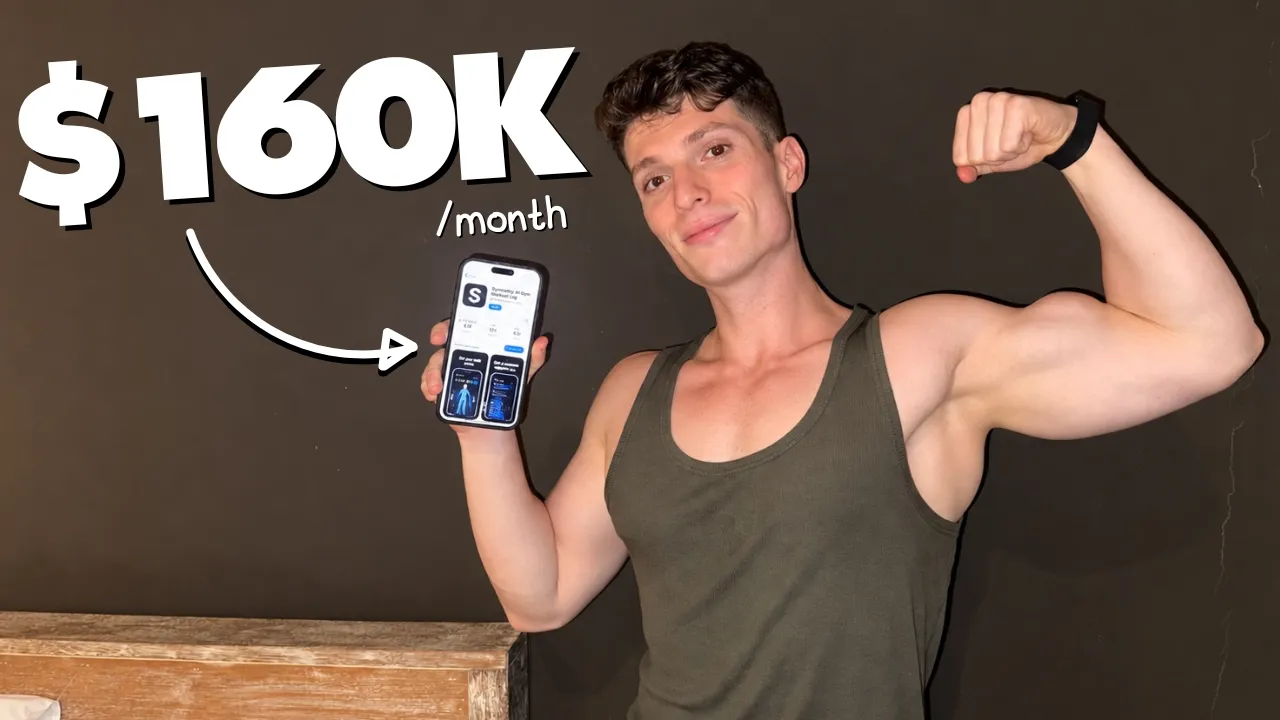
Mauro, a 22-year-old founder, built Symmetry, a Spanish fitness app, into a powerhouse generating over $160,000 monthly. His success hinges on a scientific approach to app development, treating every feature as an experiment.
Initially, Mauro and his co-founders tried building what they personally desired and later what users directly requested, yielding only mediocre results. Their breakthrough came with a methodical, data-driven strategy. By rigorously A/B testing features and focusing on high-impact areas like the exercise search screen, they significantly boosted activation and retention. This scientific method, contrasting with developers who simply ship features and hope for the best, is credited as the key to Symmetry's rapid ascent in a crowded market.
Short Highlights
- Symmetry's Success: Generates over $160,000 monthly revenue with 3 million downloads.
- Target Market: Primarily targets the Spanish market (Spain and Mexico) with a fitness tracking app.
- Growth Strategy: Leveraged User-Generated Content (UGC), posting nearly 80,000 videos and achieving a billion views in a year.
- Development Approach: Moved from building personal desires and user feedback to a methodical, scientific, and experimental process.
- Feature Testing: Treats features as science experiments, A/B testing extensively to measure impact on metrics like retention.
- Key Metrics: Focuses on downloads, activation, retention (especially first-week and 30-day), and Average Revenue Per User (ARPU).
- Advice for Founders: Play long-term games with long-term people and maintain persistence through challenges.
Key Details
The Genesis of Symmetry [0:00]
- Mauro, at 22, launched Symmetry, a fitness app, a year ago.
- It quickly became a major player in a highly saturated app market.
- The app now generates over $160,000 per month.
"This is Mauro. He's 22, and in just one year, he built an app that makes over $160,000 a month."
From Personal Desire to User Feedback [0:00]
- Mauro outlines three phases of app development: building what he wanted, building what users wanted, and a methodical, scientific approach.
- The first two approaches yielded poor and mediocre results, respectively.
- The current scientific method is deemed the primary reason for the app's success.
"First, we built what we wanted. Terrible idea. Second, we built what users wanted. Mediocre."
Symmetry: The App and Its Revenue [0:58]
- Symmetry is a gym tracking app allowing users to log workouts, weights, and reps.
- It primarily operates in the Spanish markets, including Spain and Mexico.
- The app boasts around $160K in monthly revenue and 3 million downloads across iOS and Android.
"Okay, so basically, it's a gym tracking app, so you can track your workouts and track your weight and reps for different exercises."
Mauro's Background and Motivation [1:34]
- Mauro's personal journey with obesity led him to the gym, inspiring the creation of Symmetry.
- He and his co-founders were previously fitness YouTubers aiming to help more people.
- They transitioned from YouTube to building Symmetry to scale their impact.
"Growing up, I was actually obese, and the gym is what helped me a lot."
Growth Timeline and Tactics [2:09]
- Symmetry launched on June 6th of the previous year.
- Initial downloads spiked due to a prior YouTube community, but a sustainable channel was needed.
- User-Generated Content (UGC) proved highly effective after influencer marketing failed.
"When we first launched, we had a very small spike in downloads due to our previous YouTuber era, but then we had to transform into another acquisition channel that was reliable and scalable."
Mastering User-Generated Content [3:26]
- Symmetry has posted nearly 80,000 UGC videos, involving over 500 accounts, and garnered nearly a billion views.
- They segment videos into effective formats, including one simulating an iPhone lock screen notification.
- Creators are compensated significantly, receiving nearly half of the app's revenue to incentivize content creation.
"Something that really works for us is we segment the videos into formats. This was a format that works really good for us, where you see the lock screen of your iPhone with a notification..."
The Scientific Approach to Building Features [4:45]
- Mauro emphasizes a methodical and scientific approach, treating features like science experiments.
- He contrasts this with developers who ship features hoping they work.
- A/B testing is crucial, with even a single screen addition increasing retention by 3% in one instance.
"And now we approach a methodical and scientific way of actually building useful things."
Identifying High-Impact Features [5:31]
- Mauro explains that not all features have equal impact; some affect a small percentage of users (e.g., dark theme), while others have radical effects (e.g., paywall).
- The exercise search screen significantly impacts activation and retention, unlike the app's login screen.
- He stresses finding and exploiting critical areas of the app through A/B testing.
"Let's say you build a dark theme or a light theme. This may affect like 2% of your daily active users. Whereas if you test the paywall, it's going to affect a lot of users and in a radical way."
Setting Ambitious OKRs [6:48]
- Mauro uses quarterly OKRs (Objectives and Key Results) with ambitious goals, especially for new apps.
- He explains that increasing metrics is easier for newer products.
- Daily or weekly tracking ensures the team stays on course towards these OKRs.
"For me, I use quarterly OKRs and put really ambitious OKRs. If your app is really new, put ambitious OKRs."
Activation and Key Metrics [7:34]
- Activation is a critical metric for Symmetry, as it leads to retention, despite the high friction of getting users to the gym and tracking workouts.
- He contrasts this with calorie tracking apps where activation is simpler (e.g., snapping a photo).
- Key tracked metrics include downloads, activation, first-week/30-day retention, and ARPU.
"A very important metric is activation. If you move activation, retention follows."
Implementing a Data-Driven System [8:34]
- The most common error is not tracking anything; analytics must be integrated everywhere in the app.
- Detailed tracking is crucial for onboarding screens to identify drop-off points (quantitative data).
- Qualitative data from user interviews or community feedback (Discord, Reddit) is needed to understand the "why" behind user behavior.
"Well, first, the most common error I see everybody is not tracking anything. Like, they don't have any events at all in their app."
The A/B Testing Process [9:40]
- Decisions should stem from problems, not solutions.
- Hypotheses are formed, and experiments are designed to test them.
- Experiments run for at least two weeks before data analysis.
"First, what problem am I solving? How do I know it's real? We must know if this is happening."
Experiment Velocity and Impact [10:17]
- An experiment on a post-onboarding screen showed no metric movement despite design variations.
- Conversely, a single screen added at the end of onboarding, prompting a commitment to work out, increased retention by 3%.
- This highlights the critical importance of A/B testing everything.
"For example, this experiment is just one screen at the end of the onboarding, where you commit to like workout. So you're like signing, hey, I'm going to work out. That's it. One screen."
Symmetry's Tech Stack [11:04]
- The team uses Cloud everywhere with MCPs and integrates analytics tools like PostHoc and SuperWorld.
- RevenueCat is used with MCPs to view data.
- Whisperflow, Notion, Slack, and SuperWorld (for A/B testing paywalls) are also utilized.
"Well, obviously I use, me and my team, we use Cloud everywhere, we love to use Cloud with MCPs and we connect to this analytics tool like PostHoc or SuperWorld, RevenueCat with MCP and see all our data from there."
App Demo and Key Features [12:07]
- Symmetry features a simple workout plan interface, workout preview, and the ability to track weights and reps.
- It includes exercise videos and a popular ranking system for muscle groups and exercises.
- A social network component, similar to Strava, allows users to share workouts and maintain streaks.
"So the first thing you see when you come, just like your plan to work out, you click on the plan and you see a workout preview and then you start your workout."
Advice for Aspiring Founders [13:10]
- Mauro advises playing long-term games with long-term people.
- He emphasizes persistence and continuous improvement, noting that success is a matter of time when committed to long-term goals and partners.
- Symmetry launched a year ago, but the company started two years prior, requiring sustained effort.
"I would say to play long-term games with long-term people. Symmetry was launched one year ago, but we actually started the company two years ago."