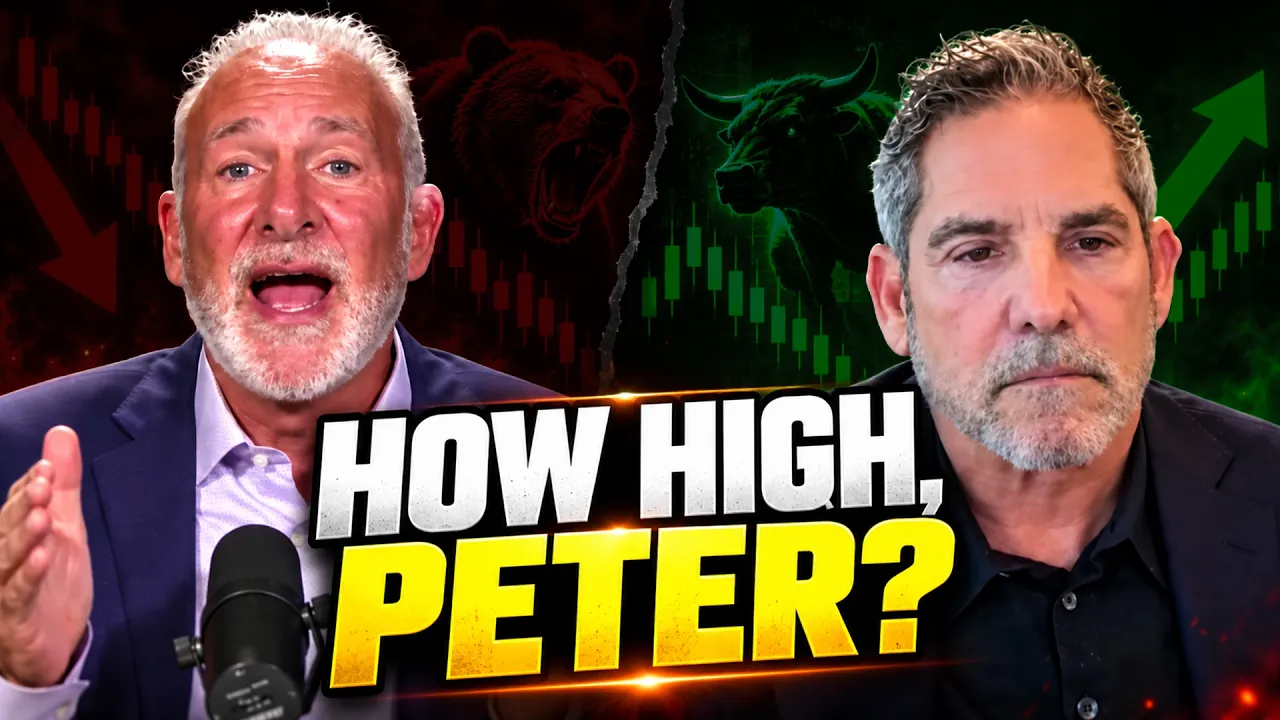
Grant Cardone CONFRONTS Peter Schiff: “You’ve Been Selling Fear Your Entire Life”
Grant Cardone
9,497 views • yesterday Save 11 min 4 min read
Video Summary
The U.S. housing market faces a high-stakes collision between record-low mortgage rates and an era of high debt and rising interest rates. While some investors argue that the massive volume of existing sub-4% fixed-rate mortgages creates a floor that prevents a price collapse, others contend that the "lifeline" of refinancing has been severed, leaving homeowners vulnerable to rising costs and potential insolvency.
This debate highlights a fundamental tension in the current economic landscape: whether the "lock-in" effect of low interest rates will stabilize the market or if the combination of high debt and climbing rates will force a long-overdue correction. With consumer confidence at historic lows, the disagreement centers on whether real estate prices can withstand a sustained environment of high interest rates or if the economy is barreling toward a sovereign debt crisis.
Short Highlights
- The current U.S. economic environment is characterized by high debt and rising interest rates, a combination not seen in previous decades.
- Roughly 50% of U.S. mortgage loans are currently below 4% with long remaining terms, creating a significant "lock-in" effect for homeowners.
- Rising interest rates are squeezing cash flows for institutional real estate assets, forcing a re-evaluation of entry-level pricing.
- The "lifeline" of cash-out refinancing, which previously allowed homeowners to lower payments and extract equity, has been effectively severed.
- Disagreement persists on price trajectory:
- One perspective argues that low-rate mortgages prevent mass selling, keeping prices stable despite low transaction volume.
- The opposing view warns that rising costs (insurance, utilities, maintenance) will eventually force sales, leading to lower valuations and negative equity.
Key Details
The Impact of Rising Interest Rates [05:07]
- Institutional real estate investors are experiencing squeezed cash flows as mortgage rates climb, leading to a valuation drop in recent weeks.
- Despite the volatility, some investors maintain that buying institutional-quality assets in prime locations remains a viable long-term strategy.
-
this is a very very tough time for real estate guys like i can tell you right now like this is not what a guy like me wants i mean there's probably 80 80 million dollars have come out of our real estate values in the last three or four weeks just in a very short period of time because of these rates
The End of the Bond Bull Market [06:30]
- The U.S. economy benefited from a 40-year bond bull market where falling yields and mortgage rates fueled rising real estate prices.
- That era has concluded, shifting the market into a new reality of high debt and high interest rates.
-
we've now entered the era of high debt and high interest rates and of course it's higher debt than we've ever had and who knows how high these interest rates are going but they're going a lot higher than the fives and the sixes
The Mortgage 'Lock-In' Effect [09:47]
- Half of all U.S. home loans are locked in below 4% with approximately 27 years remaining on their terms, creating a barrier to market liquidity.
- Because homeowners are unwilling to trade low rates for current market rates, transaction volume is expected to remain low.
-
50 percent of all the loans in this country are below four percent and they have 27 27 years left on that term think about the laws homes will not be discounted
The Risk of Insolvency [11:15]
- The prevalence of long-term, low-interest mortgages creates a significant insolvency problem for the lenders, banks, and insurance companies holding that debt.
- As the cost of homeownership—including insurance, utilities, and maintenance—rises, the financial pressure on homeowners increases regardless of their mortgage rate.
-
the fact that americans have these low mortgages they're going to stay in their homes longer but here's what's going to happen right the cost of everything else is going to go up
The Potential for Price Declines [12:12]
- A counter-argument suggests that once a threshold of forced sellers is reached, home values will reset based on new, lower comparable sales.
- Historical precedent for price drops is debated, with one side citing the 2006 subprime market as evidence that real estate prices can and will fall.
-
once a few people sell and now the houses start selling at lower prices all the houses are now worth those lower prices because it's all worth based on the cops
Future Economic Outlook [13:58]
- There is disagreement on whether the U.S. is headed toward a sovereign debt crisis or if the economy will continue to demonstrate resilience.
- The debate concludes on the tension between the "doomer" outlook of inevitable collapse and the "optimistic" view that the economy will adapt to the new interest rate environment.
-
there is going to be a debt crisis a sovereign debt crisis if you would have bought it's inevitable