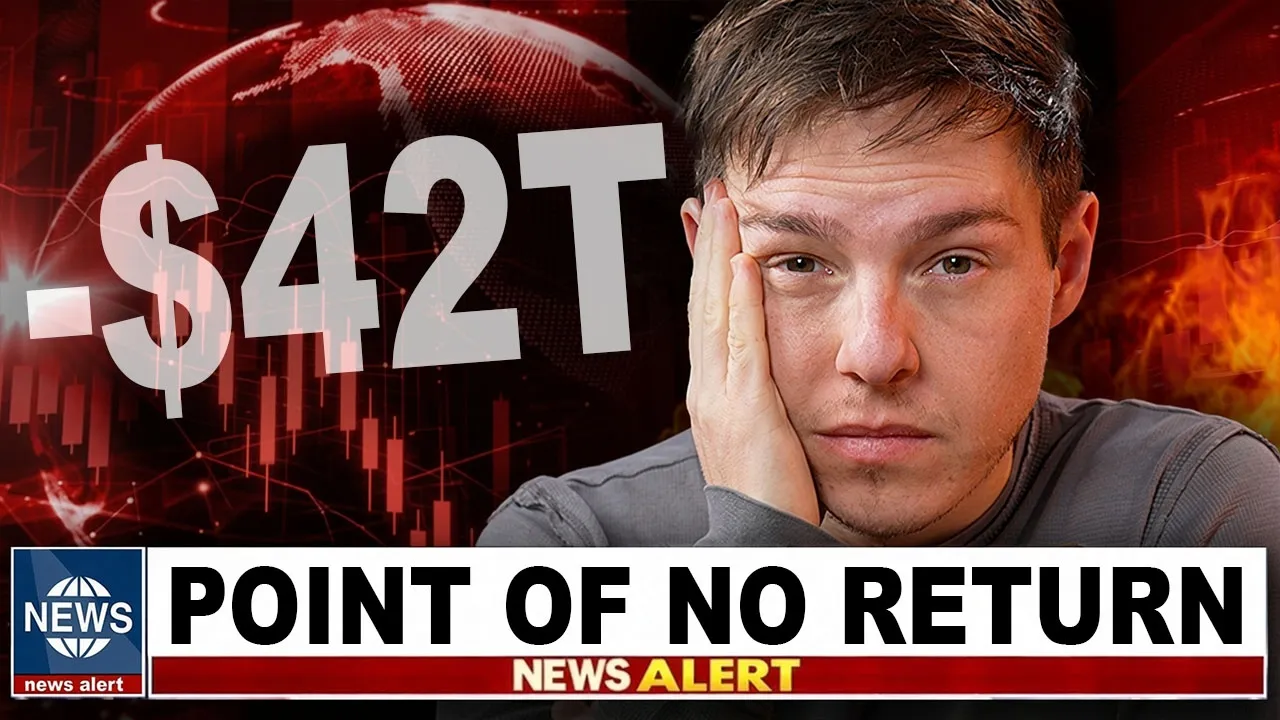
“America’s Debt Spiral Is Going To Implode Within 3 Years” - Ray Dalio’s Final Warning
Graham Stephan
452,277 views • 3 days ago Save 12 min 5 min read
Video Summary
The United States is teetering on the edge of a national debt spiral, a dire scenario predicted by Ray Dalio, where soaring interest rates force ever-increasing borrowing, creating a vicious cycle that could break the economy. Demand for U.S. debt has plummeted, causing interest rates to skyrocket at their fastest pace in decades, while the deficit balloons by billions daily. This unsustainable trajectory has led to projections of interest payments alone costing $2.1 trillion annually by 2036, a sum so vast it would necessitate cutting the entire military budget.
The crisis is fueled by a confluence of factors: declining foreign investment from nations like China and Japan, a surge in U.S. debt supply coupled with competition from AI companies, persistent inflation, and a weakening U.S. dollar. These pressures are making U.S. debt less attractive, potentially leading to a crisis where the market forces a drastic intervention. The consequences could ripple through stocks, real estate, and the broader economy, with higher interest rates making risk-free assets more appealing than stocks and disproportionately harming growth companies.
Short Highlights
- The U.S. is facing a national debt spiral due to rapidly rising interest rates and weak demand for its debt.
- Interest payments on the national debt are projected to reach $2.1 trillion annually by 2036.
- Several factors contribute to the crisis: fewer foreign buyers, increased U.S. debt supply, persistent inflation, and a falling U.S. dollar.
- Higher interest rates make stocks less attractive, especially growth stocks, and increase borrowing costs for companies.
- Mortgage rates have risen significantly, impacting housing affordability.
- Banks and bondholders face potential losses as bond values decrease with rising interest rates.
- Potential outcomes include economic growth offsetting debt, inflation eroding debt value, or market intervention.
Key Details
The Start of a National Debt Spiral [0:00]
- Ray Dalio predicts the U.S. is entering a national debt spiral where rising interest rates force more borrowing, creating a self-perpetuating cycle.
- Demand for U.S. debt is weak, causing interest rates to surge at their fastest pace in decades.
- The U.S. deficit has increased by $2 trillion this year, and Dalio believes the U.S. is at a point of no return, with financial repression potentially on the horizon.
"After all, demand for U.S. debt is now so weak that interest rates are skyrocketing at their fastest pace in decades."
The Scale of U.S. Debt and Interest Payments [1:00]
- The United States owes over $40 trillion, with the debt increasing by $6 billion daily.
- The primary issue is not the total debt amount, but the rapidly increasing interest payments required.
- Historically low interest rates allowed for extensive borrowing, with the expectation of refinancing at similar rates, but this is no longer the case.
"See, for the longest time, the United States could borrow money at near free, like 0% interest rates."
The Debt Spiral Mechanism [1:45]
- The debt spiral occurs as higher interest payments necessitate more borrowing, which in turn increases the deficit and requires even more borrowing.
- The Congressional Budget Office projects interest costs to reach $2.1 trillion annually by 2036, a figure larger than the entire military budget.
- The U.S. issues treasury bonds to borrow money, promising repayment with interest.
"The Congressional Budget Office now projects interest will cost $2.1 trillion a year by 2036."
Declining Demand for U.S. Debt [2:30]
- Demand for U.S. debt is weakening due to several converging factors.
- Foreign buyers, historically major investors like China and Japan, are reducing their holdings.
- Increased U.S. borrowing needs, coupled with borrowing by AI companies, are flooding the market and competing for buyers.
"But recently, China's holdings fell to their lowest level since 2008."
Inflation and the Falling U.S. Dollar [3:30]
- Persistent inflation, exacerbated by factors like Middle East conflict impacting oil prices, makes locking money into long-term bonds less attractive.
- Investors are concerned about the decreasing value of the dollar and potential future inflation.
- The U.S. dollar's status as the global reserve currency is being questioned as trust in U.S. debt erodes.
"This is the question nobody wants to ask. What happens when the rest of the world doesn't trust US debt like they once used to?"
Economic Impacts of Rising Interest Rates [5:00]
- Rising interest rates reprice every asset in the economy, making stocks less attractive compared to risk-free government bonds.
- Growth stocks are hit hardest as investors prioritize immediate profits over future earnings.
- Mortgage rates have increased, impacting housing affordability, and companies face higher borrowing costs, reducing profits and growth potential.
"Like, think about it, if you could earn 6% risk-free from the government, why would you pay 30 times earnings on a company that's only returning back 3%?"
Potential Outcomes and Personal Strategy [9:00]
- Potential scenarios include economic growth outstripping debt, inflation reducing debt's real value, or market intervention.
- The speaker advocates for diversification, holding a mix of stocks, real estate, international assets, treasuries, cash, and potentially crypto.
- The speaker personally holds 15-20% in treasuries yielding around 5% and the rest in S&P 500 and international index funds, aiming to buy stocks at lower prices if the market falls.
"Personally, I don't think this is a black swan event that's going to come crush our economy and collapse everything, because banks are pretty well capitalized, and they've had years to prepare for this."