This Happened Twice in 100 Years... Both Times, Stocks Fell 49%
Peter Schiff
53,821 views • 22 hours ago Save 64 min 8 min read
Video Summary
The U.S. stock market's breadth is mirroring historical downturns, with 86% of the S&P 500 in bear market territory. This alarming trend echoes the periods of 1973 and 2000, which preceded nearly 50% market crashes. Despite the S&P 500 nearing all-time highs, the average stock is 19% below its peak, signaling a severe disconnect.
Meanwhile, bond yields are relentlessly climbing, with the 10-year Treasury hitting a 20-year high and mortgage rates surpassing 7%. The speaker argues that the consumer is not in good shape, citing falling consumer sentiment and rising inflation expectations. This inflationary psychology could lead to hoarding and further price hikes, creating a self-perpetuating spiral. The speaker also criticizes the government's handling of his former bank, Europe Pacific Bank, alleging corruption and mismanagement in its receivership, which has left most customers without their funds years later.
Short Highlights
- Market Breadth Warning: 86% of the S&P 500 is in bear market territory, mirroring the dangerous breadth seen before the 1973 and 2000 market crashes, which led to nearly 50% declines.
- Soaring Bond Yields: Long-term interest rates continue to rise, with the 10-year Treasury yield at a 20-year high and mortgage rates exceeding 7%, indicating significant pressure on borrowing costs.
- Consumer Confidence Waning: Despite low unemployment, consumer sentiment has dropped, and inflation expectations are rising, suggesting consumers are not in as strong a position as commonly believed.
- Inflationary Psychology: Fear of rising prices is leading consumers to hoard goods, which could create shortages and further accelerate price increases, fueling a dangerous spiral.
- Government Mismanagement Alleged: The receiver of Europe Pacific Bank has allegedly mismanaged the liquidation, with only 78 out of 3,500 customers receiving their funds over four years, costing the bank millions.
Key Details
Market Breadth Mirrors Historical Downturns [00:00:00]
- The breadth of the U.S. market is showing extreme weakness, with 86% of the S&P 500 in bear market territory.
- This situation is comparable to January 1973 and early 2000, periods preceding significant market crashes where the S&P 500 dropped nearly 50%.
-
"The breadth in the U.S. market has only been this bad twice in all of the last 100 years."
Soaring Bond Yields Unnoticed by Stocks [00:00:00]
- Long-term interest rates, reflected in U.S. Treasury yields, have been relentlessly rising.
- The 10-year Treasury yield closed at 5.16%, a 19-20 year high, with an intraday high of 5.22%.
- The 30-year yield hit a 22-year high at 5.49% intraday.
-
"But what's also amazing about what's happening in the bond market is the fact that it's having no impact on the overall stock market."
Stock Market Complacency [00:00:00]
- Stock market investors are aware of rising bond yields but appear unconcerned, rationalizing that "this time it's different."
- They believe rising rates do not impact stocks or the economy significantly.
-
"They've noticed it, but they just don't seem to care."
Global Yields on the Rise [00:00:00]
- Yields are not just rising in the U.S.; they are increasing globally, including in Japan.
- Japan's 10-year JGB yield is above 3%, and the 30-year yield is at a record high of 4.13%.
-
"Yields are rising around the world. And this is a major problem for economies and for the stock market."
Housing Market Under Pressure [00:00:00]
- Mortgage yields have surpassed 7%, with the 30-year fixed-rate mortgage nearing 8%.
- The Trump administration's order for Fannie and Freddie to buy long-term mortgages has artificially suppressed rates but is causing losses for these entities.
-
"And the only reason why they're not substantially higher, the only reason that a 30-year fixed-rate mortgage is not already at 8% is because the Trump administration ordered the GSEs, Fannie and Freddie, to buy long-term mortgages."
Oil Prices Fall, Yields Rise [00:00:00]
- Oil prices have fallen from around $100 a barrel to $92, despite a lack of resolution in geopolitical conflicts.
- Historically, oil prices and bond yields had a strong correlation, but this has broken down, with yields rising regardless of oil price movements.
-
"Well, now the bond market has broken out of that and bond yields are rising regardless of what happens to the price of oil."
Fed Rate Hikes Ineffective? [00:00:00]
- The Federal Reserve's recent rate hike, intended to signal seriousness about fighting inflation, has not stopped rising bond yields.
- Probabilities for further rate hikes have increased, but the market seems to be shrugging off these developments.
-
"Bond yields show no sign that they're going to stop rising even though the Fed delivered that symbolic rate hike that everybody thought was required."
Consumer Confidence Plummets [00:00:00]
- Consumer sentiment has dropped significantly, with the University of Michigan Consumer Sentiment index falling from 51.7% to 48.1%.
- Year-over-year inflation expectations have risen, with one-year expectations at 4.6% and five-year expectations at 3.4%.
-
"I don't know what fantasy world people are in if they think the consumer is in such good shape."
Inflationary Psychology and Hoarding [00:00:00]
- Consumers are buying goods out of fear that prices will rise further, leading to pulled-forward spending and potential hoarding.
- This behavior can create a self-perpetuating spiral of rising prices and demand.
-
"This is the type of inflationary psychology that can really spiral because now you have hoarding."
Stock Market Deception [00:00:00]
- Major stock market averages appear strong, but this masks the weakness in the vast majority of individual stocks.
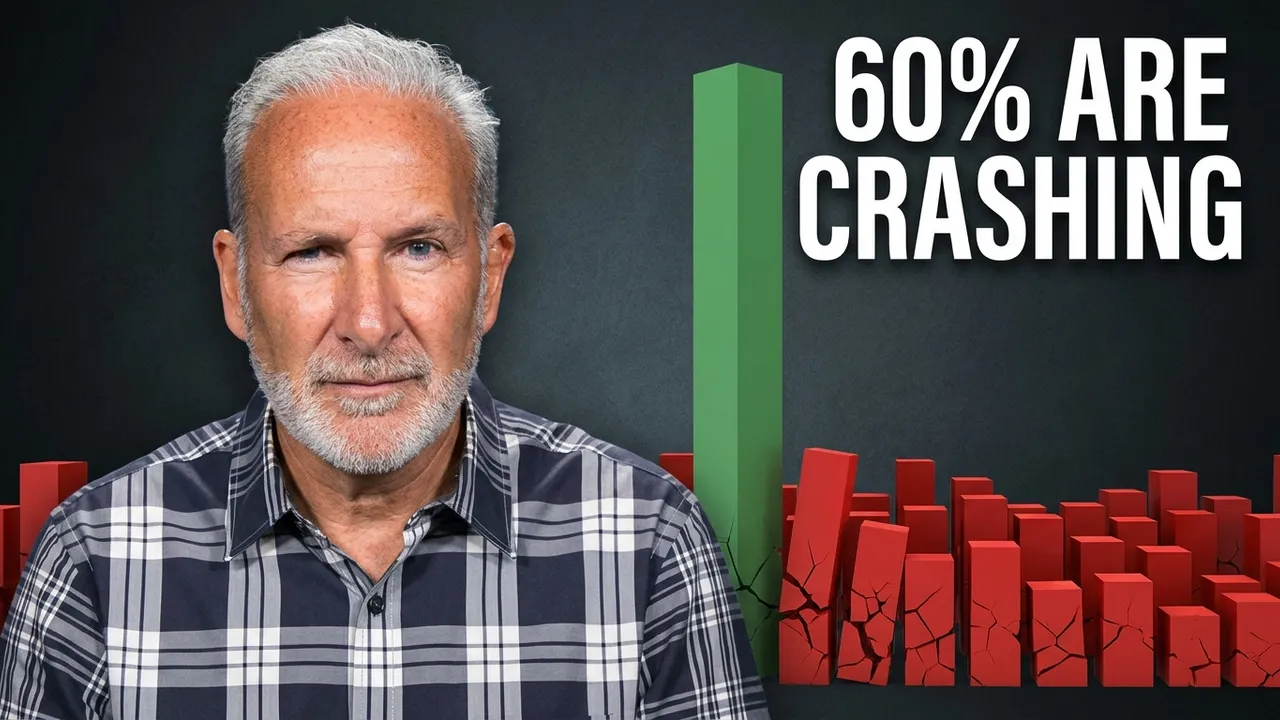
- The average stock in the S&P 500 is 19% below its record high, and 60% of all S&P 500 stocks are in bear market territory.
-
"So on average, 86% of the S&P 500 is a bear market."
Historical Precedents for Market Crashes [00:00:00]
- The current market breadth situation has only occurred twice in the last 100 years, both preceding major crashes.
- In 1973, the S&P 500 dropped 48.2%, and in 2000, it fell 49.2%.
-
"And in both cases, the S&P dropped nearly 50%."
Bill Ackman's Controversial Advice [00:00:00]
- Investor Bill Ackman is criticizing the Fed's rate hikes, arguing they will worsen inflation and deter investment in AI.
- He suggests raising the inflation target to 2.5%-3% and ceasing rate hikes.
-
"Ackman is saying, look, stop hiking rates and raise the inflation to 2.5% to 3%."
U.S.-China Relations Stagnate [00:00:00]
- The meeting between President Biden and Xi Jinping yielded little concrete progress on key issues like Iran's nuclear program or China's trade with Russia.
- Tariffs and trade policies are harming the U.S. economy more than trading partners.
-
"A lot of pomp and circumstance, a lot of photo ops, but really much ado about nothing."
Europe Pacific Bank Lawsuit [00:00:00]
- The speaker is suing the IRS for violating FOIA in relation to the shutdown of his bank, Europe Pacific Bank.
- FOIA requests reveal that IRS agents believed the bank was involved in tax evasion and money laundering, despite official statements claiming insolvency.
-
"I wanted to see the communications regarding my bank and why my bank was shut down because I knew that the bank didn't do anything wrong."
IRS Misled Public on Bank Closure [00:00:00]
- IRS chief Jim Lee was prepared to announce the bank's closure for tax evasion and money laundering, unaware it was a PR stunt.
- Internal communications show a Memorandum of Understanding between the IRS and OSIF, contradicting claims of independent action.
-
"Well, how do you act independently if you have a memorandum of understanding to act together, right?"
Receiver's Incompetence and Greed [00:00:00]
- The receiver appointed to Europe Pacific Bank has allegedly mismanaged the liquidation, returning funds to only 78 out of 3,500 customers in over four years.
- The receiver has paid himself over $850,000, costing the bank $2.2 million, while customers have received nothing.
-
"The greediest people are the people who work for government. I've always said that."
Government vs. Free Market [00:00:00]
- The speaker contrasts the slow government receivership with his bank's ability to return funds to 4,500 customers in under two years before the shutdown.
- He argues that the receivership was unnecessary and a deliberate act to damage the bank's reputation for publicity.
-
"This is the difference between the free market and government."
Republican Inaction on IRS Issues [00:00:00]
- Despite Republican promises to address IRS overreach, there has been no action in Congress to investigate the alleged weaponization of the IRS.
- The speaker criticizes Republicans for using the IRS as a campaign issue without taking substantive steps.
-
"But when it comes down to actually doing something to put a stop to the harassment, they are all talk and no action."