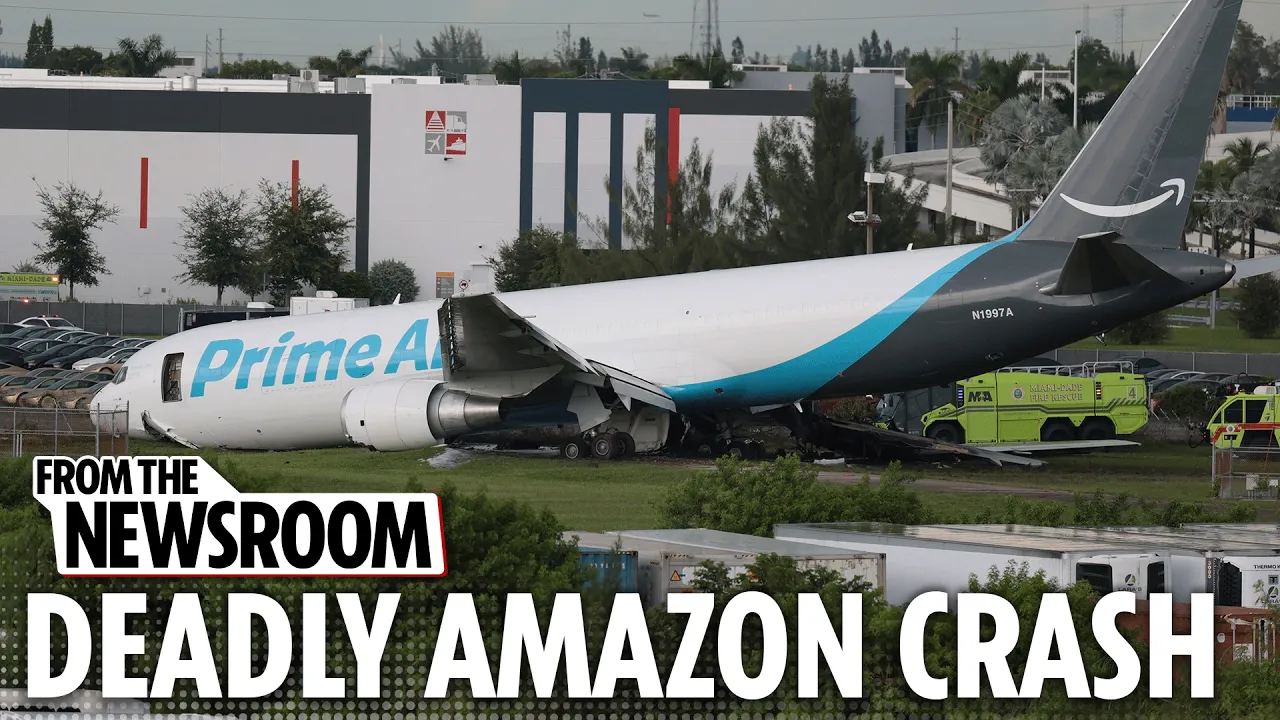
What caused an Amazon plane to crash at Miami airport?
The Sun
43,500 views • 1 month ago Save 3 min 3 min read
Video Summary
An Amazon cargo plane overshot a runway at 129 mph, resulting in a fatal crash that killed five people and injured five others. Former pilot Terry Tozer suggests the disaster began long before the runway, citing an unstable approach with high speed and altitude, compounded by crosswinds and thunderstorms. Tozer emphasizes that pilots should abort landings that are not stable, rather than pressing on, a decision he believes may have been influenced by a "get the job done" culture.
The aircraft's landing gear may not have fully engaged the runway, preventing critical slowing systems like reverse thrust and spoilers from activating. This, combined with a landing halfway down the runway, meant the plane had insufficient distance to stop, ultimately leading to its catastrophic exit from the runway. The incident highlights the paramount importance of a strong safety culture within aviation, where procedures are strictly followed to prevent such tragic outcomes.
Short Highlights
- An Amazon cargo plane crashed after overshooting a runway at 129 mph.
- Five people were killed and five others injured in the incident.
- The crash occurred during thunderstorms with a crosswind.
- An unstable approach, too high and too fast, is identified as a primary issue.
- The aircraft may not have fully touched down, disabling critical slowing systems.
Key Details
Unstable Approach and Crosswinds [0:33]
- The aircraft's approach began to go wrong a significant distance from the airport.
- Thunderstorms were present, and a crosswind from the left required a specific landing technique.
- The aircraft was unstable on approach, too high and too fast.
"And at that point, the good idea would have been to throw the approach away, go around and do it again."
The Decision to Press On [0:59]
- There is a trend in some aviation cultures to prioritize completing the job over safety.
- Pilots should be commended for aborting unsafe landings.
- Pressing on with an unstable approach appears to be what happened in this incident.
"What you don't do is press on. And that on the surface looks as if that's what's happened here."
Landing Gear and Slowing Systems [1:19]
- Footage suggests the rear wheel did not touch the floor evenly or at all.
- If the weight is not fully on both wheels, the weight-on-wheel switches that enable reverse thrust may not activate.
- Spoilers designed to kill lift might not have deployed, further hindering deceleration.
"Now, there's no apparent sign of either of those things happening. And that may well be because it hasn't got its weight fully on both wheels."
Mid-Runway Landing and Culture [2:24]
- Data indicates the aircraft landed halfway down the runway, which is highly irregular.
- An aircraft of this power could have aborted the landing even after landing halfway down.
- The safety culture of an airline is crucial; a culture that emphasizes procedures and discourages pushing limits is vital.
"If on the other hand, pilots do feel under pressure to complete a task, it can lead to unforced errors."