They Are About to RESET Your Money — Pay Attention
Tom Bilyeu
4,556 views • yesterday Save 45 min 11 min read
Video Summary
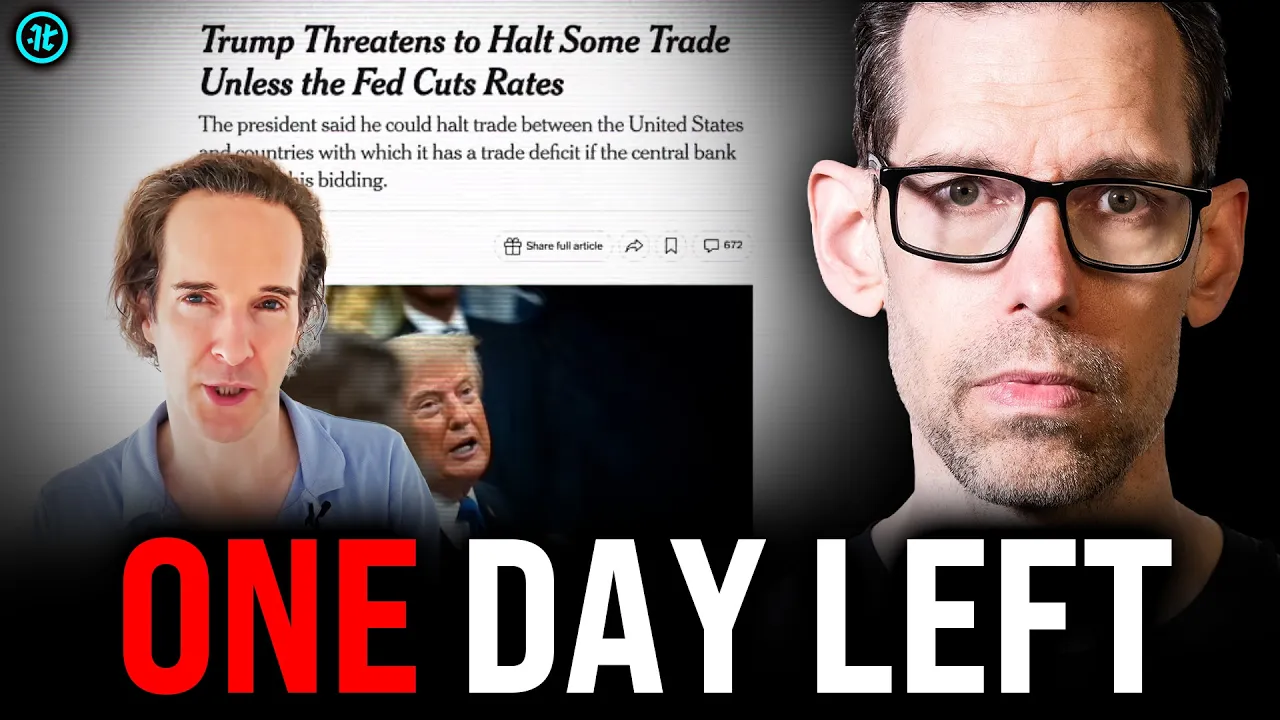
The U.S. financial system is undergoing a significant reset, marked by a presidential ultimatum to the Federal Reserve to lower interest rates by September 16th. This pressure on the independent Fed, coupled with global distrust in U.S. debt, is causing countries to pull their gold reserves from American vaults. This mirrors the events of 1971 when the U.S. closed the gold window, leading to the "great inflation" of the 1970s. The speaker warns that the current system is being rebuilt with a new digital dollar, spearheaded by major financial institutions, which could concentrate control and leave ordinary people behind. The core issue is the U.S.'s $40 trillion debt, forcing a choice between unpopular tax hikes, reduced spending, or inflation to devalue the debt. The most likely path, according to the speaker, is inflation, which erodes purchasing power and benefits the government in paying off its debt, but punishes those holding cash.
Short Highlights
- Presidential Ultimatum to the Fed: On September 16th, the Fed faces pressure to lower interest rates, threatening trade repercussions if they don't.
- Global Distrust in U.S. Debt: Countries are withdrawing gold from U.S. vaults, and major investors like Norway are cutting holdings of U.S. treasuries, signaling a loss of confidence.
- The Rise of the Digital Dollar: 21 major financial institutions are forming a company to launch a U.S. dollar stablecoin, potentially creating a new financial infrastructure controlled by banks.
- Historical Parallels to 1971: The current situation echoes the events leading to Nixon closing the gold window, which resulted in the high inflation of the 1970s.
- The Debt Dilemma: The U.S. faces $40 trillion in debt, with options of raising taxes, cutting spending, or using inflation to devalue the debt, with inflation being the most probable outcome.
- Impact on Your Money: The "reset" is seen as a mechanism to devalue the dollar and erode purchasing power, making it crucial to invest in assets that hold value.
Key Details
The President's Ultimatum to the Fed [0:00]
- The U.S. President has issued an ultimatum to the Federal Reserve: lower interest rates or face trade consequences.
- This action challenges the traditional independence of the Fed, creating a potential "death spiral" for the economy.
- All eyes are on the bond market, as its collapse signifies a loss of trust in the government's ability to repay its debts.
"Lower the rate or I'll stop trading with countries with which we have a deficit."
The Bond Market's Crucial Role [1:09]
- The bond market reflects people's trust in the government's repayment capabilities.
- President Trump has called high interest rates a "very fair disadvantage" and urged the Fed to be "patriots."
- The Fed's decision on September 16th is critical, with markets expecting rates to rise, while the President wants them to fall.
"All eyes need to be on the bond market because if you break the bond market, that's basically people's trust that they're going to get paid back from the government."
Lowering Rates: Stimulus or Response? [2:29]
- Lowering rates is often seen as stimulatory, but it's argued to be a response to the economy's psychology rather than an effective stimulus on its own.
- Japan's experience of holding low rates for decades without economic stimulation is cited as an example.
- If people lack confidence in the future, they won't borrow or invest, regardless of low rates.
"But the problem is it's not an effective response, which is why you don't see that stimulus working."
Loss of Trust and Rising Yields [4:20]
- When people lose trust in a borrower's ability to repay, especially over long terms, they demand higher returns.
- Concerns about inflation and potential money supply increases lead investors to demand extraordinary returns on their money.
"And that means you're going to have to pay me a very extraordinary return on my money if I'm going to come out ahead."
Gold Exiting U.S. Vaults [4:59]
- Pallets of gold are being loaded onto planes and flowing out of America, with countries reclaiming their gold for the first time since 1971.
- This is seen as a sign of distrust, similar to the situation in 1971 when the U.S. government was fiscally irresponsible.
"Country after country pulling their gold home for the first time since 1971."
The 1971 Precedent [5:30]
- In 1971, the U.S. government's fiscal irresponsibility led to limitations on gold redemption.
- Countries began demanding their gold back, a significant vote of no confidence.
- Paul Volcker, then an official, tried to convince the Dutch not to take their gold, but they did, seeing the U.S. printing money.
"And when you're printing money at that level and people are getting to the point where they don't trust they're going to be able to get their gold, that's when you know the psychology of what's going to be happening in the bond market."
The Bond Market as a Barometer [6:39]
- Ray Dalio emphasizes that the bond market governs everything, indicating future interest rates and people's expectations of the world.
- In 1971, the expectation was that the U.S. wouldn't be able to provide gold on demand, a prediction that proved true.
- Nixon closed the gold window, preventing the exchange of dollars for gold.
"The bond market governs everything. It lets you know, first of all, what rates are going to be."
The "Reset" and Its Consequences [7:30]
- The current situation is a playbook seen before, where a president leans on the money printer while the world pulls out gold.
- This can lead to a decade or two of watching money shrink, as seen in the 1970s and post-COVID.
- The system's "plumbing" under bank accounts and pensions is being reset.
"When the printer starts answering to the politicians, the people who understand that early do really, really well."
Four Quietly Happening Events [8:30]
- While the President's actions are loud, four quieter events are occurring simultaneously, signaling a system reset.
- Gold is leaving U.S. vaults, indicating a lack of trust.
- A major, safe financial institution is dumping U.S. debt.
- Banks are artificially suppressing debt yields (financial repression via yield curve control).
- Central banks, like Japan's and the U.S.'s, are buying their own debt.
"The system itself, like the plumbing under your bank account, your pension, your 401k is being reset right now, not sometime in the future."
Banks Building a New Dollar [10:00]
- 21 of the largest banks are forming a company to launch a U.S. dollar stablecoin in 2027.
- This is a digital dollar, a product of blockchain technology, not necessarily a "crypto play" in the traditional sense.
- This new infrastructure could give immense control over money flow to those who build the rails.
"21 of the largest banks on the planet, think Goldman Sachs, Citibank, Bank of America, they teamed up and they're building a new dollar."
The AI Bet and Market Concentration [11:20]
- A significant portion of stock market gains is concentrated in a few tech companies, primarily driven by AI.
- This concentration poses a risk, as the market's performance is heavily reliant on a single sector.
- Historically, there's a delay between infrastructure investment (like AI) and revenue generation, creating potential financial strain.
"The most dangerous thing you can own might be the very thing that you were told as the safest thing to own, right?"
Diversification and Time Horizon [13:00]
- While the S&P 500 is diversified, 40% of it is concentrated in just 10 AI-focused stocks that drove 72% of gains this year.
- Diversification across the S&P 500 can still lead to recovery over time, especially with a long-term horizon (20+ years).
- However, the time duration for recovery is a critical factor, and short-term investors could face significant losses.
"72% of your returns are coming from just 10 companies. And guess who those 10 companies are? They're entirely AI companies."
The "Index Fund Trap" [14:30]
- The speaker is hosting a free live training called "The Index Fund Trap" to discuss why the S&P 500 might be misleading.
- The training will cover how to check for real concentration and where smart money is moving.
- The core idea is that the "safe" S&P 500 may no longer be safe due to its concentration in AI.
"We're going to do it live. We're going to do a real Q&A. You can ask me anything you want. I'll show you how to check your real concentration and all of that."
Gold as a Lie Detector [15:30]
- Gold is presented as a "lie detector" for the financial world, holding value when paper money loses it.
- Countries are moving their gold reserves out of the U.S. due to a perceived lack of trust and potential future instability.
- This physical movement of gold signifies a fundamental shift in trust, not just technical adjustments.
"Gold is the only thing that's held its value for thousands of years, and it's the only thing that can't be printed."
The 1971 Gold Withdrawal and Nixon's Decision [17:30]
- The Netherlands requested to convert $250 million into gold in 1971, a move Paul Volcker tried to prevent.
- The Dutch response: "If the boat capsizes because I asked to swap $250 million for gold, then the boat's already sunk."
- In August 1971, Nixon closed the gold window, as the U.S. had printed too much money to back all outstanding dollars with gold.
"Because we had printed so much money that now, if people actually wanted to claim their gold, we weren't going to be able to pay them back."
The Great Inflation of the 1970s [19:00]
- The decade following 1971 saw the "great inflation," where prices roughly doubled and the value of the dollar evaporated.
- This was a "slow bleed" of purchasing power, not a sudden crash.
- The current situation is described as a similar "reset" mechanism.
"The 10 years that followed were the great inflation of the 1970s. Pricely roughly doubled."
The Debt Trap and Inflation as a Solution [19:40]
- With $40 trillion in debt, the U.S. faces a dilemma: raise taxes, spend less, or use inflation to devalue the debt.
- Inflation is presented as the most likely outcome, as it allows the government to pay back debt with devalued dollars.
- This process erodes the purchasing power of individuals while making the debt more manageable for the government.
"What happens mechanistically is you go, okay, well, if we can't get people to vote for spending less money or taxes, then we'll do the thing that they don't get to vote for, which is we're going to use inflation as a way to take your purchasing power."
Navigating the Reset: Strategies for Your Money [22:00]
- Don't hold too much cash: Keep an emergency fund but avoid excessive cash, as inflation will erode its value.
- Own assets that hold value: Focus on hard assets like gold or shares in genuinely great businesses with pricing power.
- Diversify: Avoid over-allocation in any single direction, even seemingly safe assets like gold.
- Maintain optionality: Keep some flexibility to invest when opportunities arise during market dips.
"The goal here is that you've got to understand what's going on in the marketplace. What are the mechanisms?"
The System's Groaning Weight [24:30]
- Global events like gold leaving the U.S., Norway backing away from U.S. debt, presidential pressure on the Fed, and Japan's economic situation are interconnected.
- These are not isolated incidents but symptoms of a system being reset under immense pressure.
- The replacement system is being built, but its control rests with large institutions, not individuals.
"It is the slow, deliberate remaking of the money that you have and own. And it's not a forecast. I'm not telling you this is something that could happen. It's happening right now."
The Digital Dollar and CBDCs [26:00]
- The formation of a company to launch a U.S. dollar stablecoin signifies a shift towards digital money controlled by major banks.
- This is distinct from decentralized cryptocurrencies like Bitcoin and raises concerns about government control and surveillance.
- The speaker warns against Central Bank Digital Currencies (CBDCs) due to the potential for government control over spending.
"Money that lives on a computer is money that can be tracked, moved and managed in ways a paper note couldn't."
Preparing for the Reset [28:00]
- The reset is happening now, not in the future.
- Key strategies include holding assets that cannot be printed (like gold), investing in strong businesses, and maintaining diversified portfolios.
- Understanding the mechanisms of the reset is crucial for making informed decisions and protecting oneself from the devaluation of paper money.
"If you understand this, you're listening. You're actually migrating your money over to something that is in assets, very diversified, protecting against overconcentration and things like A.I., but you're actually diversified."