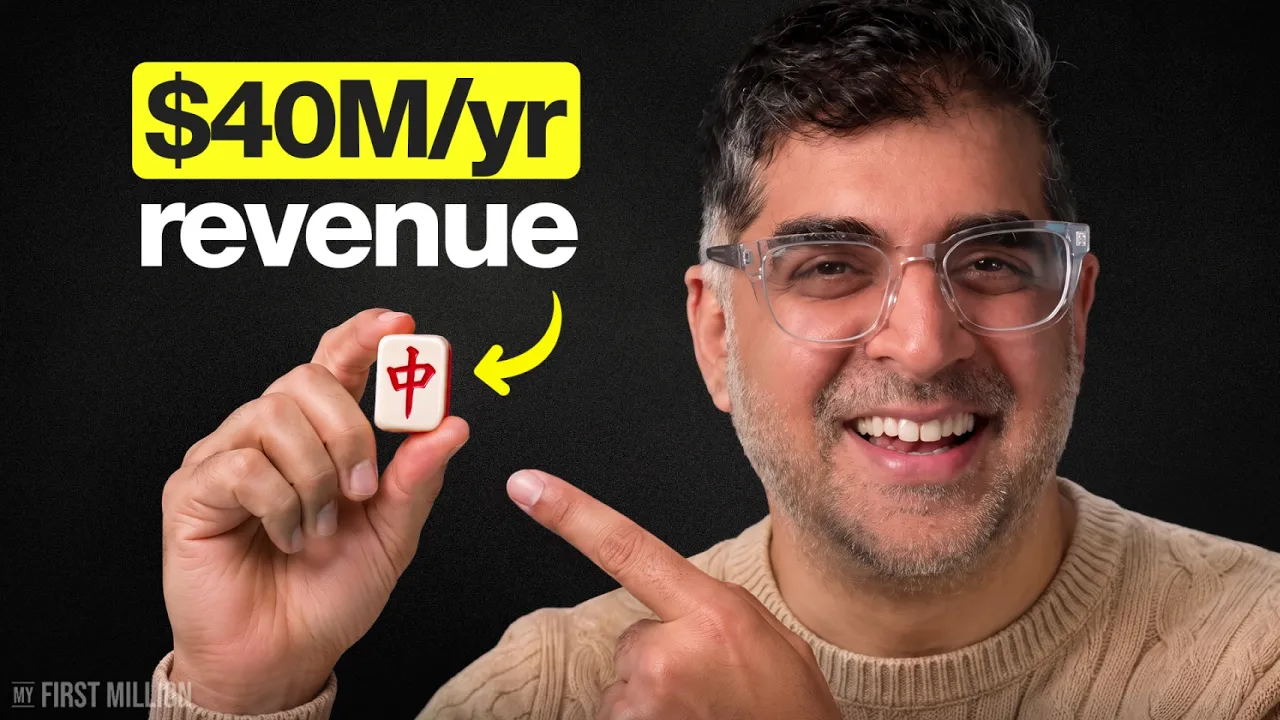
The next pickleball is already making $40M/year
My First Million
24,777 views • yesterday Save 50 min 16 min read
Video Summary
Mahjong is experiencing a massive resurgence, driven by a desire for offline social connection and a modernized aesthetic. Yelp searches for mahjong-related terms have surged 4,000%, and Google search volume is up 70% year-over-year. Companies like "Oh My Mahjong" have seen explosive growth, raking in tens of millions in revenue. This boom is fueled by several factors: the game's inherent social appeal, its complex learning curve that fosters strong community bonds through shared effort (a psychological phenomenon known as the severity of initiation), and a new wave of beautifully designed, aesthetically pleasing mahjong sets that are treated as art pieces rather than just games.
This trend taps into a broader cultural shift away from constant digital engagement. The game offers a tactile, no-phone social activity, appealing to a generation seeking authentic connections. Historically, mahjong has seen booms in America, notably a century ago when it was introduced by tourists. The current revival, however, is distinguished by its sophisticated marketing, high-end product design, and strategic leveraging of social trends, making it a compelling business opportunity and a cultural phenomenon.
Short Highlights
- Mahjong is experiencing a significant boom, with Yelp searches up 4,000% and Google search volume up 70% year-over-year.
- Companies like "Oh My Mahjong" have seen rapid revenue growth, reaching tens of millions in just a few years.
- The game's complexity and steep learning curve create strong community bonds through shared initiation.
- Modern mahjong sets are designed with a high aesthetic appeal, transforming them into art pieces.
- The trend taps into a desire for offline, tactile social activities as an antidote to digital saturation.
- Historically, mahjong has seen previous booms in popularity in America.
- The game offers a blend of skill and luck, making it accessible and engaging for new players.
Related Video Summary
Key Details
The Mahjong Boom Ignites [00:00:00]
- Searches for "mahjong club," "mahjong coach," and "mahjong" have skyrocketed by 4,000% on Yelp.
- Yelp recognized mahjong as one of its top emerging trends.
- Google search volume for mahjong has increased by 70% year-over-year and has been steadily climbing since COVID-19.
"Yelp searches for mahjong club, mahjong coach, mahjong, all these things, up 4,000%."
"Oh My Mahjong" Skyrockets [00:00:00]
- A company called "Oh My Mahjong," founded three years ago, has seen explosive growth.
- Year one revenue: $1 million.
- Year two revenue: $40 million.
- Current year (year three): Already surpassed $40 million, with projections to reach $60 million.
"Year two, want to take a guess? Two million? Try 40. 40? Thank you for the homie guess. 40 million year two."
A Socially Entrenched Game [00:00:00]
- A personal anecdote describes a mahjong-themed birthday party where nearly all attendees were avid players.
- The game is described as "unbelievably complicated" with a steep learning curve.
"And my wife doesn't play mahjong or tennis. So she's like, great. Here we go. And so she goes to this party. And she's like, well, it's okay. I don't play, but I'm sure, like, I mean, how many people really play mahjong?"
The High Cost of Entry [00:00:00]
- A beginner mahjong set, described as an "entry level" option, cost $450.
- The total initial purchase for a "beginner" set, including necessary tools, amounted to $850.
"So the lady goes, oh, this is one of our like entry level ones. It's really good. This one's $4.50. What? And I was like, yen? What are we talking about here? $450?"
The Aesthetic Appeal of Mahjong Sets [00:00:00]
- Mahjong sets are now designed to be highly aesthetic, resembling art pieces.
- The tactile and auditory experience of the tiles (the "clickety-clack") is described as addictive.
- Even the rulebooks can come with an annual fee, highlighting the commercialization of the game.
"So these are mahjong tiles. I don't know if you can see them. So we got this kind of like aesthetic looking set. There's different. This is like crack. It's the character ones. There's bamboo. There's the dragons. There's all these different ones."
Historical Echoes: The First Mahjong Boom [00:00:00]
- Mahjong first gained popularity in America about 100 years ago after American tourists discovered it in China.
- It briefly became popular in Hollywood circles but eventually faded due to its complexity and lack of infrastructure.
- Key elements for its past success included adapting rules for American players and the availability of teachers.
"The backstory is 100 years ago, these American tourists go to China. They discover Mahjong while there. It's like an ancient Chinese game. And they like it."
The Severity of Initiation [00:00:00]
- The game's steep learning curve necessitates lessons or joining clubs, creating a barrier to entry.
- Shops offer free lessons, similar to how Lululemon offers free yoga, to draw people in.
- This difficulty fosters a sense of value and belonging for those who master the game.
"The harder it is to get into a club, the more everybody's going to value being in the club."
Psychological Drivers: Severity of Initiation [00:00:00]
- The principle of "severity of initiation" suggests that the more effort one expends to join a group, the more they value membership.
- Studies show that groups with higher initiation difficulty (e.g., high embarrassment or pain) lead to greater commitment.
- This psychological phenomenon is observed in activities like CrossFit, wine appreciation, and even exclusive clubs.
"The harder it is to get into a club, the more everybody's going to value being in the club."
Mahjong as Art and Furniture [00:00:00]
- Modern mahjong sets are designed to be visually appealing, akin to art or furniture, meant to be displayed.
- This contrasts with traditional board games that are often stored away.
"Mahjong sets are not like board games. You want to kind of like stuff and put away in a cabinet before guests come over. It's like art. It's basically furniture in the house."
The Modern Appeal: Tactile and Social [00:00:00]
- Mahjong is a "no phone" social activity, appealing to a desire to disconnect from screens.
- The tactile nature and the sound of the tiles are described as "addictive."
"This is also, it makes for very good content. That's the other component of this is the like, because like the way I showed you the ASMR, like there's just content about breaking, cracking open the packs for the first time or new sets or Mahjong Mondays or Mahjong and martinis."
Game Dynamics: Skill vs. Luck [00:00:00]
- Mahjong games are relatively short, typically lasting 20-30 minutes.
- While skill is involved, luck plays a significant role, allowing less experienced players to win.
- This contrasts with games like chess, where skill is the dominant factor.
"It's like chess a little bit where there's like infinite possibilities, but there is a definitive end within 30 minutes."
The "Mahjong Cut" and Aesthetic [00:00:00]
- The speaker notes a distinct "mahjong cut" hairstyle and a sophisticated aesthetic associated with players.
- Themes like tea parties and martinis are often associated with mahjong events and branding.
"The lady who owns this Oh My Mahjong, first of all, looks exactly like I thought she was going to look like. It looks exactly like the people who I know who play Mahjong look like. The haircut. There's a Mahjong cut. It's a sophistication, just like tennis."
Content Creation Goldmine [00:00:00]
- The aesthetic and social aspects of mahjong lend themselves well to content creation (e.g., ASMR, unboxing, themed events).
- This aligns with broader trends of physical board games and book clubs gaining popularity.
"And like, there's like all these things that people are doing to rally around. In the same way that, I don't know if you've seen like book clubs are on the rise, board, physical board games are on the rise."
Collaborations and High-End Market [00:00:00]
- Brands like "Love Shack Fancy" have collaborated on mahjong sets, selling out rapidly.
- A $500-$550 mahjong set from this collaboration resells for $5,000 online.
"They did a Mahjong set and in five minutes sold out. And that $500, $550 set is reselling for $5,000 online."
The "Bougie Business" Trend [00:00:00]
- The discussion touches on other luxury or niche businesses, such as $1,000+ sunglasses from Jacques Marie Mage.
- These businesses often thrive on limited production, craftsmanship, and compelling storytelling.
"One, look at the price. Tell me what you see. How much do they cost? $1,000. That's the low end. They range, they, they go from one to $3,000."
The Anti-Screen Movement [00:00:00]
- The trend of "year unplugged" and digital detoxes is highlighted, with individuals seeking to reduce screen time.
- This movement is driven by a desire for deeper connection, focus, and a return to analog activities.
"This guy's basically what Brian Johnson was to not dying. This guy is to not, to, to not using screens."
The Value of Effort and Humanity [00:00:00]
- A resurgence in humanities education and a rejection of "reward shortcutting" (e.g., AI assistance) is observed.
- Activities requiring effort, like reading physical books and engaging in challenging intellectual pursuits, are becoming more valued.
- This reflects a desire for genuine connection and accomplishment over superficial digital interactions.
"And I think what you're seeing with people is that they want to get rid of that and they want to do the hard work to get the reward."
The Opposite Reaction Creates Opportunity [00:00:00]
- When society swings too far in one direction (e.g., towards excessive screen time or ease), a demand for the opposite emerges.
- This creates opportunities for businesses and movements that offer a counterbalance, like digital detoxes or high-effort activities.
"And so when the world is full of screens, it creates the demand for someone to do a radical experiment."
The Power of Scarcity and Storytelling [00:00:00]
- Luxury markets often thrive on limited supply and compelling narratives.
- Businesses that can charge a premium by offering unique stories, craftsmanship, and exclusivity can achieve significant success.
"And I think what's interesting is that for every category you could think of, we're talking about like ballpoint pens to fishing lures, anything you could think of. There's a world where you can charge 10 to 20 times more than the average and have some fascinating, interesting story behind it."
The Rise of "Fat Loss Prisons" and Controlled Environments [00:00:00]
- The concept of highly controlled environments, like "fat loss prisons" in China, illustrates a demand for radical solutions to modern problems.
- These environments enforce strict routines and calorie control, demonstrating the effectiveness of disciplined systems.
"You dropped five pounds in the first 48 hours. It's $400 a month and everything is included. You get three low-calorie meals a day. You're required to work out four times a day."
The "Teflon Don" Strategy: Embracing Outrage [00:00:00]
- The idea that being consistently outrageous or offensive can lead to "uncancellability" is discussed.
- This strategy involves lowering expectations and making it difficult for any single offense to stick.
"Well, yeah. That's the cancellation vaccination, right? It's like, I will offend you all the time. And so, what? You're going to pick one of those and overreact?"
The High Stakes of Fidelity for the Ultra-Rich [00:00:00]
- The discussion touches on the high divorce rates among the world's wealthiest men, suggesting infidelity is common.
- This raises questions about the logistics and risks of infidelity for individuals with immense wealth and public profiles.
"There's been 13 divorces amongst the 10 richest men in the world."
Andrew Huberman's Lucrative Sponsorship Deals [00:00:00]
- Health influencer Andrew Huberman is reportedly earning $8-9 million annually from a sponsorship deal with telehealth company HIMSS.
- This includes board compensation, advisory fees, and payments for podcast and YouTube ad placements.
"So you add the whole thing up and it's kind of like a cumulative, like, you know, he's making kind of, let's call it eight, $9 million a year from this company."
Navigating the Blurry Line Between Education and Endorsement [00:00:00]
- The increasing integration of sponsored content with educational or advisory roles raises questions about potential conflicts of interest.
- Influencers and experts must navigate the challenge of differentiating genuine advice from financially incentivized recommendations.
"Where do, you know, where does the education end and the kind of endorsement begin? There's always going to be a tricky thing for anybody who's influential, us included, like anybody who promotes products."
The Podcast Revenue Explosion [00:00:00]
- Top podcasters are earning tens of millions of dollars annually from ad revenue alone.
- Deals can range from $5 million to over $100 million per year, especially for established figures with large audiences.
"Like I would say in our kind of peer group and above, right? Like I don't really know what's going on in the smaller or super niche podcast. I'm not sure there, but like of the people that I know, it's tens of millions of dollars a year is what they're making in ad money."
Underpriced Attention: The Streamer Boom [00:00:00]
- Early in the rise of streaming, top gamers had massive live audiences but were significantly underpriced for sponsorships.
- Companies that capitalized on this, like G Fuel, built substantial businesses by securing these early deals.
"And if you reached out to them to sponsor them, you know, what you would get is the girlfriend, the mom, the little brother, their best friend, who's like also 18 years old."
Market Corrections: Bubbles and Overcorrection [00:00:00]
- Markets naturally experience cycles of underpricing, overbuilding, and eventual correction, seen in tech bubbles and influencer marketing.
- This phenomenon is a feature, not a bug, driving innovation and eventually finding equilibrium.
"It's like, we will overbuild. We will over, just like we overbuilt in the internet age of like fiber and all that stuff until it corrected."
The New Frontier: Long-Form Video on Instagram [00:00:00]
- Instagram is rolling out a new long-form video format, distinct from Reels, which may offer new growth opportunities.
- Content creators are advised to leverage this format, especially for business and news content, as platforms often prioritize new features.
"Instagram is rolling out a new thing. Have you seen this thing they're rolling out? They're doing long form video on Instagram and it looks different from the reels."
The Flatlining of Screen Time [00:00:00]
- Despite the narrative of increasing phone usage, total screen time has reportedly flattened in recent years.
- Platforms are now competing for a fixed amount of user attention, leading to cannibalization of other screen time.
"The stat I read is that surprisingly screen time has been flat for the past few years. I found that interesting. Cause like it's the narrative in my head is like, Oh, we're just on our phones more than ever."
The Noble Pursuit of Disconnecting [00:00:00]
- The desire to disconnect from the internet and social media by a certain age is a recurring theme.
- This aspiration is seen as courageous and inspiring, a deliberate choice against the pervasive digital current.
"When I'm 40, I want to get off. I've been connected forever. When I'm 40, I want to get off."
The "Pay the Bills" Excuse: A Relapse into Digital Habits [00:00:00]
- The struggle to disconnect from social media is common, with many relapsing into old habits.
- Using work or "paying bills" as an excuse to access screens highlights the difficulty of maintaining digital boundaries.
"She's like, goodbye, daddy, go pay the bills. Or like, if I have to work from home and it's like work hours and I'm on my computer, she's like, daddy, are you paying the bills?"
Vocalizing Thoughts: The Socratic Method for Self-Correction [00:00:00]
- Speaking thoughts aloud, even to a rubber duck or children, can reveal cognitive biases and "bugs in the code."
- This act of articulation helps in self-correction and understanding one's own reasoning.
"And so you, you sort of like use, you know, whether it's a therapist or a coach or your kids or a rubber duck is very, very useful to speak out loud how you're thinking about a thing."
Treating Children Like Adults: The Power of Language [00:00:00]
- Talking to children using a rich vocabulary and explaining complex words fosters their development.
- This approach, rooted in the idea that children are capable of understanding, empowers them and enriches their learning.
"Her whole thing was, um, she noticed that the kids who had the best vocabularies, the parents talked to their kids like they were grownups."
The Choice Between Being Babied and Being Respected [00:00:00]
- Individuals, including children, have a choice in how they are treated, whether as victims or as capable individuals.
- Opting to be treated with respect, rather than being "babied" after a setback, can lead to more empowered behavior.
"Do you want that? Or do you want to like, do you want us to treat you like who you are? Or do you want us to baby you?"
The Montessori Principle: Happiness in Purposeful Work [00:00:00]
- Children are often happiest and most engaged when given a sense of purpose or a task, rather than pure indulgence.
- This aligns with the idea that meaningful activity, even if challenging, is more fulfilling than passive consumption.
"And when it's just indulgence, they actually like don't feel great. They're not their like most lit up self."
The "Back Door" Approach: Whispering to Gain Quiet [00:00:00]
- Sometimes, the most effective way to achieve a goal is not through direct confrontation but through a more subtle, indirect approach.
- Whispering to get children to be quiet is an example of using an unexpected method to achieve the desired outcome.
"If you want your kid to be quiet, don't scream at them to quiet down. Start whispering to them. And suddenly they'll start, they'll get quiet because they want to hear what you're whispering."
Dog Training as a Metaphor for Leadership [00:00:00]
- The principles of calm assertiveness and understanding animalistic mentality in dog training can be applied to leading people.
- Effective leadership, like effective dog training, requires patience, consistency, and an understanding of behavior.
"And so instead you need to be calm assertive as opposed to hyper assertive. Actually, I saw someone say this, but I agree to be true that if you want to get good at leading people, learn how to train a dog."
Life Hacks for Kids: The "Bet" Method for Routines [00:00:00]
- Simple, game-like strategies can make routine tasks, like getting ready for bed, more engaging for children.
- Turning a chore into a "bet" or a challenge can motivate kids to complete it quickly and willingly.
"And so instead, I'll just be like, I bet you can't do this in 10 seconds. And they're like, you know, just give them a bet. And they're like, immediately, we're just playing a new game called, can you get ready for bed in 10 seconds?"