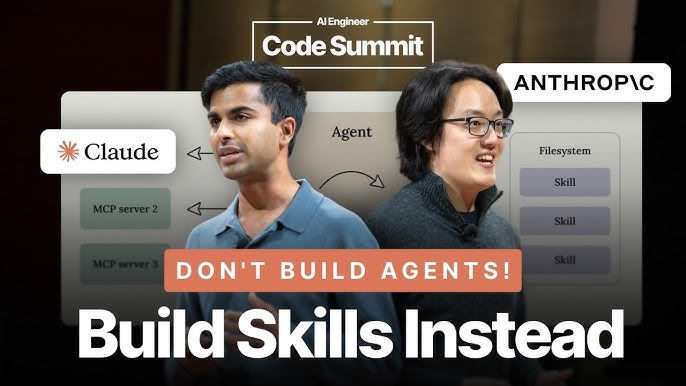
Don't Build Agents, Build Skills Instead – Barry Zhang & Mahesh Murag, Anthropic
AI Engineer
76,046 views • 9 months ago Save 8 min 8 min read
Video Summary
The video discusses a paradigm shift in agent development, moving from building individual agents for specific tasks to creating "skills" – organized collections of files that package composable procedural knowledge. This approach leverages code as a universal interface to the digital world, addressing the limitations of general-purpose agents that often lack domain expertise. The new architecture for general agents integrates an agent loop, a runtime environment, MCP servers for external connectivity, and a library of skills that can be dynamically loaded. This allows agents to gain new capabilities and domain-specific knowledge without being rebuilt, fostering a more mature and scalable ecosystem.
An interesting fact revealed is that "skills" are essentially organized folders containing scripts as tools, simplifying their creation and usage for both humans and agents. This innovation has led to a rapidly growing ecosystem with thousands of skills, categorized into foundational, third-party, and enterprise-specific types, democratizing agent development and extending AI capabilities beyond technical users.
Short Highlights
- Agents possess intelligence and capabilities but often lack specialized domain expertise.
- "Skills" are introduced as organized collections of files packaging composable procedural knowledge for agents.
- Skills can include scripts as tools, offering advantages over traditional tools like being self-documenting and modifiable.
- The agent architecture now comprises an agent loop, a runtime environment, MCP servers, and a library of skills.
- The development paradigm is shifting from rebuilding agents to building and sharing skills for expanded AI capabilities.
Key Details
The Evolution of Agents and the Need for Expertise [0:21]
- Agents have evolved significantly, with many now used daily, but persistent gaps in expertise remain.
- While agents have intelligence and capabilities, they often lack the specialized knowledge required for real-world tasks.
- The creators realized that instead of building more agents, they needed to focus on building "skills."
"Agents have intelligence and capabilities, but not always expertise that we need for real work."
Code as the Universal Interface and the Domain Expertise Gap [01:15]
- The core belief is that code is the fundamental requirement for agents, serving as a universal interface to the digital world.
- Cloud Code, initially conceived as a coding agent, proved to be a general-purpose agent capable of performing complex tasks through code execution, like generating financial reports.
- However, the limitation encountered was the lack of domain expertise, comparing the brilliance of a mathematical genius (Mahesh) to the practical knowledge of a tax professional (Barry) for a specific task like taxes.
"What we realized is that code is not just a use case but the universal interface to the digital world."
Introducing Agent Skills: Packaged Procedural Knowledge [02:56]
- Agent skills were created to address the expertise gap, defined as organized collections of files that package composable procedural knowledge for agents.
- The simplicity of skills, essentially "folders," is deliberate, allowing anyone with a computer to create and use them, and enabling versioning with Git or storage in cloud drives.
- Skills can incorporate scripts as tools, overcoming limitations of traditional tools such as ambiguous instructions and static code that cannot be modified by the model.
"Skills are organized collections of files that package composable procedural knowledge for agents."
Skills as Organized Folders with Scripts as Tools [04:51]
- Skills are fundamentally organized folders containing scripts that function as tools for agents.
- This approach allows for more consistent and efficient execution of tasks, as demonstrated by an example of a Python script for slide styling being saved within a skill for reuse.
- To manage context windows and enable composability, skills are progressively disclosed; only metadata is initially shown to the model, with the rest of the skill's content read when needed.
"So that's all skills are. They're organized folders with scripts as tools."
The Growing Ecosystem of Skills [05:02]
- Since their launch five weeks prior, skills have fostered a rapidly growing ecosystem of thousands of skills.
- These skills are categorized into foundational skills (providing new general or domain-specific capabilities), third-party skills (from partners), and enterprise-specific skills.
- Foundational skills include examples like document creation and editing, while third-party skills enhance agent interaction with specific software like Browserbase and Notion.
"Since our launch five weeks ago, this very simple design has translated into a very quickly growing ecosystem of thousands of skills."
Enterprise and Developer Productivity Skills [06:30]
- The most significant traction for skills has been observed within large enterprises, where company and team-specific skills are built.
- These skills are used to imbue agents with organizational best practices and knowledge of bespoke internal software.
- Developer productivity teams utilize skills to teach agents like Cloud Code about code style best practices and preferred internal workflows for thousands of developers.
"And I think where I've seen the most excitement and traction with skills is within large enterprises."
Evolving Trends in Skills: Complexity and Collaboration [07:30]
- Skills are becoming increasingly complex, evolving from simple markdown files to packaging software, executables, and assets, with some taking weeks or months to build.
- The ecosystem of skills complements existing MCP servers by enabling developers to orchestrate workflows of multiple MCP tools for more complex tasks, with MCP handling external connectivity and skills providing expertise.
- A key trend is the creation of skills by non-technical users in fields like finance, recruiting, and legal, validating the idea that skills make general agents more accessible and useful for day-to-day work.
"We're also seeing that this ecosystem of skills is complementing the existing ecosystem of MCP servers that was built up over the course of this year."
The General Agent Architecture: Loop, Runtime, MCP, and Skills [09:07]
- The emerging architecture for general agents includes an agent loop for managing model context and tokens, coupled with a runtime environment providing file system access for code read/write capabilities.
- This agent can be connected to MCP servers for external tools and data, enhancing its relevance and effectiveness.
- A library of hundreds or thousands of skills can be provided to the agent, which it selectively pulls into context at runtime for specific tasks.
"First, we think this architecture is converging on a couple of things. The first is this agent loop that helps manage the the model's internal context and manages what tokens are going in and out."
Future of Skills: Development, Versioning, and Dependencies [10:37]
- Future focus areas for skills include treating them like software with better testing, evaluation, and tooling for triggering skills at the right time.
- Versioning is crucial to track evolving agent behavior and maintain clear lineage over time.
- Exploration of skills that explicitly depend on other skills, MCP servers, and environmental packages will enhance predictability and composability, leading to more complex and relevant agent behavior.
"We really want to support developers, enterprises, and other skill builders by starting to treat skills like we treat software."
Sharing, Distribution, and Collective Knowledge [12:02]
- A significant value of skills lies in sharing and distribution, envisioned as a collective and evolving knowledge base of capabilities curated by people and agents within an organization.
- Skills provide the procedural knowledge for agents to perform tasks, and as agents interact and receive feedback, they improve, benefiting all agents within a team or organization.
- This collective knowledge extends beyond the organization, with skills built by the community making individual agents more capable, reliable, and useful.
"The vision that excites us most is one of a collecting and collective and evolving knowledge base of capabilities that's curated by people and agents inside of an organization."
Continuous Learning and Agent Evolution Through Skills [13:20]
- The vision of an evolving knowledge base is amplified when AI models like Claude can create skills, facilitating continuous learning and transferable memory.
- Skills capture procedural knowledge that agents can use for specific tasks, making the concept of memory more tangible.
- The flexibility of skills allows agents to instantly acquire new capabilities, evolve them as needed, and discard obsolete ones, making AI learning more cost-effective, especially for information that changes frequently.
"This makes the learning actually transferable."
The Agent Stack Analogy: Processors to Applications [14:33]
- The agent stack is compared to computing: models are like processors, requiring significant investment but limited use alone.
- Agent runtimes, akin to operating systems, orchestrate processes and resources around the model, making them more valuable.
- The real value emerges from applications, where millions of developers encode domain expertise and unique perspectives, a layer that skills aim to democratize.
"In a rough analogy, models are like processors. Both require massive investment and contain immense potential, but only so useful by themselves."
Conclusion: Building Skills, Not Rebuilding Agents [15:42]
- The convergence on a general architecture for general agents is complete, with skills representing a new paradigm for shipping and sharing capabilities.
- The recommendation is to stop rebuilding agents and start building skills instead to foster innovation and address concrete problems.
- The ultimate goal is to create a collective and evolving knowledge base that enhances agent capabilities and makes AI more accessible and useful for everyone.
"We've created skills as a new paradigm for shipping and sharing new capabilities. So we think it's time to stop rebuilding agents and start building skills instead."