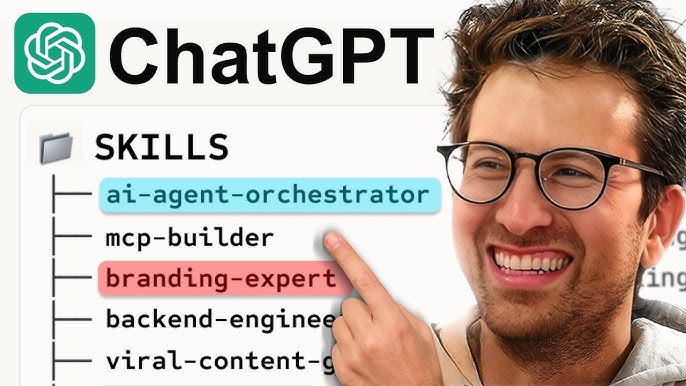
OpenAI Releases ChatGPT AI Agent Skills
Greg Isenberg
3,485 views • 8 months ago Save 12 min 6 min read
Video Summary
The video discusses several key developments and opportunities for entrepreneurs and builders. It highlights OpenAI's quiet launch of "skills" for CodeX, a feature that allows reusable bundles of instructions to enhance AI task completion, drawing parallels to Anthropic's Claude skills. A significant trend identified is "face yoga," a niche with substantial search volume and low competition, presenting opportunities for app development. The speaker also shares a favorite productivity app, "Things," for its simplicity and one-time fee model. A compelling startup idea, "Last 20," is presented as a "phone a friend" service for non-developers stuck on the final 20% of their projects. Finally, a six-step framework for viral app validation is outlined, emphasizing building community and consistent content creation.
An interesting fact is that OpenAI's new "skills" feature for CodeX adheres to the agent skills IO standard, similar to Anthropic's approach.
Short Highlights
- OpenAI has quietly launched "skills" for CodeX, enabling reusable instruction bundles for task completion, aligning with the agent skills IO standard.
- "Face yoga" is identified as a growing trend with significant search volume (110,000 searches in August) and low competition, offering opportunities for app development.
- The speaker recommends "Things," a simple to-do list app from Culture Code, for its one-time fee and focus on core functionality, despite a desire for AI features.
- A startup idea called "Last 20" is proposed: a marketplace connecting non-developers who are "80% done" with their projects to experts for quick, paid assistance, with pricing models ranging from per-session to yearly subscriptions.
- A six-step framework for viral app validation is presented, including warming up social accounts, designing visually engaging and easily explainable apps, building a simple MVP, posting daily, community building, and launching with a hard paywall.
Key Details
OpenAI Skills Launch [00:40]
- OpenAI has quietly launched "skills" for CodeX, allowing for reusable bundles of instructions, scripts, and resources to help CodeX complete specific tasks.
- This feature follows the agent skills IO standard, previously seen with Anthropic's Claude skills.
- Skills can be called directly or chosen by CodeX based on prompts.
- Examples include skills for reading/updating Jira tickets, fixing GitHub CI failures, and implementing Notion specs.
- A skill is defined as a folder with an
skill.mdfile for instructions and metadata.
"So, what's really cool is they're just following the agent skills IO standard, the one uh by Anthropic."
Understanding AI Agent Concepts [01:49]
- The video clarifies the difference between skills, sub-agents, and MCPS (Multi-Service Communication Protocols).
- A skill is a guide for an AI (like CodeX or ChatGPT) to perform a specific task, such as analyzing spreadsheets or writing emails in a certain voice, allowing for consistent, reusable output.
- A sub-agent involves creating multiple copies of the LLM, each assigned a specific job (e.g., code review, testing, documentation), enabling parallel and organized task execution.
- An MCP acts as a "universal power plug" enabling LLMs to access external tools, such as updating Jira tickets.
- The official announcement of agent skills can be found at agentskills.io.
"A skill is just a folder, basically an MD uh skill.md file for instructions and metadata."
Offline Mode Event [04:46]
- An event called "Offline Mode" is announced for businesses generating at least $50,000 per month in revenue.
- It's a 2-day event held in a mansion in Fort Lauderdale, Florida, on January 23rd and 24th.
- The event focuses on scaling businesses into "rocket ship mode," increasing cash flow, achieving product-market fit, and making businesses AI-first, with the goal of building multiple successful products.
- Attendees will leave with tactical answers and strategies.
"It's basically for people who have a business that's kind of cranking, but they really want to put it in rocket ship mode."
Face Yoga Trend [05:49]
- "Face yoga" is identified as a significant emerging trend.
- It involves facial exercises, stretches, and massage to tone facial muscles, potentially reducing signs of aging, wrinkles, and sagging.
- This trend has substantial search volume (110,000 searches in August), an average Cost Per Click (CPC) of $1, and low competition.
- Opportunities exist for developing apps, YouTube content, or services around face workouts, facial exercises, and jawline training.
"Face yoga is kind of a subniche that I think is interesting. Um and is getting a ton of volume."
"Things" Productivity App Recommendation [08:00]
- The speaker recommends the "Things" to-do list app by Culture Code, which they have used for 14 years.
- It's praised for its simplicity, focusing on "Today," "Upcoming," and "Someday" lists.
- The app offers a one-time fee rather than a monthly subscription.
- While acknowledging a desire for AI features, the speaker finds "Things" to be the simplest and most effective for personal task management.
"And it isn't a monthly fee, it's just like a onetime fee."
Startup Idea: "Last 20" [09:59]
- The startup idea is "Last 20," a service for non-developers who are stuck on the final 20% of their projects.
- It functions as a "phone a friend" for builders using tools like Cursor, Replit, or Vercel.
- Users upload their code, describe the issue, and are matched with an expert for a brief screen-sharing session (e.g., 15 minutes).
- Potential revenue models include per-session fees ($15-$50), yearly subscriptions for agencies ($100-$500), or a marketplace model taking a percentage of expert fees (5-15%).
- The idea scores highly for pain point severity (9/10), feasibility (5/10), and timing (9/10).
"Last 20 is a phone of friend for builders who are almost there."
Viral App Validation Framework [14:46]
- A six-step playbook for viral app validation, sourced from "Builder Cult," is presented.
- Step 1: Warm up your account: Engage actively on platforms like Instagram and TikTok to avoid shadow bans.
- Step 2: Design the idea: The app should have a visually heavy element, be explainable in three words, and solve a fundamental human insecurity.
- Step 3: Build the simplest MVP: Create a minimal, embarrassingly simple app (e.g., 3 screens) in 2-3 days using builders like Roor.app or Vibe Code.
- Step 4: Post daily until one goes viral: Create one video per day or four per week, testing different angles of the app idea.
- Step 5: Build the community: Establish a waiting list through Discord, Telegram, WhatsApp, or an email newsletter before launching.
- Step 6: Launch the app: Finalize features, convert the MVP to a full product, launch with a hard paywall (e.g., Superwall.com), and continue posting content to scale organically.
"And then finally launch the app once it's secure and stuff like that. Finalize features. convert the the ROR or anything or vibe code app into a full-fledged product."